What the evidence shows
- Randomized human studies suggest resistant starch can improve some fasting or post-meal glucose and insulin-resistance markers, but effects are inconsistent.
- Results differ by resistant-starch type, comparator food, intervention length, and participants’ metabolic status.
- HOMA-IR and fasting measurements are indirect markers and do not always match clamp-based insulin-sensitivity results.
- A short randomized study in healthy middle-aged adults found no significant improvement in working memory or selective attention.
- Mood changes and correlations between insulin sensitivity and cognition do not establish that resistant starch improves cognitive performance.
- There is currently no established human evidence that resistant starch prevents cognitive decline or dementia.
What resistant starch is—and what this question involves
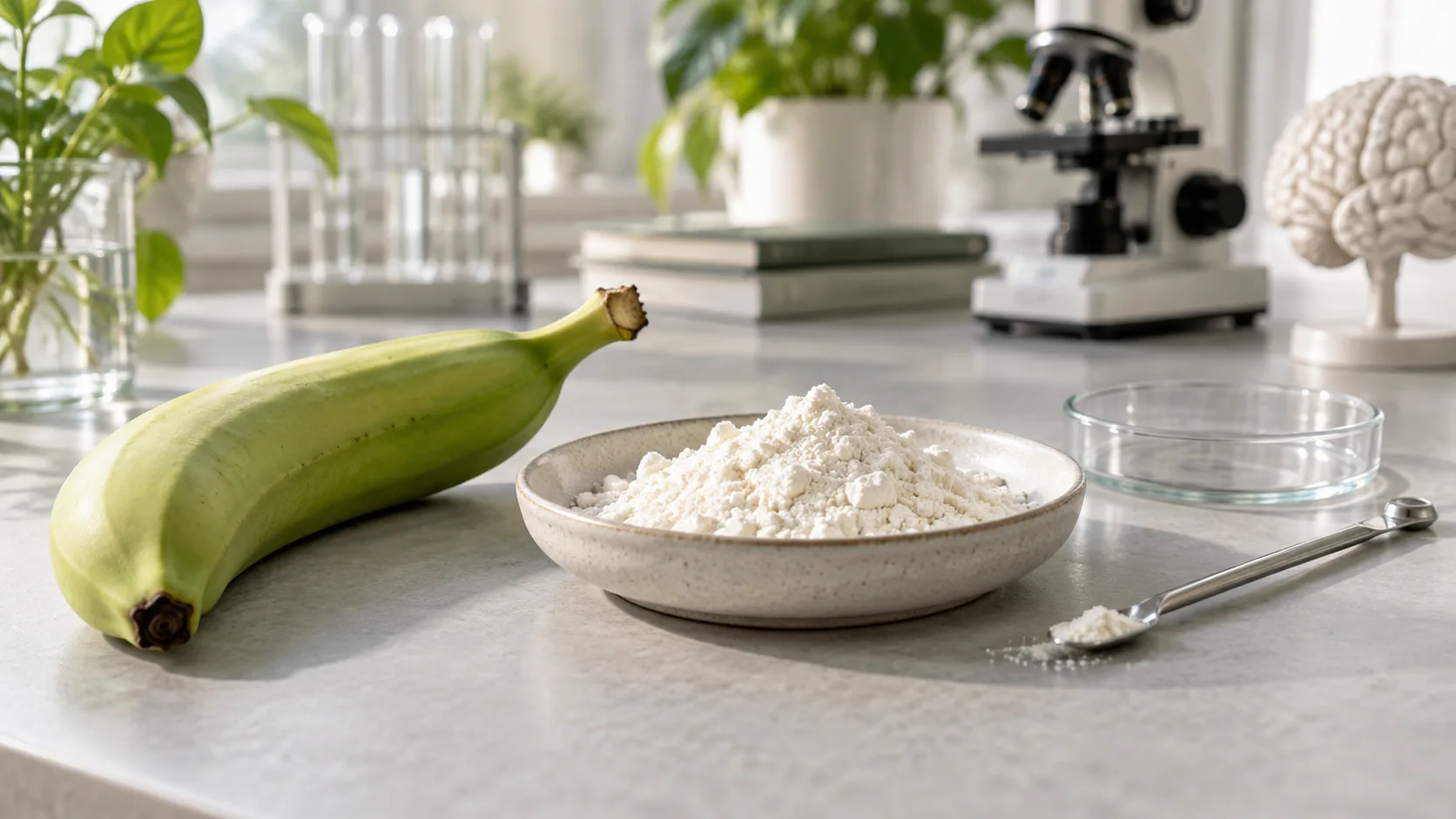
Resistant starch is starch that escapes digestion in the small intestine and reaches the colon, where gut microbes ferment part of it. It is not a single substance: naturally occurring starches, high-amylose starches, retrograded starches, and chemically modified starches can behave differently in foods and experiments.
The research question has two separate parts:
- Whether resistant starch changes glucose regulation or insulin-sensitivity markers.
- Whether those metabolic changes are accompanied by better performance on cognitive tests.
An improvement in fasting glucose, post-meal glucose, or HOMA-IR would not by itself demonstrate better memory, attention, or protection against cognitive decline.
What human metabolic research has established
Randomized-trial evidence points to a possible but generally modest effect on some metabolic outcomes. A systematic review of 19 randomized controlled trials found an improvement in fasting plasma glucose and HOMA-estimated insulin resistance compared with digestible starch, while several other insulin-related measures were not significantly changed.
A separate review in adults with prediabetes or type 2 diabetes found that resistant starch types 1 and 2 could reduce some acute and longer-term glucose measures. The results were not uniform across starch types, outcomes, or study durations. This pattern supports a conditional metabolic effect rather than a universal response.
HOMA-IR and related calculations are indirect markers. They are useful in large studies but are not equivalent to a gold-standard insulin clamp. Therefore, findings based mainly on fasting blood tests should not be described as proof that resistant starch consistently improves tissue-level insulin sensitivity.
Who has been studied, and how strong were the designs
Human trials have included healthy adults, people with overweight or obesity, adults with prediabetes, and adults with type 2 diabetes. The populations are therefore heterogeneous, and results from one group cannot automatically be generalized to another.
The stronger evidence comes from randomized controlled trials, including crossover studies in which participants receive resistant starch and a comparator at different times. These designs can reduce the effect of individual differences. However, many trials were small or short, and the food intervention often changed more than resistant starch alone.
Important sources of uncertainty include:
- Different resistant-starch types and food matrices.
- Differences in background diet, body weight, metabolic status, and habitual fiber intake.
- Short intervention periods and reliance on surrogate metabolic markers.
- Possible variation in gut-microbial responses between participants.
One carefully measured crossover study in adults with well-controlled type 2 diabetes found lower post-meal glucose after resistant starch but no improvement in clamp-measured hepatic or peripheral insulin sensitivity or HbA1c. That result illustrates why apparently favorable glucose findings do not always extend to every metabolic endpoint.
What the direct cognitive evidence shows
Direct human evidence is limited. A relevant randomized crossover study enrolled healthy adults aged 52 to 70 who consumed, for three consecutive days, a whole-grain rye product containing added type 2 resistant starch or white wheat bread. Thirty-eight participants completed both intervention periods.
The rye-and-resistant-starch product improved some insulin-sensitivity and post-meal glucose measures and changed subjective mood ratings. However, the study found no significant difference in the tested measures of working memory or selective attention. Insulin sensitivity was statistically associated with working-memory performance, but an association does not show that the intervention caused better cognition.
The study also could not isolate resistant starch from the rest of the intervention. Whole-grain rye, food structure, fermentation, fiber, and other components differed between products. The short duration measured immediate or next-morning effects, not long-term memory, executive function, dementia risk, or preservation of cognition.
Why a metabolic effect might not translate into cognition
Several biological pathways could connect carbohydrate metabolism and brain function, including fluctuations in glucose availability, gut-derived short-chain fatty acids, gut hormones, inflammation, and vascular health. These mechanisms provide plausible hypotheses, but plausibility is not confirmation in humans.
Animal studies have reported changes in brain-related or behavioral measures after resistant-starch feeding, yet animal findings cannot establish a cognitive benefit in people. Human studies would need validated cognitive outcomes, adequate sample sizes, longer follow-up, appropriate comparators, and analyses that distinguish resistant starch from whole grains and overall dietary quality.
The available human evidence therefore supports studying the gut–metabolism–brain connection, not claiming that resistant starch improves cognition.
Bottom line and remaining research gaps
The most defensible conclusion is that resistant starch may improve selected glucose-regulation markers in some adults, especially in certain starch types and metabolic contexts. The size and reliability of the effect vary, and stronger measures of insulin sensitivity do not always agree with simpler fasting markers.
Evidence for cognitive improvement is much weaker. The clearest directly relevant human trial found metabolic and mood changes without better working-memory or attention-test performance. No established human evidence shows that resistant starch prevents cognitive decline, dementia, or other neurological conditions.
Future trials should:
- Compare clearly defined resistant-starch types with matched control foods.
- Recruit both metabolically healthy and insulin-resistant participants.
- Use validated cognitive batteries rather than mood measures alone.
- Measure insulin sensitivity with methods stronger than surrogate indices when feasible.
- Follow participants long enough to evaluate durable metabolic and cognitive outcomes.
Until those studies are available, metabolic findings and cognitive claims should be treated as separate levels of evidence.
Sources
- Effects of resistant starch on glycaemic control: a systematic review and meta-analysis
- A comparison of the effects of resistant starch types on glycemic response in individuals with type 2 diabetes or prediabetes: a systematic review and meta-analysis
- Efficacy of increased resistant starch consumption in human type 2 diabetes
- Impact of rye-based evening meals on cognitive functions, mood and cardiometabolic risk factors: a randomized controlled study in healthy middle-aged subjects
- Dietary resistant starch improves selected brain and behavioral functions in adult and aged rodents
About this article
NootroWorld publishes research summaries, not medical advice. This article describes what studies have and have not established; it does not tell you what to take. Supplements can interact with medication, pregnancy and existing health conditions, and study populations often differ from your own situation. Discuss any personal decision with a qualified healthcare professional.