What the evidence shows
- Some randomized trials report lower subjective stress or better performance on selected cognitive tasks, but effects are not consistent across conditions.
- Healthy volunteers, moderately stressed adults, and clinically diagnosed populations have been studied, and results from one group do not automatically generalize to another.
- The intervention is strain-specific: evidence for one probiotic strain or combination cannot be assumed to apply to all probiotic products.
- Clinical meta-analyses report lower depression or anxiety symptom scores, but substantial heterogeneity limits confidence in a universal effect.
- Cortisol, microbiome, inflammatory, or brain-imaging changes do not by themselves prove a durable improvement in mood or everyday cognition.
- Current evidence supports cautious research interest, not broad claims that probiotics reliably enhance mood, reduce psychiatric symptoms, or improve cognition.
What the gut-brain axis means in human research
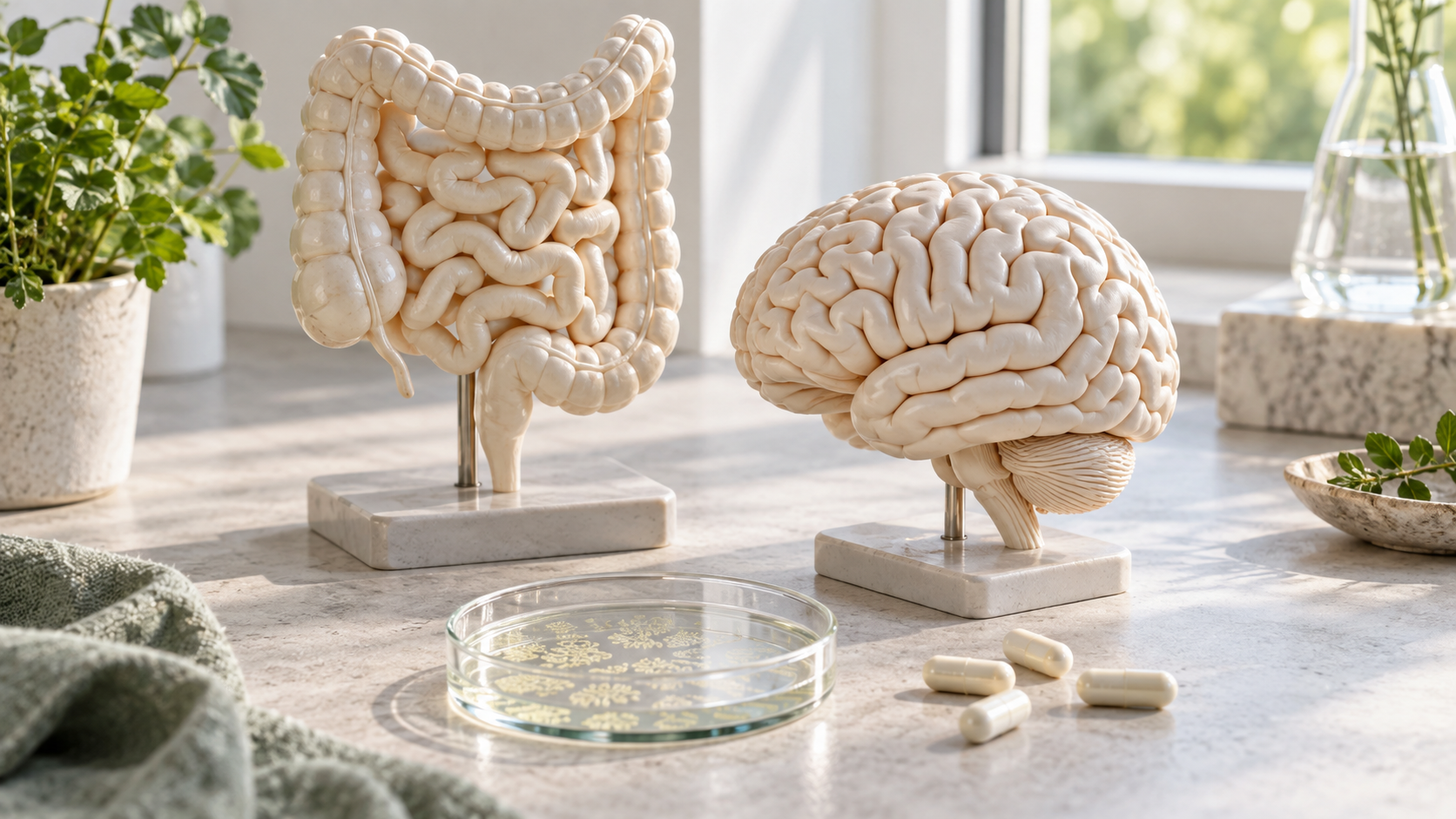
The gut-brain axis describes two-way communication between the gastrointestinal system and the nervous system through neural, endocrine, immune, and metabolic pathways. Probiotics are therefore studied as possible modifiers of stress responses, emotional symptoms, sleep, or cognitive performance.
That biological plausibility is not the same as demonstrated benefit. Human trials usually test a specific strain or combination, for a defined period, in a particular population. Results from one formulation cannot automatically be applied to another product or to all people.
Most trials measure questionnaires, cortisol, laboratory cognitive tasks, or brain activity. These are useful research outcomes, but they do not necessarily show durable changes in everyday functioning or establish that a probiotic alters the underlying cause of a mood condition.
What randomized trials in healthy or stressed adults have found
The clearest human evidence comes from small-to-moderate randomized, placebo-controlled studies in healthy people, often selected because they reported moderate stress rather than a psychiatric disorder.
A systematic review and meta-analysis of seven randomized trials involving 1,146 healthy volunteers found an overall reduction in subjective stress with probiotics. The review also reported a possible improvement in stress-related subthreshold anxiety or depression, but subgroup analyses were not consistently significant, and cortisol did not show a significant overall effect. The included studies used different strains, durations, and outcome measures, limiting the precision of the conclusion.
Individual trials illustrate the context dependence of the findings:
- In a 28-day trial of 58 healthy women, a multispecies probiotic did not improve neurocognitive or emotional measures under unstressed conditions. A benefit appeared when participants were exposed to an acute stress challenge, where working-memory performance and related frontal brain activity changed relative to placebo.
- In a 12-week exploratory trial, 129 otherwise healthy adults aged 21 to 52 with moderate stress received either Lactiplantibacillus plantarum HEAL9 or placebo. Four cognitive tests favored the probiotic group, while perceived stress declined in both groups. Several mood measures showed only trends rather than conventionally conclusive between-group differences.
Together, these studies support the possibility of stress-contingent effects on selected outcomes. They do not show that probiotics reliably improve mood or cognition in healthy adults under ordinary, unstressed conditions.
Evidence in people with depressive or anxiety symptoms
Trials involving clinical populations provide a different kind of evidence, but they also remain heterogeneous. A 2025 systematic review and meta-analysis assessed randomized trials in clinically diagnosed samples. It included 23 trials involving 1,401 participants; among the probiotic studies, 18 assessed depression and nine assessed anxiety, with some overlap between outcomes.
The review reported lower depression and anxiety symptom scores with probiotics compared with control conditions. However, the analysis also found substantial variation between studies, and probiotic formulation and study duration helped explain some of that variation. The review included probiotic, prebiotic, and synbiotic interventions, so its overall conclusions should not be treated as evidence for every probiotic product.
These results indicate a research signal, not a settled clinical effect. Many studies were short, used symptom rating scales rather than long-term functional outcomes, and tested probiotics alongside existing care or within highly selected samples. The findings do not establish that probiotics cure, diagnose, or replace established approaches for mental-health conditions.
What has been studied for cognition
Cognition has been assessed with tasks involving working memory, verbal learning, attention, information processing, and cognitive control. Positive findings have generally involved particular tests rather than a uniform improvement across all cognitive domains.
The 58-person neuroimaging study found no general improvement in emotion processing or cognitive control without stress, but it reported better stress-related working-memory performance after the intervention. The HEAL9 study found between-group differences on four cognitive tests after 12 weeks in moderately stressed adults. Because the latter study was exploratory, included many outcomes, and was funded by the probiotic manufacturer, its results are useful but should be interpreted cautiously.
Cognitive-test improvements are not equivalent to evidence of enhanced intelligence, prevention of cognitive decline, or improved real-world productivity. Replication across independent research groups, standardized cognitive outcomes, longer follow-up, and testing in people with clinically meaningful impairment would make the evidence more persuasive.
Why strain-specific evidence matters
The word probiotic refers to a broad category of live microorganisms, not to one standardized intervention. Effects may differ by species, strain, combination, preparation, host microbiome, diet, baseline stress, and outcome being measured.
A multispecies product tested in healthy women cannot be assumed to behave like HEAL9, another L. plantarum strain, or a formulation containing different organisms. Even closely related strains may have different survival, metabolic, immune, or signaling properties.
This is why broad statements such as “probiotics improve mood” compress distinct experiments into one claim. The more defensible conclusion is narrower: some specific formulations have produced favorable changes in selected stress, mood, or cognitive outcomes in particular study populations, while other trials have found null results.
Main limitations of the evidence
The human literature has several recurring weaknesses that affect how confidently the findings can be generalized.
- Many studies are short and include relatively small, highly selected samples.
- Healthy volunteers with moderate stress are not interchangeable with people who have persistent depressive or anxiety symptoms.
- Subjective outcomes are vulnerable to expectancy and placebo effects; in several trials, both probiotic and placebo groups improved.
- Trials often assess multiple mood, sleep, biomarker, and cognitive outcomes, increasing the chance that some findings appear positive by chance.
- Products, strains, combinations, intervention periods, diets, and background treatments vary substantially across studies.
- Biomarker or microbiome changes do not by themselves prove that a gut change caused a mood or cognitive change.
- Some positive trials have commercial funding or author-industry ties, making independent replication especially important.
Systematic reviews can increase statistical power, but pooling heterogeneous interventions does not eliminate these underlying differences.
Bottom line
Human research supports a cautious, strain-specific interpretation. Probiotics may influence perceived stress and selected cognitive or mood measures in some healthy or moderately stressed adults, and meta-analyses of clinical samples report improvements in depressive or anxiety symptom scores. The most consistent limitation is not a complete absence of positive findings; it is the difficulty of predicting which formulation will affect which population and outcome.
The evidence is therefore better described as promising but conditional than as proof of a general mood or cognition-enhancing effect. Future trials need clearer strain identification, preregistered primary outcomes, independent funding where possible, larger and more diverse samples, longer follow-up, and meaningful functional measures alongside symptom scales.
Sources
- Efficacy of probiotics on stress in healthy volunteers: A systematic review and meta-analysis based on randomized controlled trials
- Effect of Probiotics on Psychiatric Symptoms and Central Nervous System Functions in Human Health and Disease: A Systematic Review and Meta-Analysis
- Stress matters: Randomized controlled trial on the effect of probiotics on neurocognition
- Intake of Lactiplantibacillus plantarum HEAL9 Improves Cognition in Moderately Stressed Subjects: A Randomized Controlled Study
- Effects of Prebiotics and Probiotics on Symptoms of Depression and Anxiety in Clinically Diagnosed Samples: Systematic Review and Meta-analysis of Randomized Controlled Trials
About this article
NootroWorld publishes research summaries, not medical advice. This article describes what studies have and have not established; it does not tell you what to take. Supplements can interact with medication, pregnancy and existing health conditions, and study populations often differ from your own situation. Discuss any personal decision with a qualified healthcare professional.