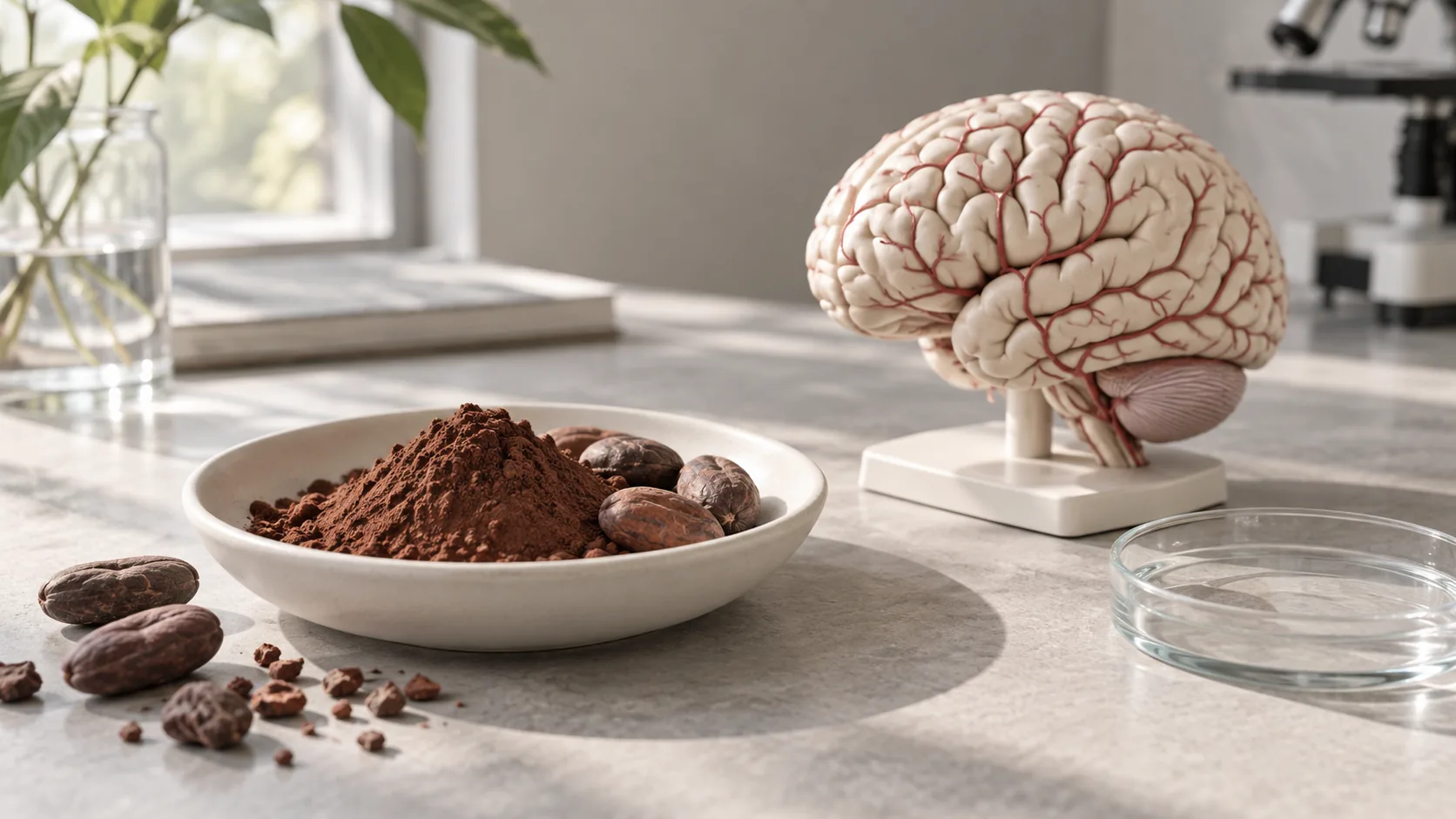
What the evidence shows
- Acute cocoa-flavanol studies have reported increases in regional cerebral perfusion or cortical oxygenation in some healthy adults.
- Brain blood-flow and oxygenation findings are physiological endpoints; they do not automatically demonstrate better memory or executive function.
- Small crossover trials can detect short-term effects but provide limited evidence about lasting benefits or broad populations.
- Large randomized trials in older adults found no overall improvement in global cognition from long-term cocoa-extract supplementation.
- Possible effects in people with lower diet quality or lower habitual flavanol intake remain exploratory and require confirmation.
- The link between vascular changes and meaningful long-term cognitive outcomes remains uncertain.
What researchers are actually testing
Cocoa flavanols are plant compounds found in cocoa, but research products are not interchangeable with ordinary chocolate. Human studies have used flavanol-matched cocoa drinks, dark chocolate, or standardized cocoa extracts. These preparations differ in flavanol content, calories, methylxanthines, and other components, so a finding from one product cannot automatically be applied to every cocoa food.
The proposed chain is vascular: flavanols may influence endothelial signaling and vasodilation, which could alter blood delivery or oxygen availability in the brain. That mechanism is plausible, but a measured change in cerebral blood flow is not itself evidence of better memory, attention, or executive function.
The central question is therefore two separate questions:
- Do cocoa flavanols change cerebral blood flow or related vascular measurements?
- If they do, does that change produce a reliable and meaningful improvement in cognition?
Evidence for cerebral blood flow and oxygenation
The clearest positive findings are short-term physiological signals. In a randomized, double-blind, counterbalanced crossover study, 18 healthy adults aged 50 to 65 received high- or low-flavanol cocoa drinks. Arterial-spin-labeling MRI found greater regional perfusion after the high-flavanol drink, particularly in parts of the anterior cingulate and parietal opercular cortex. This was an acute, regional result rather than proof of a sustained increase throughout the brain. [2]
Other studies have measured related but different outcomes. A randomized crossover trial in 12 healthy men found that acute cocoa flavanols increased prefrontal oxygenated hemoglobin during a resting cognitive task, as measured with near-infrared spectroscopy. The same study did not find a corresponding improvement in executive-task performance. [3]
A 2025 systematic review of randomized human studies concluded that acute flavanol interventions showed more consistent effects on vasodilator responses than on resting microvascular measures. The review also emphasized that the evidence base was small and heterogeneous, with different populations, products, brain regions, instruments, and challenge conditions. Cerebral perfusion, middle-cerebral-artery blood-flow velocity, and cortical oxygenation should therefore be treated as related but non-identical endpoints. [1]
Which populations have been studied
The human evidence does not come from one representative population. Most mechanistic studies enrolled healthy adults, often young adults or healthy older volunteers. These participants generally had no diagnosed cognitive disorder, and the experiments commonly examined an acute response over hours or a short intervention lasting days or weeks.
Older-adult studies have included cognitively healthy people as well as people with subjective memory complaints or mild cognitive impairment. The populations were usually selected volunteers rather than people with established dementia or acute cerebrovascular disease. Results from these groups cannot be assumed to apply to clinical populations that were not tested.
The large COSMOS-Mind trial enrolled 2,262 older adults, with a mean age of 73 years and 60% women, and followed cognitive performance for three years. Its cocoa-extract intervention did not improve global cognition. A related clinic subcohort provided more detailed in-person testing over two years and likewise found no overall benefit for global cognition, episodic memory, or executive function and attention. [4] [5]
This distribution matters because an acute vascular response in a healthy volunteer answers a different question from whether a daily cocoa extract prevents cognitive decline in an older community sample.
How strong are the designs
The strongest evidence for a causal effect comes from randomized, placebo-controlled trials, and several cocoa-flavanol studies used double blinding and crossover designs. Crossover experiments can efficiently compare each participant with their own control, but they are usually small and primarily suited to short-term physiological outcomes.
The cerebral-perfusion study in healthy middle-aged and older adults was carefully controlled for several drink characteristics, but it still involved only 18 people and assessed an acute response. The oxygenation study included 12 healthy men and found a physiological difference without an executive-function improvement. These designs support the possibility of an acute vascular effect, while providing limited evidence about durability, real-world functioning, or broader populations. [2] [3]
COSMOS-Mind was much larger and longer, with annual telephone-based cognitive assessments over three years. Its clinic subcohort added detailed neuropsychological testing but was smaller and not a separate randomized trial. Together, these studies provide stronger evidence about long-term cognitive outcomes than small acute experiments, and their overall null findings weigh against a large general cognitive-enhancement effect in older adults. [4] [5]
The literature also contains smaller short-term trials with mixed cognitive results. Differences in baseline diet, cognitive tests, flavanol composition, control treatments, adherence, and statistical adjustment make the positive findings difficult to combine into one precise estimate.
Does better blood flow translate into better cognition?
At present, the answer is not established. Some experiments show increased regional perfusion or cortical oxygenation, while separate experiments show no improvement in executive function or other cognitive outcomes. A vascular change may be too small, too brief, too localized, or unrelated to the particular task used in a study.
Cognition is also influenced by practice effects, motivation, sleep, mood, education, baseline diet, cardiovascular status, and the sensitivity of the test. A single reaction-time or verbal-fluency result is not equivalent to preserved memory or reduced dementia risk. Likewise, increased oxygenated hemoglobin on near-infrared spectroscopy is not a direct measure of improved neural processing.
The long-term randomized evidence is especially important. In COSMOS-Mind, three years of cocoa extract did not improve the prespecified global cognition outcome. The clinic subcohort found no overall improvement in global cognition, episodic memory, or executive function and attention after two years. Exploratory subgroup signals related to poorer diet quality remain hypotheses for further research, not established effects for the general population. [4] [5]
The most defensible interpretation is that cocoa flavanols may influence some short-term cerebrovascular measurements, but a reliable downstream cognitive benefit has not been demonstrated.
What remains uncertain
Several uncertainties prevent a firm conclusion about the full pathway from cocoa flavanols to cognition:
- Whether acute changes in regional perfusion persist with repeated exposure.
- Whether cerebral blood flow is the cause of any cognitive change, rather than a parallel response.
- Which flavanol compounds, metabolites, or accompanying cocoa constituents matter most.
- Whether baseline flavanol intake, diet quality, vascular function, age, or cognitive status modifies the response.
- Whether any subgroup benefit would remain after confirmation in adequately powered trials and correction for multiple comparisons.
- Whether vascular measurements predict meaningful outcomes such as everyday memory, functional independence, cognitive impairment, or dementia.
Future trials would be more informative if they prespecified both vascular and cognitive outcomes, used well-matched controls, measured adherence and flavanol biomarkers, recruited diverse participants, and tested whether changes in perfusion statistically mediate changes in cognition. Until then, the evidence supports a cautious mechanistic signal rather than a proven cognitive benefit.
Sources
- The role of cocoa flavanols in modulating peripheral and cerebral microvascular function in healthy individuals and populations at-risk of cardiovascular disease: a systematic review
- The effect of flavanol-rich cocoa on cerebral perfusion in healthy older adults during conscious resting state: a placebo controlled, crossover, acute trial
- Acute cocoa flavanol improves cerebral oxygenation without enhancing executive function at rest or after exercise
- Effects of cocoa extract and a multivitamin on cognitive function: A randomized clinical trial
- Effect of cocoa extract supplementation on cognitive function: results from the clinic subcohort of the COSMOS trial
About this article
NootroWorld publishes research summaries, not medical advice. This article describes what studies have and have not established; it does not tell you what to take. Supplements can interact with medication, pregnancy and existing health conditions, and study populations often differ from your own situation. Discuss any personal decision with a qualified healthcare professional.