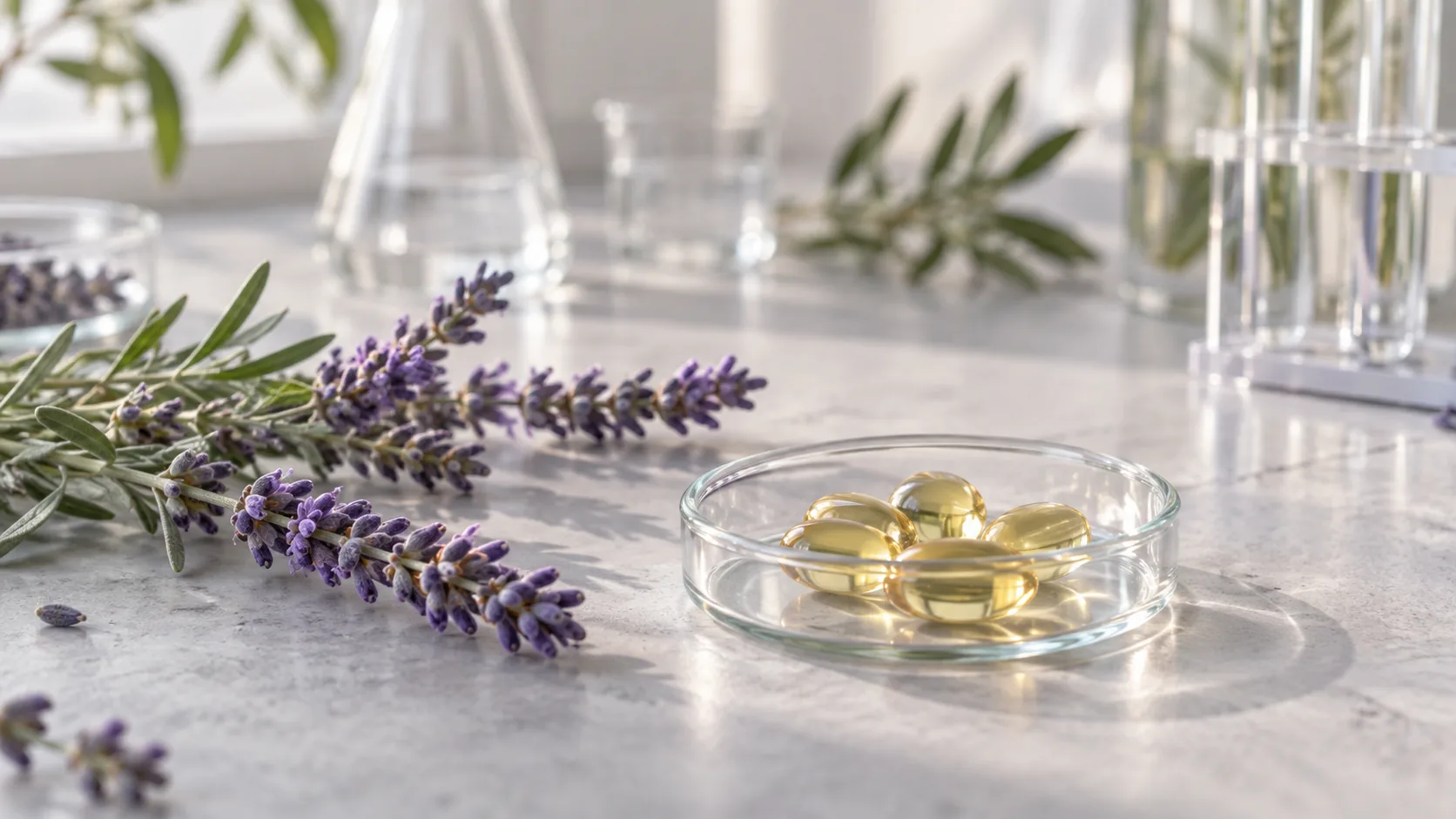
What the evidence shows
- The best human evidence concerns the standardized oral preparation Silexan, not lavender products in general.
- Randomized trials in adults with subthreshold anxiety or generalized anxiety disorder generally found lower anxiety scores than placebo over six to ten weeks.
- A later meta-analysis combined five double-blind placebo-controlled trials involving 1,213 adult outpatients.
- The studies were short and concentrated around one defined product, so long-term effects and broader generalizability remain uncertain.
- Short-term trials did not show a clear excess of overall or serious adverse events versus placebo, but digestive symptoms and allergic reactions remain relevant safety signals.
- Evidence for oral capsules should not be assumed to apply to aromatherapy, topical products, homemade preparations, or nonstandardized essential oils.
What the research is actually studying
The strongest human evidence concerns Silexan, a defined oral preparation made from Lavandula angustifolia oil. That is narrower than “lavender oil” as a general category. Capsules, aromatherapy, massage oils, teas, and nonstandardized essential oils should not be treated as interchangeable interventions.
The relevant studies were designed to test changes in anxiety symptoms, usually with clinician-rated scales such as the Hamilton Anxiety Rating Scale. They do not establish that oral lavender oil prevents anxiety disorders, cures them, or works for every form of anxiety.
What controlled trials found
Randomized, double-blind, placebo-controlled trials have generally reported lower anxiety scores with Silexan than with placebo after several weeks of use. One primary-care trial enrolled 221 adults with anxiety disorder not otherwise specified and sleep disturbance; participants were followed for 10 weeks. The lavender-oil group had a larger average reduction in Hamilton Anxiety scores than the placebo group.
A separate multicenter trial enrolled 539 adults meeting criteria for generalized anxiety disorder and compared two fixed Silexan regimens with placebo and paroxetine over 10 weeks. Another controlled study compared oral Silexan with lorazepam in adults with generalized anxiety disorder over six weeks. These active-comparator studies are useful for context, but they do not by themselves prove equivalence, superiority, or suitability as a replacement for established medicines.
A 2019 systematic review and meta-analysis reported a statistically significant pooled advantage for oral Silexan on anxiety-rating outcomes. A later meta-analysis covering five randomized placebo-controlled trials also found consistent advantages on clinician-rated and self-rated anxiety measures.
Who was studied
The evidence base is concentrated in adults treated as outpatients. Participants generally had clinically meaningful anxiety symptoms, including subthreshold anxiety, anxiety disorder not otherwise specified, mixed anxiety and depressive disorder, or generalized anxiety disorder. Several trials required a minimum Hamilton Anxiety score, so the findings do not mainly represent people with occasional everyday worry.
The studies provide limited evidence about:
- Children and adolescents
- Pregnancy or breastfeeding
- People with major medical illness or substantial polypharmacy
- Long-term or recurrent use
- Anxiety associated with conditions that were excluded from the trials
- Lavender products other than the standardized preparation studied
This means the research population is more specific than the broad audience implied by the phrase “lavender for anxiety.”
How strong is the evidence?
The core trials have important strengths: random allocation, placebo control, blinding, prespecified anxiety outcomes, and repeated follow-up. The consistency across several trials and the agreement between clinician-rated and participant-reported measures make the signal more credible than evidence from uncontrolled testimonials or observational surveys.
There are also meaningful limitations. The trials were short, generally lasting six to ten weeks, and the evidence base is relatively concentrated around one proprietary preparation and related research groups. A meta-analysis can increase precision, but it cannot remove limitations shared by the underlying trials. Active-comparator results also require caution because a similar change in scores is not the same as a formal equivalence finding.
The most defensible conclusion is that standardized oral Silexan has short-term controlled-trial evidence for reducing anxiety symptoms in selected adults. The evidence is not a blanket finding about all oral lavender supplements.
Safety signals and remaining questions
Across the placebo-controlled trials summarized in the major meta-analyses, overall adverse-event rates, serious adverse events, and withdrawals because of adverse events were not significantly different between Silexan and placebo. Reported product-specific complaints included belching or other digestive symptoms; allergic skin reactions have also been described in the clinical literature.
These findings are reassuring for the studied short-term settings, but they do not settle every safety question. Important uncertainties include longer-term exposure, use during pregnancy, effects in children, interactions with medicines, differences between commercial products, and risks from ingesting nonstandardized essential oils. The absence of a clear excess signal in short trials should not be interpreted as proof of universal safety.
The formulation matters. Evidence from a standardized capsule cannot automatically be transferred to inhaled lavender, topical products, homemade preparations, or an essential oil sold for another purpose.
Bottom line
Controlled human research supports a modest, short-term anxiety-symptom signal for the standardized oral lavender-oil preparation Silexan in adults with clinically significant anxiety symptoms. The most credible evidence comes from randomized, double-blind trials and their meta-analyses, not from general claims about lavender aromatherapy.
What remains uncertain is at least as important as what has been established: durability beyond the trial periods, usefulness across broader populations, interaction risks, and whether other lavender products have comparable composition and effects. The evidence therefore supports cautious scientific interest, while leaving substantial room for better independent and longer-term research.
Sources
- Dold M, Bartova L, Volz H-P, et al. Efficacy of Silexan in patients with anxiety disorders: a meta-analysis of randomized, placebo-controlled trials. European Archives of Psychiatry and Clinical Neuroscience. 2023.
- Kasper S, Gastpar M, Müller WE, et al. Silexan, an orally administered Lavandula oil preparation, is effective in the treatment of subsyndromal anxiety disorder: a randomized, double-blind, placebo controlled trial. International Clinical Psychopharmacology. 2010.
- Kasper S, Angheべ? No, Woelk H, Schläfke S. Lavender oil preparation Silexan is effective in generalized anxiety disorder—a randomized, double-blind comparison to placebo and paroxetine. International Journal of Neuropsychopharmacology. 2014.
- Woelk H, Schläfke S. A multi-center, double-blind, randomised study of the Lavender oil preparation Silexan in comparison to Lorazepam for generalized anxiety disorder. Phytomedicine. 2010.
- Kasper S, et al. Effects of lavender on anxiety: a systematic review and meta-analysis. European Neuropsychopharmacology. 2019.
About this article
NootroWorld publishes research summaries, not medical advice. This article describes what studies have and have not established; it does not tell you what to take. Supplements can interact with medication, pregnancy and existing health conditions, and study populations often differ from your own situation. Discuss any personal decision with a qualified healthcare professional.