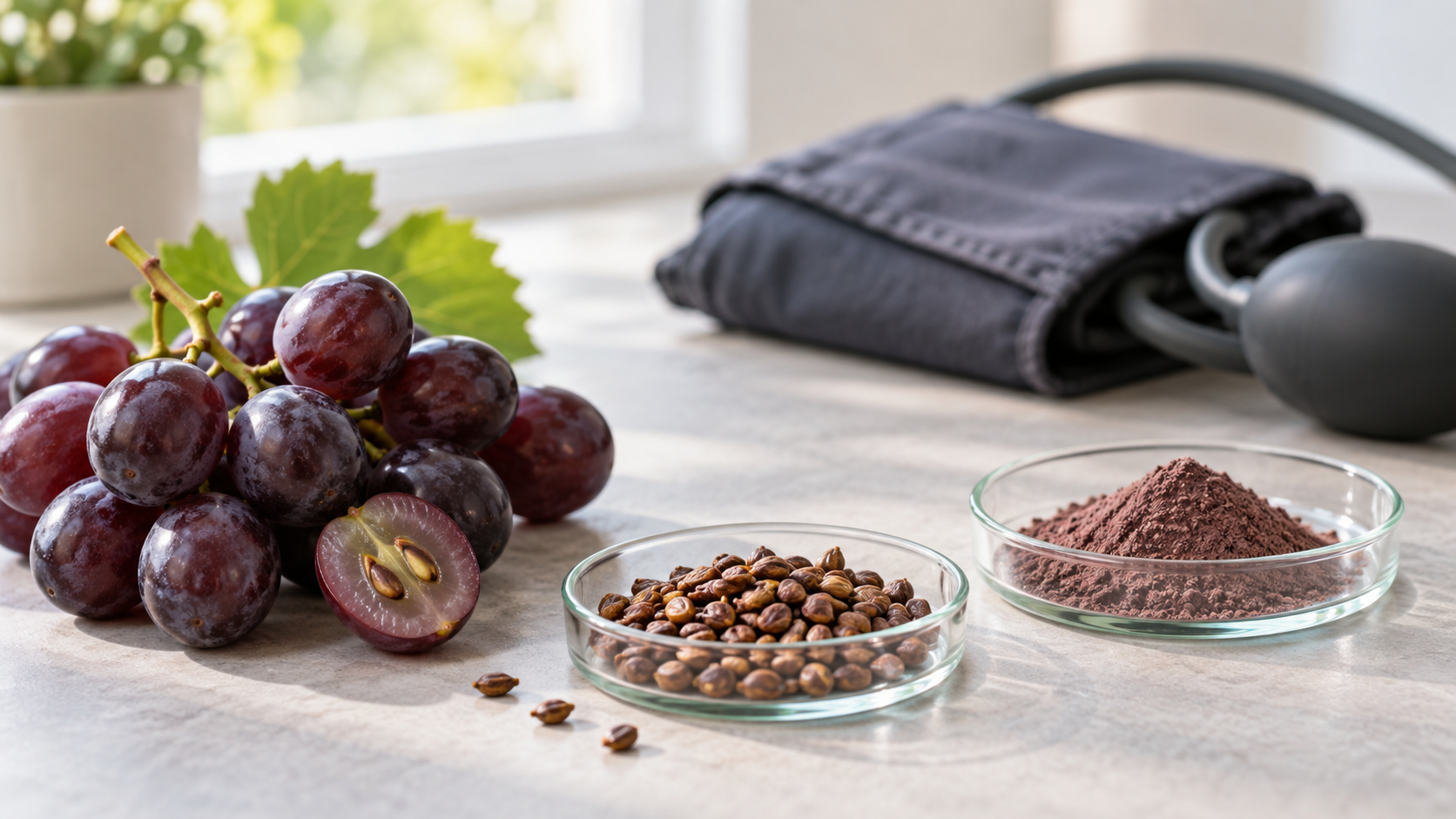
What the evidence shows
- Randomized trials suggest a possible modest blood-pressure effect, but results are inconsistent and heterogeneous.
- The largest cited blood-pressure synthesis included 16 trials and 810 participants, with substantial variation between studies.
- A controlled ambulatory-blood-pressure trial in untreated pre- or stage 1 hypertension did not find a statistically significant effect.
- A six-month trial in older adults with mild cognitive impairment found no significant improvement in cognition compared with placebo.
- Human research has not established that grape seed extract improves vascular cognition or links blood-pressure changes to better cognitive outcomes.
Bottom line
The human evidence supports a cautious conclusion: grape seed extract has shown a possible, generally modest blood-pressure effect in some randomized trials, but the finding is not consistent enough to establish a reliable effect across populations or products.
Evidence for cognition is more limited. The directly relevant trials tested cognitive performance rather than a clearly defined vascular-cognitive pathway. In older adults with mild cognitive impairment, a six-month randomized trial found no statistically significant advantage over placebo on the Montreal Cognitive Assessment. In healthy young adults, another randomized trial found no consistent cognitive benefit across acute and 12-week assessments.
Taken together, the research does not establish that grape seed extract improves vascular cognition, prevents cognitive decline, or changes the course of hypertension, vascular disease, mild cognitive impairment, or dementia.
What the blood-pressure studies actually tested
The blood-pressure literature includes several different populations rather than one clearly defined target group. The 2016 meta-analysis combined 16 clinical trials involving 810 participants. The included studies enrolled healthy adults, people with pre-hypertension or untreated stage 1 hypertension, people with metabolic syndrome, people with higher body mass index, women with menopausal symptoms, and adults with elevated vascular risk.
Individual trials were usually short and used product-specific grape seed preparations. One randomized, double-blind trial enrolled middle-aged adults with pre-hypertension and followed them through an intervention period and a post-intervention observation period. Another randomized, double-blind trial enrolled untreated adults with pre- or stage 1 hypertension and assessed ambulatory blood pressure over eight weeks.
This matters because grape seed extract is not a single chemically identical intervention. Extracts can differ in polyphenol composition, standardization, capsule or beverage format, and manufacturing. Results from one preparation should therefore not automatically be generalized to every product sold under the same broad name.
Blood-pressure findings: a signal, but not a settled result
The meta-analysis reported lower systolic and diastolic blood pressure when trials were pooled. However, statistical heterogeneity was high for systolic blood pressure and moderate for diastolic blood pressure, meaning that the studies did not behave as though they were estimating one uniform effect. The review authors also noted the small evidence base and called for larger, longer, multiple-dose randomized trials.
The individual trials illustrate why the pooled result requires caution. In the pre-hypertension beverage study, blood pressure improved during the intervention period and returned toward baseline after the intervention stopped. The trial randomized 36 people, but only 29 completed all protocol-specified procedures, leaving a small final sample.
In the ambulatory-blood-pressure study of 70 untreated adults with pre- or stage 1 hypertension, the reported differences favored grape seed extract numerically but were not statistically significant. The estimated between-group differences were −3.0 mmHg for systolic pressure and −1.4 mmHg for diastolic pressure, with confidence intervals that included no difference.
The most defensible reading is therefore possible modest blood-pressure lowering in selected groups, not a reproducible effect demonstrated across all adults or a substitute for established clinical care.
Vascular measures are not the same as vascular cognition
Some trials measured vascular or metabolic markers in addition to blood pressure, but these outcomes do not directly demonstrate improved brain blood flow or cognition. In the pre-hypertension beverage study, there were no significant changes in flow-mediated dilation or several vascular adhesion and metabolic markers.
A separate randomized study in healthy volunteers reported changes in blood pressure and perceived stress for a particular standardized extract. Its laboratory component examined endothelial-cell responses, but cell experiments cannot establish what happens in the human brain. The study also had industry-linked authorship and tested one named extract, so its findings have limited generalizability.
A chain such as grape seed extract, lower blood pressure, healthier cerebral vessels, and better cognition remains hypothetical in humans. To test that chain directly, a trial would need to measure blood pressure together with validated cognitive outcomes and relevant vascular or cerebral measures, such as endothelial function, cerebral perfusion, or imaging markers. The cited grape seed trials did not provide that complete package.
What the direct cognition trials found
The most directly relevant trial enrolled adults aged 60 years or older with mild cognitive impairment. Participants were randomly assigned to grape seed procyanidin extract or placebo for six months, and cognition was assessed with the Montreal Cognitive Assessment. Scores increased from baseline in both groups, but the difference in change between groups was not statistically significant. The study therefore did not demonstrate an improvement attributable to the extract.
A separate randomized, double-blind trial enrolled 60 healthy adults aged 18 to 30 years and assessed cognition after an acute exposure and after repeated use over 12 weeks. The investigators found no consistent pattern of cognitive benefit across the test battery. Some reaction-time and psychomotor findings favored the extract, but the placebo group also improved on some reaction-time and memory outcomes.
These trials cover two very different populations: healthy young adults and older adults with mild cognitive impairment. Neither population represents people with established vascular cognitive impairment, prior stroke, cerebral small-vessel disease, or clinically diagnosed dementia. The available evidence therefore cannot answer whether grape seed extract affects vascular-related cognitive decline.
How strong is the evidence?
The strongest features of the evidence are the use of randomized, placebo-controlled designs in several studies and the availability of a meta-analysis of blood-pressure trials. These features reduce some sources of bias compared with uncontrolled studies or laboratory evidence.
The main weaknesses are small samples, short follow-up, incomplete retention in some trials, inconsistent extract formulations, and substantial variation in participant characteristics. Blood-pressure results also differed between trials, with at least one well-controlled ambulatory-blood-pressure study finding no statistically significant effect.
For cognition, the evidence base is especially thin. The mild-cognitive-impairment trial used a recognized screening instrument, but a single global score over six months cannot establish effects on executive function, processing speed, memory trajectories, or vascular cognitive impairment. The young-adult trial used a broader cognitive battery, but its population and findings do not resolve questions about older adults with vascular risk.
What remains uncertain
Important unanswered questions include whether any blood-pressure effect is durable, whether it is concentrated in people with elevated baseline pressure, and whether it differs by extract composition. It is also unclear whether changes seen in clinic blood pressure would appear in longer-term ambulatory measurements or translate into meaningful cardiovascular outcomes.
For cognition, there is no convincing human evidence that grape seed extract improves vascular cognitive performance. Future trials would need prespecified cognitive domains, adequate sample sizes, longer follow-up, transparent extract characterization, and concurrent vascular measurements. They would also need to distinguish grape seed extract from grape juice, whole-grape extracts, resveratrol, and other polyphenol products.
Until those studies exist, the evidence supports describing grape seed extract as an incompletely studied intervention with a mixed blood-pressure signal and no established vascular-cognitive benefit.
Sources
- The impact of grape seed extract treatment on blood pressure changes: A meta-analysis of 16 randomized controlled trials
- Effect of polyphenol-rich grape seed extract on ambulatory blood pressure in subjects with pre- and stage I hypertension
- Effects of grape seed extract beverage on blood pressure and metabolic indices in individuals with pre-hypertension
- The effect of grape seed procyanidins extract on cognitive function in elderly people with mild cognitive impairment
- Grape seed polyphenol extract and cognitive function in healthy young adults
About this article
NootroWorld publishes research summaries, not medical advice. This article describes what studies have and have not established; it does not tell you what to take. Supplements can interact with medication, pregnancy and existing health conditions, and study populations often differ from your own situation. Discuss any personal decision with a qualified healthcare professional.