1. Understanding St. John’s Wort – What It Is and How It Works
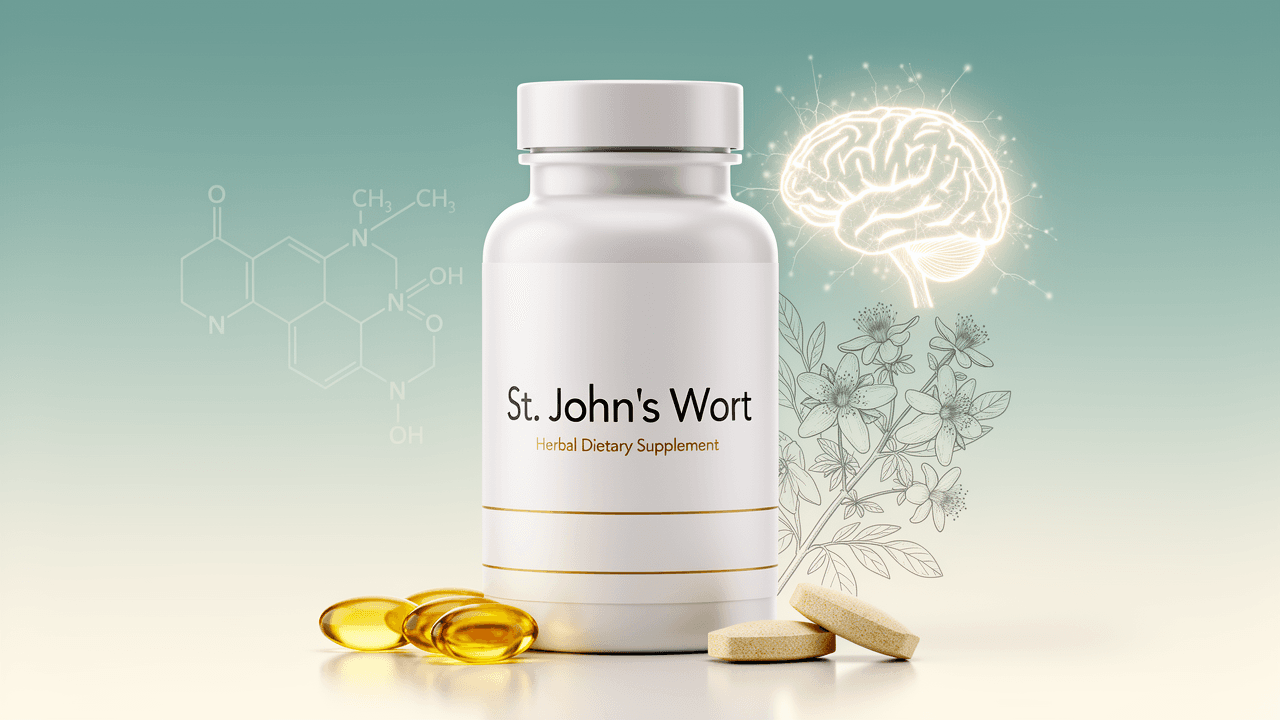
St. John’s wort (Hypericum perforatum) is a flowering plant traditionally used in European herbal medicine, most notably for mood support. Modern extracts are standardized dietary supplements, typically in capsule or tablet form, sometimes as teas or tinctures.
The plant contains multiple active constituents, primarily:
- Hypericin – a naphthodianthrone compound
- Hyperforin – a phloroglucinol derivative
- Flavonoids (e.g., quercetin, rutin)
How St. John’s Wort Works in the Body
St. John’s wort is pharmacologically complex. Unlike single-target pharmaceuticals, it affects several neurotransmitter systems and metabolic pathways simultaneously.
Key mechanisms proposed by human and preclinical studies:
Monoamine modulation (serotonin, dopamine, norepinephrine)
- Hyperforin appears to inhibit the reuptake of several neurotransmitters (serotonin, norepinephrine, dopamine, GABA, glutamate) by altering sodium gradients across nerve terminals.
- This can lead to increased availability of mood-related neurotransmitters in synaptic spaces, somewhat analogous to antidepressant drugs, though via broader, less selective mechanisms.
Regulation of HPA axis and stress response
- Animal studies suggest St. John’s wort may reduce stress-induced increases in corticosterone (the rodent equivalent of cortisol), indicating possible modulation of the hypothalamic–pituitary–adrenal (HPA) axis.
- This may contribute to reduced stress sensitivity and improved stress resilience.
Neuroplasticity and neuroprotection
- Some preclinical work shows increased brain-derived neurotrophic factor (BDNF) expression and protection against glutamate-induced neurotoxicity.
- Antioxidant and anti-inflammatory effects of flavonoids may help reduce oxidative stress in the brain.
Enzyme induction and drug metabolism
- Critically, St. John’s wort induces cytochrome P450 enzymes (especially CYP3A4, also CYP2C9, CYP2C19) and the drug transporter P-glycoprotein.
- This speeds up the breakdown or efflux of many medications, reducing their blood levels and effectiveness. This is one of the most important safety considerations.
Because of these combined actions, St. John’s wort is often used for mild to moderate depressive symptoms, stress-related mood changes, and sometimes for seasonal mood issues. Its role as a “nootropic” is secondary and largely indirect—improvements in mood and stress can support cognitive performance, but it is not a classic cognitive enhancer like some other compounds.
2. Key Benefits of St. John’s Wort
1. Support for Mild to Moderate Depression
The most robust evidence for St. John’s wort is in mild to moderate major depressive disorder (MDD).
- Multiple randomized controlled trials (RCTs) and meta-analyses indicate that standardized extracts can be more effective than placebo and comparable to some SSRIs (e.g., fluoxetine, sertraline) for mild–moderate depression, often with fewer side effects.
2. Improvement in General Mood and Emotional Well-Being
Even outside of diagnosed depression, some evidence suggests St. John’s wort may help:
- Reduce subclinical depressive symptoms
- Improve emotional balance and stress-related mood changes
This is likely due to its broad monoamine reuptake inhibition and HPA-axis modulation.
3. Potential Support for Anxiety Symptoms (Limited Evidence)
Some studies report improvements in anxiety symptoms when St. John’s wort is used for depression.
- However, evidence for primary anxiety disorders (like generalized anxiety disorder) is limited and not nearly as strong as for depression.
4. Indirect Cognitive and Functional Benefits
By improving mood, energy, and stress resilience in people with mild–moderate depressive symptoms, St. John’s wort may indirectly:
- Enhance concentration and attention
- Improve psychomotor performance and daily functioning
These effects are secondary to mood improvement rather than direct nootropic action on memory or executive function in healthy individuals.
3. Research Findings – What Studies Show
3.1 Meta-Analyses and Systematic Reviews
Linde et al., 2008 (BMJ)
- Design: Meta-analysis of 29 randomized controlled trials
- Participants: 5,489 adults with major depression
- Duration: Typically 4–12 weeks
- Findings:
- St. John’s wort extracts were superior to placebo for major depression.
- Compared with standard antidepressants, they were similarly effective for mild to moderate depression.
- St. John’s wort was associated with fewer adverse events than conventional antidepressants.
Ng et al., 2017 (Journal of Affective Disorders)
- Design: Meta-analysis of 27 RCTs
- Participants: ~3,800 adults with major depressive disorder
- Findings:
- St. John’s wort was significantly more effective than placebo.
- It showed similar efficacy to SSRIs for mild to moderate depression.
- Dropout rates due to side effects were lower than with SSRIs.
3.2 Individual Clinical Trials
Hypericum vs. Sertraline (Kasper et al., 2006)
- Design: Double-blind RCT
- Participants: 251 adults with moderate depression
- Intervention:
- St. John’s wort extract (WS 5570) 900–1,800 mg/day
- vs. sertraline up to 100 mg/day
- Duration: 6 weeks
- Results:
- Both groups showed comparable improvement in Hamilton Depression Rating Scale (HAM-D) scores.
- St. John’s wort group had fewer treatment-emergent adverse events.
St. John’s Wort vs. Paroxetine (Szegedi et al., 2005)
- Design: Double-blind, randomized, multicenter trial
- Participants: 251 adults with moderate to severe depression
- Intervention:
- St. John’s wort extract (WS 5570) 900–1,800 mg/day
- vs. paroxetine 20–40 mg/day
- Duration: 6 weeks
- Results:
- St. John’s wort was non-inferior to paroxetine in reducing HAM-D scores.
- Tolerability was better in the St. John’s wort group.
- Note: This trial included some moderate–severe cases, but most evidence overall is strongest for mild–moderate depression.
3.3 Limitations and Inconsistencies in Research
- Severity of depression matters: St. John’s wort is consistently effective for mild–moderate depression; evidence for severe depression is mixed and less convincing.
- Product variability: Trials typically use standardized extracts (e.g., WS 5570, LI 160) with controlled hypericin/hyperforin content. Over-the-counter products can vary widely in potency and composition.
- Publication bias: Some meta-analyses warn that positive trials are more likely to be published, so overall effects may be slightly overestimated.
- Limited data for anxiety, cognition, or long-term use: Most trials are 4–12 weeks; long-term safety and efficacy data are more limited.
4. Best Sources & Dosage – Forms, Dosing, Timing, Safety
4.1 Forms of St. John’s Wort
Standardized Extract Capsules/Tablets
- Most research uses these forms.
- Typically standardized to 0.3% hypericin and/or 2–5% hyperforin.
- Common brand-specific extracts in studies: WS 5570, LI 160.
Tinctures/Liquid Extracts
- Alcohol or glycerin-based extracts.
- Dosing can be less precise; potency depends on product.
Teas and Dried Herb
- Generally much lower and less consistent dosing.
- Not equivalent to clinical trial doses.
For evidence-based use, standardized extracts are strongly preferred.
4.2 Evidence-Based Dosage Ranges
Important: Doses below are for standardized extracts. Always follow the specific product’s directions and consult a healthcare professional, especially if you take medications.
1. Mild to Moderate Depression (Adults)
- Typical studied range: 300–900 mg/day of standardized extract.
- Common regimens in RCTs:
- 300 mg, 3× daily (total 900 mg/day)
- 450 mg, 2× daily (total 900 mg/day)
- Some trials for more pronounced symptoms used up to 1,800 mg/day, usually as a titrated dose under medical supervision.
Onset of effect:
- Initial improvements may appear within 2 weeks, but full effects often take 4–6 weeks, similar to conventional antidepressants.
2. General Mood Support / Subclinical Symptoms
Evidence is less formal here, but in practice and in some lower-intensity studies:
- 300–600 mg/day of standardized extract is commonly used.
- Still, the same safety and interaction concerns apply even at lower doses.
3. Timing and Administration
- Take with food to reduce gastrointestinal discomfort.
- Divide dose (e.g., morning and evening) to maintain steadier levels.
- Because of possible photosensitivity, some people prefer evening dosing, though evidence is mixed; the photosensitivity is systemic, not purely about timing.
4.3 Duration of Use
- Clinical trials typically last 4–12 weeks.
- If effective and well tolerated, some guidelines allow continued use for several months under medical supervision.
- For long-term use, regular medical review is recommended to reassess benefit, side effects, and interactions.
4.4 Safety, Side Effects, and Drug Interactions
Common Side Effects (Usually Mild)
Reported in clinical trials (often less frequent than with SSRIs):
- Gastrointestinal upset (nausea, diarrhea, stomach discomfort)
- Dry mouth
- Dizziness or lightheadedness
- Fatigue or restlessness
- Headache
These are typically dose-related and may lessen after the first 1–2 weeks.
Photosensitivity
St. John’s wort can increase sensitivity to sunlight due to hypericin:
- Risk: Sunburn, skin irritation, or rash with UV exposure.
- More common at higher doses or in fair-skinned individuals.
Precautions:
- Use broad-spectrum sunscreen, wear protective clothing, and limit intense sun/UV exposure (including tanning beds), especially in the first weeks of use.
Serious Risks
Serotonin Syndrome (when combined with other serotonergic agents)
- St. John’s wort can increase serotonin levels.
- Combining it with other serotonergic medications can lead to serotonin syndrome, a potentially life-threatening condition.
- Symptoms: agitation, confusion, rapid heart rate, high blood pressure, dilated pupils, sweating, diarrhea, muscle rigidity, tremor, fever.
Mania or Hypomania in Bipolar Disorder
- Like other antidepressants, St. John’s wort can precipitate manic or hypomanic episodes in people with bipolar disorder.
Pregnancy and Breastfeeding
- Data are limited and mixed.
- Some case reports and small studies suggest possible risks; most authorities advise against use during pregnancy and lactation unless clearly recommended and monitored by a physician.
Major Drug Interactions (Critical)
St. John’s wort induces CYP3A4, CYP2C9, CYP2C19, and P-glycoprotein, leading to reduced blood concentrations of many drugs. This can cause treatment failure or serious consequences.
Medications with notable interactions include (not exhaustive):
Antidepressants and Psychiatric Medications
- SSRIs (e.g., fluoxetine, sertraline, citalopram)
- SNRIs (e.g., venlafaxine, duloxetine)
- Tricyclic antidepressants (e.g., amitriptyline)
- MAO inhibitors
- Atypical antidepressants (e.g., bupropion, mirtazapine)
- Some antipsychotics
Risks: serotonin syndrome, altered drug levels, unpredictable mood effects.
Oral Contraceptives (Birth Control Pills)
- St. John’s wort can reduce hormone levels, potentially leading to breakthrough bleeding and reduced contraceptive effectiveness, increasing the risk of unintended pregnancy.
Anticoagulants and Antiplatelet Agents
- Warfarin: reduced levels and decreased anticoagulant effect.
- Some direct oral anticoagulants (DOACs) may also be affected.
Immunosuppressants
- Cyclosporine, tacrolimus, sirolimus: reduced levels can lead to organ transplant rejection or disease flare.
Antiretrovirals for HIV
- Protease inhibitors and non-nucleoside reverse transcriptase inhibitors: reduced levels may lead to treatment failure and resistance.
Cancer Chemotherapy Agents
- Some chemotherapeutic drugs metabolized by CYP3A4 may have reduced efficacy.
Cardiovascular Drugs
- Certain calcium channel blockers, some statins (e.g., simvastatin, atorvastatin), digoxin: reduced plasma concentrations.
Benzodiazepines and Sedatives
- Levels can be reduced; clinical impact varies.
Bottom line: If you are on any prescription medication, particularly the classes above, do not start St. John’s wort without discussing it with your prescribing physician or pharmacist. In many cases, it is contraindicated.
Discontinuation
- Abruptly stopping St. John’s wort after prolonged use may cause mild withdrawal-like symptoms in some people (irritability, sleep changes, mood dips), though data are limited.
- To minimize this, some clinicians recommend tapering over 1–2 weeks, especially from higher doses.
5. Who Should and Shouldn’t Use St. John’s Wort
5.1 Who Might Consider St. John’s Wort
With professional guidance, St. John’s wort may be appropriate for:
Adults with mild to moderate depressive symptoms
- Who prefer a herbal option and
- Are not currently on antidepressants or interacting medications.
Individuals with subclinical low mood or seasonal mood dips
- When non-pharmacologic measures (sleep, exercise, psychotherapy, light therapy) are already being addressed.
Those who experienced side effects with conventional antidepressants
- And are exploring alternatives under medical supervision.
5.2 Who Should Avoid St. John’s Wort (or Use Only Under Specialist Care)
People taking interacting medications (often a strict “avoid”):
- Antidepressants (SSRIs, SNRIs, TCAs, MAOIs, atypicals)
- Oral contraceptives
- Anticoagulants (e.g., warfarin) and some antiplatelets
- Immunosuppressants (e.g., cyclosporine, tacrolimus)
- HIV medications
- Certain chemotherapy agents
- Some cardiovascular drugs (digoxin, some statins, some calcium channel blockers)
- Many others metabolized by CYP3A4, CYP2C9, CYP2C19, or transported by P-gp
Individuals with bipolar disorder or a history of mania/hypomania
- Risk of triggering manic episodes.
Pregnant or breastfeeding women
- Due to insufficient safety data and potential risks.
Children and adolescents
- Evidence is limited; use should be specialist-supervised if considered at all.
People with severe depression or suicidal thoughts
- St. John’s wort is not appropriate as sole therapy.
- These situations require urgent medical/psychiatric care and evidence-based treatment.
Those with a history of significant photosensitivity reactions
- St. John’s wort may worsen this.
5.3 Practical Use Guidelines
- Medical review first: Before starting, discuss with a physician or pharmacist, bringing a complete list of medications and supplements.
- Start low, monitor: For suitable candidates, a common approach is starting at 300 mg/day, then increasing to 600–900 mg/day if tolerated and needed.
- Monitor mood and side effects: Track changes over 4–6 weeks. If no meaningful improvement by ~6 weeks, reconsider therapy with your clinician.
- Do not combine with antidepressants unless under direct specialist supervision for a specific reason.
Summary
St. John’s wort is one of the best-studied herbal supplements for mild to moderate depression, with multiple trials and meta-analyses showing superiority over placebo and comparable efficacy to some SSRIs, often with fewer side effects. Its mechanisms involve broad monoamine reuptake inhibition, HPA-axis modulation, and possible neuroprotective effects.
However, it is not a simple, benign herb. Potent induction of CYP450 enzymes and P-glycoprotein leads to major drug interactions that can reduce the effectiveness of many critical medications, including birth control, anticoagulants, immunosuppressants, and HIV drugs. It also carries risks of serotonin syndrome, photosensitivity, and mania in bipolar disorder.
For adults with mild–moderate depressive symptoms who are not taking interacting medications and who are managed by a knowledgeable clinician, standardized St. John’s wort extract (typically 300–900 mg/day) can be a reasonable option. For severe depression, bipolar disorder, pregnancy, or those on complex medication regimens, it is generally not recommended without specialist oversight.
Always treat St. John’s wort as a pharmacologically active agent, not a harmless tea: consult a healthcare professional, use standardized products, and prioritize safety and monitoring.