1. Understanding St. John’s Wort – What It Is and How It Works
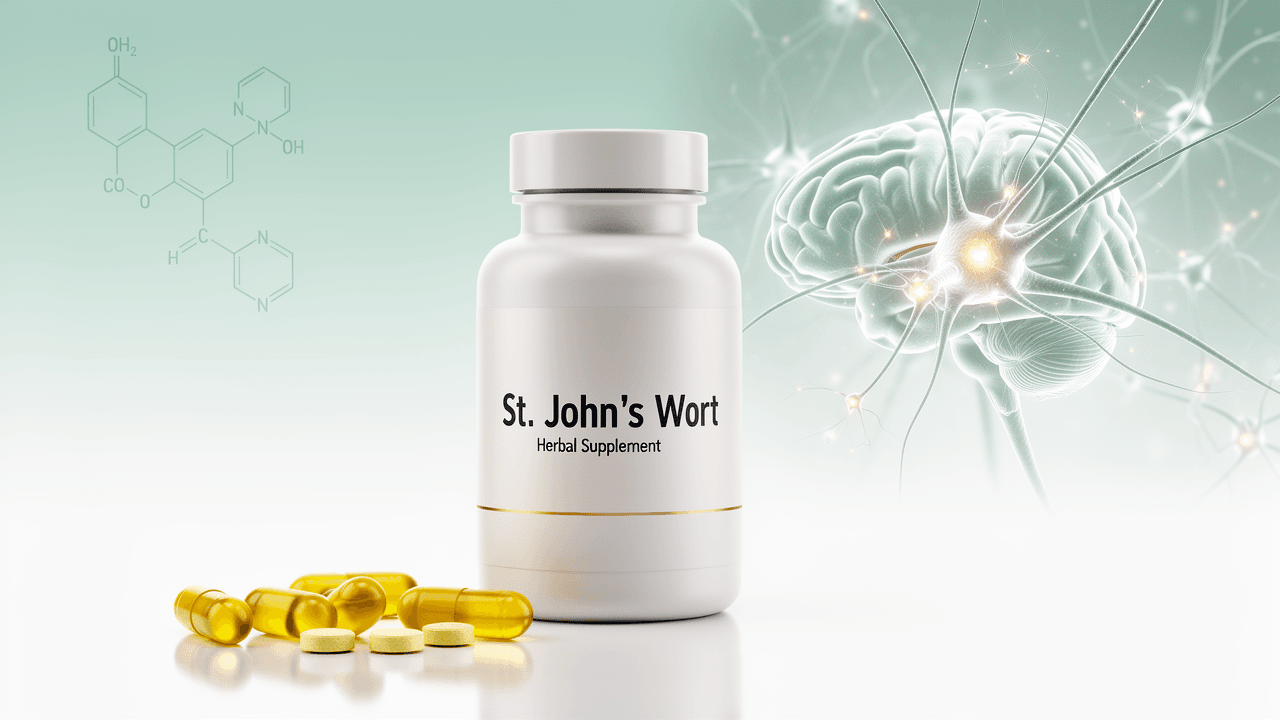
St. John’s wort (Hypericum perforatum) is a flowering plant traditionally used in European herbal medicine, mainly for mood-related conditions. As a dietary supplement, it is most commonly taken in capsule, tablet, or liquid extract form.
Active constituents
St. John’s wort contains multiple bioactive compounds, but two groups are considered most important:
- Naphthodianthrones – chiefly hypericin and pseudohypericin
- Phloroglucinols – mainly hyperforin
Other flavonoids (e.g., quercetin, rutin, hyperoside) may contribute to its antioxidant and neuroactive effects.
How it works in the body
St. John’s wort is not a classic “nootropic” in the sense of directly enhancing cognition, but rather a mood-modulating herb that can indirectly support mental performance by improving depressive symptoms and anxiety.
Key mechanisms (primarily based on in vitro and animal data, plus pharmacokinetic studies in humans):
Modulation of neurotransmitters
- Hyperforin and other constituents appear to inhibit the reuptake of:
- Serotonin (5-HT)
- Norepinephrine
- Dopamine
- GABA
- Glutamate
- This is somewhat analogous to SSRIs/SNRIs but through broader, less selective mechanisms.
- The effect is thought to be mediated by sodium gradient–dependent reuptake inhibition and interaction with transporter proteins.
- Hyperforin and other constituents appear to inhibit the reuptake of:
Neuroendocrine and stress-axis effects
- Some studies suggest modulation of the hypothalamic–pituitary–adrenal (HPA) axis, potentially normalizing stress hormone (cortisol) responses.
- Animal models show reduced behavioral markers of stress and anxiety.
Anti-inflammatory and antioxidant actions
- Flavonoids and other constituents have antioxidant effects and may reduce neuroinflammation, which is implicated in depression and cognitive decline.
Receptor-level interactions
- Experimental work suggests interactions with several receptor systems, including NMDA, GABA, and opioid receptors, though the clinical significance is not fully clear.
Overall, the best-established clinical effect is antidepressant activity, especially in mild to moderate depression. Cognitive and “nootropic” benefits are mainly secondary to improved mood, energy, and sleep in people with depressive symptoms.
2. Key Benefits of St. John’s Wort
1. Mild to Moderate Depression
The strongest and most consistent evidence supports St. John’s wort for mild to moderate major depressive disorder (MDD). Multiple meta-analyses show efficacy similar to standard antidepressants, with generally fewer side effects.
2. Seasonal and Subthreshold Depressive Symptoms
Some data suggest benefit for seasonal affective disorder (SAD) and subclinical depressive symptoms (low mood that does not meet full criteria for MDD), which can affect productivity, sleep, and overall cognitive function.
3. Anxiety and Mood Stabilization
St. John’s wort may help reduce anxiety symptoms that commonly accompany depression. Evidence for stand-alone anxiety disorders is weaker, but some studies show improvements in general anxiety and agitation.
4. Indirect Cognitive and Functional Benefits
By improving mood, energy, and sleep quality in people with depression, St. John’s wort can indirectly support:
- Concentration and attention
- Motivation and task initiation
- Perceived cognitive clarity
However, it is not well established as a direct cognitive enhancer in healthy, non-depressed individuals.
3. Research Findings
3.1 Major Depression – Comparisons with Antidepressants
Meta-analysis (Linde et al., 2008; updated Cochrane review)
- Included: 29 randomized controlled trials (RCTs), ~5,489 participants with major depression.
- Duration: Typically 4–12 weeks.
- Interventions: Standardized St. John’s wort extracts (most commonly LI 160 or WS 5570) vs placebo or standard antidepressants (e.g., SSRIs, tricyclics).
- Findings:
- St. John’s wort was significantly more effective than placebo for mild to moderate depression.
- It was similarly effective to standard antidepressants.
- Fewer participants discontinued due to side effects compared with conventional antidepressants.
Large multicenter RCT (Hypericum Depression Trial)
- Participants: 251 adults with moderate to severe MDD.
- Duration: 8 weeks.
- Intervention: St. John’s wort extract (900–1,500 mg/day) vs sertraline vs placebo.
- Findings:
- No significant difference between St. John’s wort, sertraline, and placebo on primary depression outcomes.
- Interpretation: St. John’s wort may be less reliable in moderate–severe depression, or the trial may have been underpowered due to high placebo response.
Standardized extract WS 5570 (Hyperforin-rich)
- RCT (Laakmann et al., 1998; smaller trial):
- Participants: 263 patients with mild–moderate depression.
- Duration: 6 weeks.
- Intervention: WS 5570 (300 mg, 3×/day) vs imipramine (25 mg, 3×/day).
- Findings: Comparable improvement on Hamilton Depression Rating Scale (HAM-D), with fewer side effects in the St. John’s wort group.
3.2 Mild to Moderate Depression – Placebo-Controlled Trials
Study: Harrer et al., 1999
- Participants: 151 adults with mild–moderate depression.
- Duration: 6 weeks.
- Intervention: St. John’s wort extract LI 160 (300 mg, 3×/day) vs placebo.
- Results:
- 60% response rate (≥50% reduction in HAM-D) in the St. John’s wort group vs 25% in placebo.
- Better global clinical impression scores in the active group.
Study: Woelk, 2000
- Participants: 324 outpatients with mild–moderate depression.
- Duration: 6 weeks.
- Intervention: St. John’s wort extract WS 5570 (300 mg, 3×/day) vs placebo.
- Results:
- Significant reduction in HAM-D and Beck Depression Inventory (BDI) scores vs placebo.
- Adverse events similar to placebo.
3.3 Seasonal Affective Disorder (SAD)
Evidence is more limited but suggestive.
Open-label study (Martinez et al., small sample)
- Participants: 20 patients with SAD.
- Duration: 4 weeks.
- Intervention: St. John’s wort extract 900 mg/day.
- Findings:
- Significant reductions in depression scores.
- Lack of placebo control limits conclusions.
Some clinicians combine St. John’s wort with light therapy for SAD, though robust RCT evidence is lacking.
3.4 Anxiety and Mixed Anxiety–Depression
Study: Schrader, 2000
- Participants: 151 patients with mild–moderate depression and anxiety symptoms.
- Duration: 6 weeks.
- Intervention: St. John’s wort extract vs placebo.
- Findings:
- Significant improvement in both depression and anxiety subscales compared with placebo.
For primary anxiety disorders (e.g., generalized anxiety disorder without depression), evidence is sparse and not conclusive.
3.5 Cognitive and Nootropic Effects
Human data on direct cognitive enhancement are minimal:
- Most trials focus on mood outcomes, not cognitive performance.
- Some participants report improved concentration and mental clarity, but this is generally interpreted as a secondary effect of improved mood and reduced fatigue.
At present, St. John’s wort should be viewed as a mood-supportive herb with potential indirect benefits for cognitive function in those with depressive symptoms, rather than a primary nootropic for healthy individuals.
4. Best Sources & Dosage – Forms, Dosing, Timing, Safety
4.1 Supplement Forms
Common supplemental forms include:
Standardized extracts (capsules/tablets)
- Typically standardized to 0.3% hypericin and/or specified hyperforin content (e.g., 2–5%).
- Most clinical trials used specific standardized brands (e.g., LI 160, WS 5570); generic products may vary in potency.
Liquid extracts/tinctures
- Often labeled as a ratio (e.g., 1:5 in 45% alcohol).
- Standardization may be less precise; dose consistency can vary.
Teas
- Generally much lower and inconsistent in active compounds compared to standardized extracts.
- Not recommended as the primary form for treating depression.
When using St. John’s wort for mood support, standardized extracts are preferred because they more closely match the forms used in clinical trials.
4.2 Evidence-Based Dosage Ranges
Important: Dosages below are general ranges used in research. They are not personal medical advice. Always consult a healthcare provider, especially if you take medications.
1. Mild to Moderate Depression
- Typical clinical trial dosage: 900–1,200 mg/day of standardized extract, often divided into 2–3 doses.
- Example: 300 mg, 3 times daily (total 900 mg/day).
- Standardization: often 0.3% hypericin and/or 2–5% hyperforin, depending on extract.
- Onset:
- Some people notice changes within 1–2 weeks, but full effect is usually assessed after 4–6 weeks.
2. Subclinical Low Mood / Mild Symptoms
- Lower end of the therapeutic range may be sufficient: 300–600 mg/day of standardized extract.
- Evidence is less robust than for full mild–moderate MDD, but some trials suggest benefit.
3. Seasonal Affective Disorder (Adjunctive)
- Often similar to depression doses: 600–900 mg/day.
- May be combined with bright light therapy under medical supervision.
4. Duration of Use
- RCTs typically last 4–12 weeks.
- For longer-term use (several months), regular monitoring by a clinician is advisable to assess:
- Ongoing benefit vs risks
- Potential interactions with new medications
4.3 Timing and Administration
- Can be taken with or without food, but many people tolerate it better with meals.
- Divided dosing (2–3 times daily) is common in studies, though some modern extended-release products are once daily.
- Because of potential photosensitivity, avoid taking large doses right before intense sun exposure if you know you are sensitive.
4.4 Safety, Side Effects, and Drug Interactions
St. John’s wort has a complex safety profile. While many people tolerate it well, the interaction risk is high and can be serious.
Common Side Effects
Usually mild and often less frequent than with standard antidepressants:
- Gastrointestinal upset (nausea, diarrhea)
- Fatigue or restlessness
- Headache
- Dry mouth
- Dizziness
These often improve after the first 1–2 weeks.
Photosensitivity
- St. John’s wort can increase sensitivity to sunlight (photosensitization), particularly at higher doses and in fair-skinned individuals.
- Manifestations:
- Easy sunburn
- Skin rash
- Precautions:
- Use sunscreen and protective clothing.
- Limit excessive UV exposure (sun lamps, tanning beds).
Mood and Psychiatric Risks
- Mania/hypomania: There are case reports of St. John’s wort triggering manic episodes in people with bipolar disorder or a history of mania.
- Agitation or anxiety: Some individuals may experience increased restlessness or anxiety, particularly at higher doses.
Anyone with a history of bipolar disorder, psychosis, or severe psychiatric conditions should avoid St. John’s wort unless under close psychiatric supervision.
Pregnancy and Breastfeeding
- Evidence is insufficient and conflicting.
- Because of potential effects on hormones, neurotransmitters, and drug metabolism, most guidelines recommend avoiding St. John’s wort during pregnancy and breastfeeding, unless specifically directed by a physician.
Liver and Kidney Function
- St. John’s wort is not strongly hepatotoxic in typical doses, but it induces liver enzymes that metabolize drugs.
- People with significant liver or kidney disease should use it only under medical supervision, if at all.
4.5 Critical Drug Interactions (Very Important)
St. John’s wort is a potent inducer of:
- Cytochrome P450 enzymes: especially CYP3A4, also CYP2C9, CYP2C19, CYP1A2
- P-glycoprotein (P-gp) transporter
This means it can increase the metabolism and clearance of many drugs, reducing their blood levels and effectiveness. In some cases, this can be dangerous or life-threatening.
Major Interaction Categories
1. Antidepressants and Serotonergic Drugs
Risk: Serotonin syndrome (agitation, confusion, rapid heart rate, high blood pressure, hyperthermia, tremor, diarrhea) when combined with other serotonergic agents.
Avoid combining St. John’s wort with:
- SSRIs (e.g., fluoxetine, sertraline, citalopram, escitalopram)
- SNRIs (e.g., venlafaxine, duloxetine)
- MAOIs (e.g., phenelzine, tranylcypromine)
- Tricyclic antidepressants (e.g., amitriptyline, nortriptyline)
- Other serotonergic drugs (e.g., tramadol, linezolid, triptans for migraine, some opioids)
2. Oral Contraceptives (Birth Control Pills)
- St. John’s wort can reduce the effectiveness of estrogen- and progestin-containing contraceptives by increasing their metabolism.
- Reported consequences:
- Breakthrough bleeding
- Unintended pregnancy
3. Immunosuppressants
- Drugs like cyclosporine, tacrolimus, sirolimus are metabolized by CYP3A4.
- St. John’s wort can dramatically lower their blood levels, risking organ transplant rejection.
4. Antiretrovirals (HIV Medications)
- Many antiretrovirals (e.g., certain protease inhibitors, non-nucleoside reverse transcriptase inhibitors) rely on CYP3A4.
- St. John’s wort can reduce drug levels, risking treatment failure and resistance.
5. Anticoagulants and Antiplatelets
- Warfarin: St. John’s wort can lower warfarin levels and reduce INR, increasing clot risk.
- Some direct oral anticoagulants (DOACs) and antiplatelets may also be affected.
6. Cardiovascular Medications
- Digoxin: Reduced blood levels via P-gp induction.
- Some calcium channel blockers, statins (e.g., simvastatin, atorvastatin), and antiarrhythmics may have reduced efficacy.
7. Antiepileptic Drugs
- Can alter levels of drugs like carbamazepine, phenytoin, phenobarbital, potentially affecting seizure control.
8. Other Drugs
- Benzodiazepines, certain chemotherapeutic agents, and many additional medications may be affected.
Because of these interactions, it is essential to:
- Inform your physician and pharmacist if you are taking St. John’s wort.
- Avoid starting or stopping St. John’s wort without medical guidance, especially if you are on chronic prescription medications.
5. Who Should and Shouldn’t Use St. John’s Wort
5.1 Who Might Consider St. John’s Wort (With Medical Guidance)
St. John’s wort may be an option for:
Adults with mild to moderate depression who:
- Prefer an herbal approach.
- Are not taking interacting medications.
- Are under the care of a clinician who can monitor mood and safety.
Adults with subclinical low mood or seasonal mood dips, particularly if:
- They have previously responded well to St. John’s wort.
- They are not on medications with known interactions.
Individuals interested in mood support and stress resilience, where low mood is affecting cognition, motivation, and quality of life, and where standard therapies have been discussed with a healthcare provider.
5.2 Who Should Avoid St. John’s Wort
St. John’s wort is not appropriate for:
People taking interacting medications, including (but not limited to):
- Antidepressants (SSRIs, SNRIs, MAOIs, TCAs)
- Oral contraceptives
- Immunosuppressants (e.g., cyclosporine, tacrolimus)
- HIV antiretrovirals
- Warfarin and some other anticoagulants
- Digoxin and certain heart medications
- Some antiepileptics, chemotherapeutics, and many others
Individuals with bipolar disorder or a history of mania/hypomania
- Risk of triggering manic episodes.
People with severe depression, especially with:
- Suicidal thoughts or behavior
- Psychotic features (delusions, hallucinations)
- Marked functional impairment
In these cases, urgent medical and psychiatric care is required; self-treatment with St. John’s wort is not appropriate.
Pregnant or breastfeeding women, unless specifically advised and monitored by a physician.
Children and adolescents, due to limited safety data and the need for careful psychiatric evaluation.
Individuals with significant liver disease or complex medical conditions, unless managed closely by a specialist.
6. Practical Takeaways
- St. John’s wort is a well-studied herbal antidepressant, with evidence supporting use in mild to moderate depression at doses of about 900–1,200 mg/day of standardized extract.
- It may improve mood, reduce anxiety symptoms, and indirectly support cognitive function by alleviating depressive symptoms.
- It is not a primary nootropic for healthy individuals; its main role is mood modulation.
- The major limitation is its high potential for serious drug interactions, mainly via CYP3A4 and P-gp induction and serotonergic effects.
- It should be avoided in people on many common medications, in bipolar disorder, and in pregnancy/breastfeeding without specialist supervision.
- For those who are good candidates, St. John’s wort can be a viable, evidence-based option—but only with careful medical oversight, realistic expectations, and regular monitoring of mood and safety.