
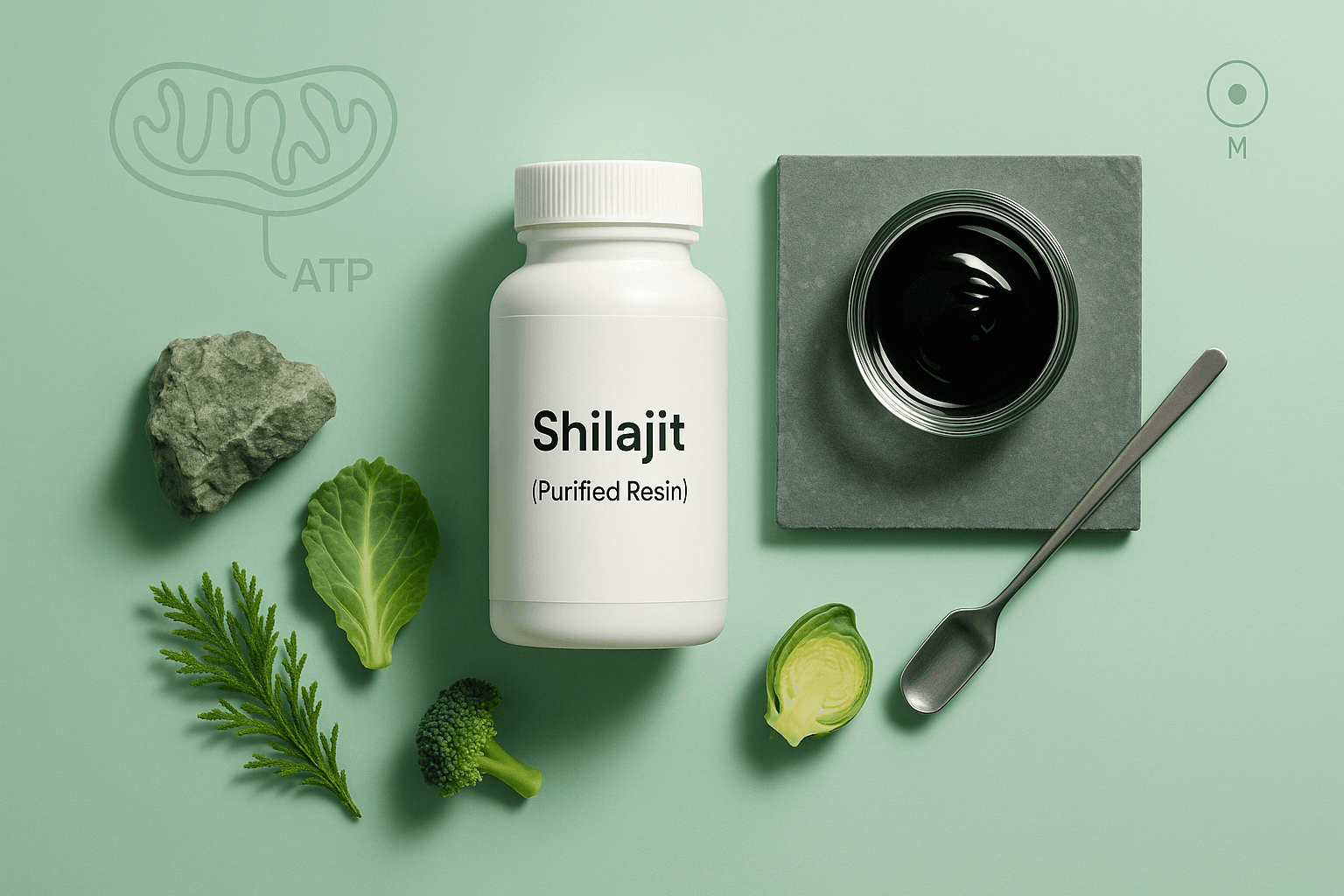
Energized Daily Function: Understanding Shilajit
Shilajit is a purified, tar-like mineral resin (a herbo-mineral “phytocomplex”) that seeps from high-altitude rock in the Himalayas and Central Asia. Modern extracts standardize marker compounds such as fulvic acids and dibenzo-α-pyrones (DBPs)—bioactives thought to support mitochondrial efficiency, antioxidant defenses, and cellular signaling. In simple terms: by improving how cells produce and protect ATP, shilajit may translate into steadier daytime energy, better training recovery, and—in men—support for healthy testosterone within the normal range. :contentReference[oaicite:0]{index=0}
Mechanistically, DBPs and related chromoproteins appear to interact with mitochondrial function and protect against hypoxia-related stress, while humic/fulvic acids may enhance transport of minerals and nutrients across membranes. These actions help explain traditional uses for vitality and adaptation to altitude, and they map onto outcomes seen in early human trials (energy/fatigue, men’s hormones).
Wellness takeaway: Choose a purified, COA-verified shilajit and trial for 8–12 weeks, tracking energy, training recovery, and—if relevant—men’s hormone labs before/after. :contentReference[oaicite:2]{index=2}
Key Benefits
Energy & fatigue: Small randomized trials (8 weeks; 250–500 mg/day) report less fatigue-related strength decline and improved recovery markers.
Healthy testosterone in men: A 90-day, double-blind, placebo-controlled trial (250 mg twice daily) increased total and free testosterone and DHEA-S in men aged 45–55.
High-altitude adaptation (exploratory): Reviews and preclinical data suggest support for acclimatization and hypoxia tolerance; rigorous human trials are limited.
Reality check: Most benefits are modest, accrue over weeks (not days), and depend on product purity and consistent dosing; altitude claims remain preliminary.
Research Findings
Time to benefit: 4–12 weeks in human studies (8 weeks for exercise recovery, ~12 weeks for men’s hormone outcomes).
Men’s hormones (healthy middle-aged men): Randomized, double-blind, placebo-controlled trial; n≈75; 250 mg twice daily of purified shilajit vs placebo for 90 days. Outcomes: significant increases in total testosterone, free testosterone, and DHEA-S vs placebo; LH/FSH unchanged—consistent with support rather than overt stimulation. Tolerability acceptable.
Fatigue & recovery (recreationally active men): Randomized, placebo-controlled trial; 8 weeks at 250 or 500 mg/day; n=63. The 500 mg/day group better maintained maximal strength after a fatiguing protocol and showed lower baseline serum hydroxyproline (a connective-tissue turnover marker). Adverse events were minimal.
Male fertility (oligospermia; exploratory): Open-label clinical study; 100 mg twice daily for 90 days in oligospermic men (n=35 completers). Reported improvements in total sperm count (≈+61%) and motility (≈+12–17%) vs baseline; uncontrolled design limits inference.
Tolerability: In the above trials (8–12 weeks), purified shilajit was generally well tolerated (occasional GI upset or headache reported). Real-world risk varies with product quality; unpurified resins can carry heavy metals or other contaminants.
Best Sources & Dosage
What to buy:
Purified shilajit resin or extract with a recent certificate of analysis (COA) verifying identity, fulvic/DBP markers, and heavy metals below international limits (USP/EFSA/WHO guidance). Avoid raw or unprocessed “pitch,” and avoid products lacking third-party testing.
Independent testing suggests wide variability across products; some meet contaminant limits but differ in cost/fulvic content—another reason to insist on COAs and transparent specs.
Evidence-aligned ranges (by use case):
Energy/fatigue & recovery: 250–500 mg/day (once or divided), 8–12 weeks; higher end (500 mg/day) showed stronger anti-fatigue signals in one RCT. Take with food.
Men’s testosterone (within normal range): 250 mg twice daily, 90 days; recheck total and free testosterone and DHEA-S at 12 weeks.
Altitude/travel (exploratory): 250 mg once–twice daily, start 1–2 weeks pre-trip and continue during exposure; prioritize proven acclimatization strategies alongside supplementation.
Timing & tips:
Morning and/or early afternoon dosing is common; avoid late-evening use if you’re stimulation-sensitive.
Stacking: keep it simple—trial shilajit alone before layering in CoQ10 or adaptogens; change one variable at a time for cleaner readouts.
Self-tracking: daily energy (0–10), training recovery, and in men TT/FT at baseline and 12 weeks. Use the same lab each time for consistency.
Safety, interactions & exclusions:
Quality matters: Herbal products can concentrate contaminants (lead, cadmium, arsenic, mercury). WHO guidelines emphasize minimizing heavy metals in herbal medicines; choose COA-verified products.
What independent testing found: A 2024 review of commercial shilajit products reported metals below levels of concern at labeled doses, but quality varied—underscoring the need to buy from reputable brands.
Common AEs: mild GI upset, headache; stool darkening may occur. Allergy is rare but reported; discontinue if rash or swelling occurs.
Drug considerations: Limited human interaction data; use caution and monitor if you take antihypertensives or antihyperglycemics (watch BP and glucose). If you’re on narrow-therapeutic-index meds, consult your clinician and consider spacing doses. (General precaution for complex humic substances.)
Who should avoid: Pregnancy/breastfeeding (insufficient human safety data), known heavy-metal disorders, unexplained iron overload or gout/hyperuricemia (mineral content varies; monitor labs if used).
Bold safety flag: Do not use unpurified/folk shilajit or products without contaminant testing; heavy-metal exposure is a serious, avoidable risk.
Dosage Quick-Reference
Energy/fatigue: 250–500 mg/day, 8–12 wks → ↑maintenance of strength under fatigue / ↓connective-tissue marker (HYP).
Men’s testosterone: 250 mg BID, 12 wks → ↑TT/FT and ↑DHEA-S within normal range.
Altitude support (exploratory): 250 mg 1–2×/day, start 1–2 wks pre-trip → ↑acclimatization signals (evidence limited; combine with standard altitude practices).
Safety note: Insist on a recent COA (metals, microbes, PAHs), start low, and reassess after 8–12 weeks with objective measures.