1. Understanding Lion’s Mane – What It Is and How It Works
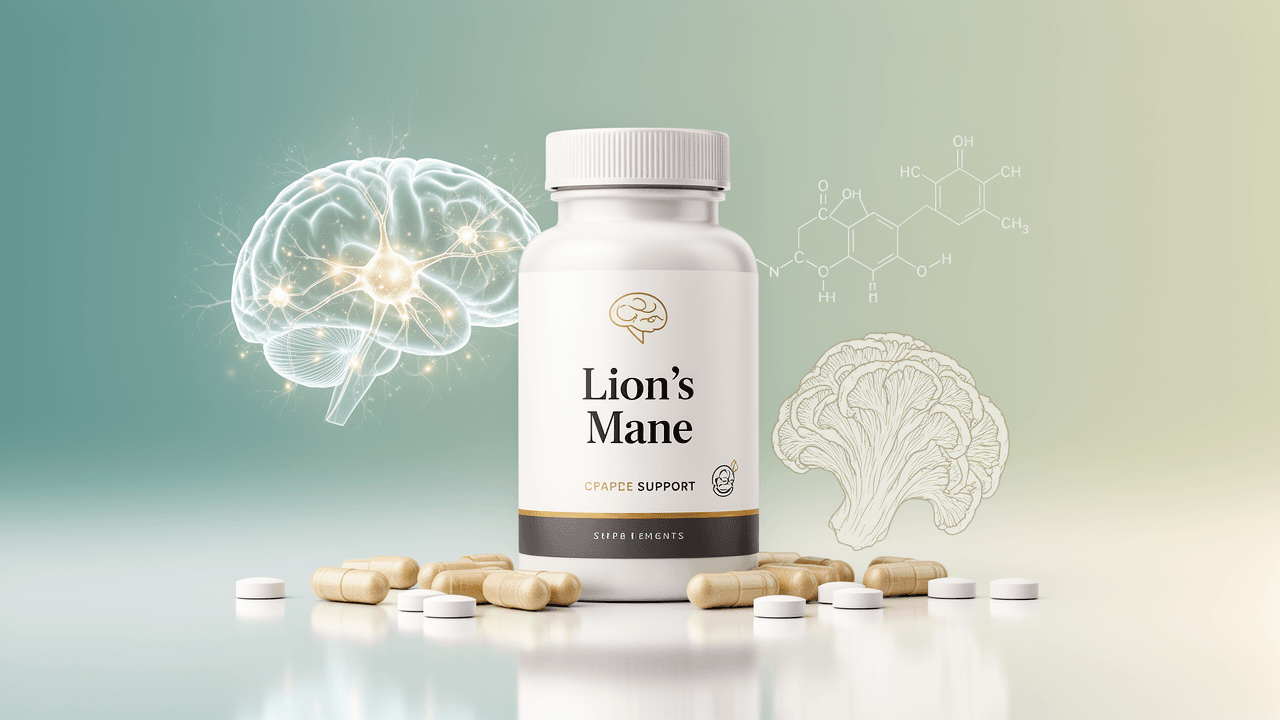
Lion’s Mane (Hericium erinaceus) is an edible medicinal mushroom traditionally used in East Asian medicine. It is now widely marketed as a nootropic and general health supplement for memory, focus, and nerve support.
1.1 Key Active Compounds
Lion’s Mane contains several bioactive compounds:
- Hericenones – primarily found in the fruiting body (the visible mushroom)
- Erinacines – primarily found in the mycelium (the root-like structure)
- Polysaccharides (β-glucans) – immune-modulating and antioxidant effects
- Sterols and phenolic compounds – contribute to anti-inflammatory and antioxidant actions
These compounds appear to influence nerve growth, inflammation, and brain plasticity.
1.2 Mechanisms of Action in the Body and Brain
Current evidence (mostly from cell and animal studies, plus a few human trials) suggests several main mechanisms:
Nerve Growth Factor (NGF) and BDNF modulation
- Erinacines and hericenones have been shown to stimulate nerve growth factor (NGF) synthesis in cell and animal models. NGF is crucial for the growth, maintenance, and survival of certain neurons.
- Some preclinical work suggests possible increases in brain-derived neurotrophic factor (BDNF), another key molecule for synaptic plasticity and learning, though human confirmation is limited.
Neuroprotection and reduced neuroinflammation
- Animal studies indicate Lion’s Mane may reduce inflammatory markers and oxidative stress in the brain, potentially protecting neurons from damage.
- β-glucans and phenolic compounds contribute antioxidant and anti-inflammatory effects.
Promotion of neurogenesis and synaptic plasticity (preclinical)
- In rodent models, Lion’s Mane extracts have been associated with enhanced hippocampal neurogenesis (growth of new neurons in the memory-related hippocampus) and improved synaptic function.
Gut–brain axis and immune modulation
- Mushroom polysaccharides can act as prebiotics, influencing gut microbiota. The gut–brain axis may contribute indirectly to mood and cognition, though this mechanism is still speculative in humans.
Overall, Lion’s Mane is best described as a neurotrophic and neuroprotective mushroom, with promising but still early-stage human evidence for cognitive and mood benefits.
2. Key Benefits – Evidence-Based Overview
Based on current data, the most plausible benefits of Lion’s Mane as a supplement are:
2.1 Cognitive Support and Mild Cognitive Impairment
- Several small human studies suggest Lion’s Mane may support memory and cognitive performance, particularly in older adults with mild cognitive impairment (MCI).
- Mechanism: likely via NGF/BDNF modulation and neuroprotection.
2.2 Mood, Anxiety, and Mild Depressive Symptoms
- Preliminary human data indicate Lion’s Mane may reduce symptoms of anxiety and mild depression, possibly via neurotrophic and anti-inflammatory effects and gut–brain interactions.
2.3 Nerve Health and Neuropathy (Preclinical and Early Clinical)
- Animal studies and limited human case-series suggest potential benefits for nerve regeneration and neuropathic pain, but robust clinical trials are lacking.
- Most evidence here is preclinical or anecdotal.
2.4 General Neuroprotection and Healthy Aging (Emerging)
- Preclinical models show Lion’s Mane may help protect against β-amyloid toxicity, oxidative stress, and inflammation, all relevant to neurodegenerative conditions.
- Human data for prevention of dementia or long-term brain aging are not yet available.
3. Research Findings – What Studies Actually Show
Human research on Lion’s Mane is still limited and often involves small sample sizes. Below are some of the better-known studies.
3.1 Cognitive Function in Mild Cognitive Impairment
Mori et al., 2009 (Japan)
- Design: Randomized, double-blind, placebo-controlled trial
- Participants: 30 older adults (50–80 years) with mild cognitive impairment (MCI)
- Intervention: 3 g/day of Lion’s Mane (dried fruiting body powder in tablets) vs placebo for 16 weeks, followed by a 4-week washout
- Outcomes: Cognitive function assessed using a standardized cognitive function scale.
Results:
- The Lion’s Mane group showed significant improvements in cognitive scores at weeks 8, 12, and 16 compared with placebo.
- After discontinuation, scores declined toward baseline by week 20, suggesting benefits may depend on continued use.
- No serious adverse events were reported.
Limitations:
- Small sample size (n=30).
- Participants had MCI; results may not generalize to healthy young adults.
- The specific extract standardization (hericenone/erinacine content) was not detailed.
3.2 Mood, Anxiety, and Menopausal Symptoms
Nagano et al., 2010 (Japan)
- Design: Randomized, double-blind, placebo-controlled pilot study
- Participants: 30 women aged 40–60 with menopausal symptoms, sleep disturbances, or mild mood complaints
- Intervention: Lion’s Mane cookies (containing 0.5 g/day of powdered fruiting body) vs placebo for 4 weeks
- Outcomes: Menopausal symptoms, sleep quality, depression, and anxiety scales.
Results:
- Lion’s Mane group showed significant reductions in anxiety and depression scores compared with placebo.
- Some improvement in sleep quality and menopausal symptoms was reported, though data are preliminary.
Limitations:
- Short duration (4 weeks).
- Small sample size (n=30).
- Low dose and food-based delivery make it hard to compare with typical supplement products.
3.3 Neuropathy and Nerve Regeneration (Early Data)
Human evidence is sparse, but some case reports and small uncontrolled studies exist.
- Peripheral neuropathy (case reports): A few case reports describe improved symptoms of peripheral neuropathy (numbness, tingling, pain) with Lion’s Mane use (often 3 g/day fruiting body), but these lack controls and may be confounded by other treatments.
- Animal models: Multiple rodent studies show that Lion’s Mane extracts enhance nerve regeneration after nerve injury, increase NGF expression, and improve functional recovery. For example, in sciatic nerve injury models, rats given Lion’s Mane extract demonstrated faster nerve regeneration and improved motor function compared with controls.
Interpretation:
- The mechanistic and animal data are promising, but robust human trials on neuropathy are not yet available. Lion’s Mane should not replace standard medical care for neuropathic conditions.
3.4 Neurodegenerative Disease Models (Preclinical)
- In cell and animal models of Alzheimer’s disease, Lion’s Mane extracts have been shown to:
- Reduce β-amyloid plaque-related toxicity
- Improve learning and memory performance in maze tests
- Decrease oxidative stress and inflammatory markers in the brain
These studies support a neuroprotective potential, but there are no large, long-term human trials demonstrating prevention or treatment of Alzheimer’s or Parkinson’s disease.
4. Best Sources & Dosage – Forms, Dosing, Timing, Safety
4.1 Supplement Forms
Lion’s Mane is available in several forms:
Fruiting body powder or extract
- Derived from the actual mushroom.
- Often standardized for polysaccharides and sometimes hericenones.
- Common in capsules, tablets, or bulk powder.
Mycelium powder or extract
- Grown on grain or other substrate.
- May contain higher levels of erinacines, which are potent NGF inducers in preclinical research.
- Quality varies, and some products contain significant residual grain.
Dual-extract products
- Combine fruiting body and mycelium, often using water and/or alcohol extraction to target both polysaccharides and terpenoid compounds (hericenones/erinacines).
- These may offer broader coverage of active compounds, but standardization is often inconsistent.
Whole food (culinary use)
- Fresh or dried Lion’s Mane used in cooking.
- Nutritious and likely beneficial, but doses of specific active compounds are unpredictable and generally lower than concentrated extracts.
When choosing a supplement, look for:
- Clear labeling of fruiting body vs mycelium
- Standardization (e.g., % β-glucans, specific erinacine/hericenone content if available)
- Third-party testing for contaminants (heavy metals, pesticides, microbes)
4.2 Evidence-Informed Dosage Ranges
Human studies use relatively modest doses, but commercial products vary widely. The following are typical supplemental ranges, not medical prescriptions.
4.2.1 General Cognitive Support / Healthy Adults
- Typical range: 500–1,500 mg/day of a standardized extract (fruiting body or combined)
- Common practice: 500 mg 1–3 times daily with food
Because long-term high-dose human data are limited, many clinicians and practitioners prefer staying ≤3 g/day of fruiting body equivalent in healthy adults.
4.2.2 Mild Cognitive Impairment (based on Mori et al., 2009)
- Studied dose: 3,000 mg/day (3 g) of dried fruiting body powder in divided doses for 16 weeks
- This is often used as a reference point for higher-end dosing in older adults under supervision.
People with cognitive impairment should be under the care of a healthcare professional; Lion’s Mane is best used as an adjunct, not a replacement for medical evaluation.
4.2.3 Mood and Mild Anxiety Support
- Pilot study dose (Nagano et al., 2010): ~500 mg/day of powdered fruiting body in cookies for 4 weeks
- In practice, many supplements use 500–1,500 mg/day for mood and general well-being.
4.2.4 Experimental / Nerve Support (Adjunctive)
- Based mostly on preclinical work and case reports, some practitioners use:
- 1,000–3,000 mg/day of fruiting body or combined extract, often in divided doses.
- Because data are limited, this should be considered experimental and ideally supervised by a clinician, especially when combined with other therapies for neuropathy.
4.3 Timing and Stacking
- With or without food:
- Can be taken with or without food; taking with meals may reduce any mild GI discomfort.
- Once vs divided doses:
- Many people take Lion’s Mane once in the morning, while others split doses (e.g., morning and early afternoon).
- Nootropic stacks:
- Often combined with coffee, L-theanine, bacopa, or other medicinal mushrooms (e.g., reishi, cordyceps).
- Be cautious about stacking multiple supplements with overlapping effects on mood, immune function, or coagulation.
4.4 Duration of Use
- Human trials typically last 4–16 weeks.
- Some users take Lion’s Mane continuously; others use it in cycles (e.g., 8–12 weeks on, 2–4 weeks off) to periodically reassess benefits and side effects.
- Long-term safety beyond 6–12 months has not been thoroughly studied.
5. Safety, Side Effects, and Drug Interactions
Overall, Lion’s Mane appears well-tolerated in human studies, but comprehensive long-term safety data are lacking.
5.1 Common Side Effects
Most reported side effects are mild and relatively uncommon:
- Digestive upset – nausea, bloating, or loose stools in some individuals, especially at higher doses or when starting supplementation
- Skin rash or itching – likely allergic reactions in sensitive individuals
- Headache or mild dizziness – rarely reported, may be idiosyncratic
Reducing the dose, taking with food, or discontinuing the supplement often resolves these issues.
5.2 Allergies and Hypersensitivity
- Because Lion’s Mane is a fungus, individuals with known mushroom allergies should avoid it.
- Case reports describe asthma-like symptoms or skin reactions in people occupationally exposed to Lion’s Mane spores or extracts.
- Signs of allergic reaction may include:
- Rash, itching, hives
- Swelling of lips, tongue, or throat
- Difficulty breathing or wheezing
- Any signs of serious allergic reaction require immediate medical attention and permanent discontinuation.
5.3 Drug Interactions – What We Know and Don’t Know
Formal drug–interaction studies are limited. Potential concerns are largely theoretical, based on mechanisms.
Anticoagulants and Antiplatelet Drugs
- Some medicinal mushrooms have mild antiplatelet or anticoagulant effects.
- While Lion’s Mane is not strongly documented in this regard, caution is prudent if you take:
- Warfarin, apixaban, rivaroxaban, dabigatran
- Aspirin, clopidogrel, or other blood thinners
- Monitor for signs of increased bleeding (easy bruising, nosebleeds, gum bleeding) and consult a clinician.
Immunomodulatory Medications
- β-glucans in mushrooms can modulate immune function.
- People on immunosuppressive drugs (e.g., after organ transplant, for autoimmune conditions) should use Lion’s Mane only under medical supervision, as theoretical interactions exist.
Hypoglycemic Agents (Diabetes Medications)
- Some animal studies suggest mushroom polysaccharides may modestly lower blood glucose.
- If combined with insulin or oral hypoglycemics (metformin, sulfonylureas, etc.), monitor blood sugar closely and consult your clinician to avoid hypoglycemia.
CNS-Active Medications
- Lion’s Mane may influence mood and cognition.
- Caution is warranted when combining with antidepressants, anxiolytics, or other nootropics, although no specific dangerous interactions are well-documented.
- Start low, monitor mood and sleep, and inform your prescriber.
Because evidence is incomplete, it is wise to:
- Inform your healthcare provider about all supplements you use.
- Start with low doses when combining with prescription medications.
- Monitor for unexpected changes in mood, bleeding, blood sugar, or other symptoms.
5.4 Special Populations and Long-Term Safety
Pregnancy and breastfeeding:
- There are no adequate human data on safety in pregnancy or lactation.
- Due to lack of evidence, most conservative guidelines recommend avoiding Lion’s Mane during pregnancy and breastfeeding unless specifically advised by a clinician.
Children and adolescents:
- Safety and efficacy have not been established.
- Use in minors should only occur under professional guidance for specific indications.
Autoimmune conditions:
- Because of immune-modulating effects, individuals with autoimmune diseases (e.g., multiple sclerosis, lupus, rheumatoid arthritis) should be cautious and consult their specialists before use.
6. Who Should and Shouldn’t Use Lion’s Mane
6.1 Who Might Consider Lion’s Mane
Lion’s Mane may be reasonable to consider (after consulting a healthcare provider) for:
Adults interested in general cognitive support
- Healthy adults seeking a relatively gentle, natural nootropic adjunct.
- Those wanting to support focus and memory alongside lifestyle measures (sleep, exercise, nutrition).
Older adults with age-related cognitive concerns or MCI
- As an adjunct to medical care, not a replacement.
- The Mori et al. (2009) study suggests potential benefit at 3 g/day fruiting body for 16 weeks.
Adults with mild mood or stress-related symptoms
- Particularly those interested in a multi-modal approach (therapy, lifestyle changes, possibly medication) where Lion’s Mane is an add-on.
- Not a stand-alone treatment for major depressive disorder or severe anxiety.
Individuals exploring adjunctive nerve support
- People with neuropathy already under medical care may discuss Lion’s Mane as a complementary option.
- Evidence is preliminary; expectations should be modest.
6.2 Who Should Avoid or Use with Extra Caution
People with mushroom allergies or prior reaction to Lion’s Mane
- Clear contraindication; avoid completely.
Pregnant or breastfeeding individuals
- Insufficient safety data; best to avoid unless specifically supervised by a clinician.
Individuals on anticoagulant or antiplatelet therapy
- Use cautiously and only with medical oversight due to theoretical bleeding risk.
People on immunosuppressive therapy or with transplants
- Immune-modulating effects may theoretically interfere with treatment; professional guidance is essential.
Individuals with poorly controlled diabetes on hypoglycemic medication
- Monitor blood glucose closely if Lion’s Mane is started; adjust medications only under clinician guidance.
Patients with serious psychiatric or neurological conditions
- Lion’s Mane should not replace evidence-based treatments for major depression, bipolar disorder, schizophrenia, epilepsy, or neurodegenerative diseases.
- Any use should be coordinated with the treating specialist.
7. Practical Takeaways
- Lion’s Mane is a promising neurotrophic and neuroprotective mushroom with early human evidence for supporting cognition and mood, particularly in older adults and those with mild symptoms.
- Typical supplemental doses range from 500–1,500 mg/day for general use, up to 3,000 mg/day in some studies, usually as standardized fruiting body or combined extracts.
- Safety appears generally good in the short term, but long-term data are limited, and caution is warranted in people on blood thinners, immunosuppressants, or glucose-lowering medications, and in pregnancy or breastfeeding.
- Lion’s Mane should be viewed as an adjunct to, not a replacement for, medical care and healthy lifestyle practices.
Anyone considering Lion’s Mane—especially those with existing medical conditions or on prescription drugs—should discuss it with a qualified healthcare professional to tailor dosing, monitor for interactions, and set realistic expectations based on the current evidence.