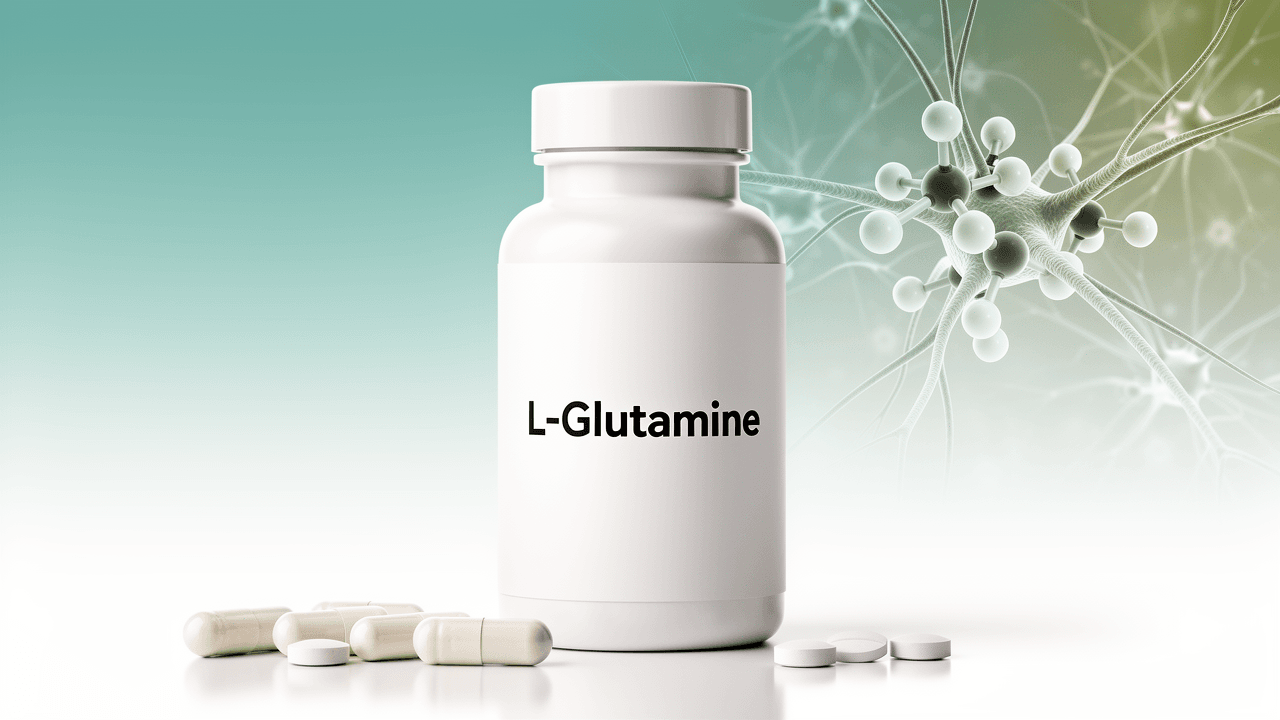
1. Understanding L-Glutamine – What It Is and How It Works
L-glutamine is the most abundant free amino acid in human blood and tissues. It is considered a conditionally essential amino acid: under normal conditions the body can synthesize enough, but during stress (intense exercise, trauma, infection, surgery) demand can exceed production.
What L-Glutamine Does in the Body
L-glutamine plays several key physiological roles:
- Nitrogen and carbon donor: It transports nitrogen and carbon between tissues, supporting protein synthesis and acid–base balance.
- Fuel for rapidly dividing cells: Intestinal epithelial cells, immune cells (lymphocytes, macrophages), and some kidney cells use glutamine as a primary energy source.
- Precursor for important molecules: It is a substrate for:
- Glutamate and GABA (key brain neurotransmitters)
- Glutathione (major intracellular antioxidant)
- Nucleotides (for DNA/RNA synthesis)
- Ammonia detoxification pathways
- Gut barrier support: Enterocytes (intestinal cells) rely on glutamine for energy and maintenance of tight junctions, which help prevent increased intestinal permeability ("leaky gut").
L-Glutamine and the Brain (Nootropic Angle)
Glutamine is intimately involved in the glutamine–glutamate–GABA cycle:
- In the brain, glutamate released from neurons is taken up by astrocytes (support cells) and converted to glutamine.
- Glutamine is then shuttled back to neurons and reconverted to glutamate or further to GABA.
- This cycle helps regulate excitatory (glutamate) and inhibitory (GABA) signaling, which influence cognition, mood, and sleep.
However, oral L-glutamine does not directly act as a stimulant or classic nootropic. Its potential cognitive effects are mainly indirect:
- Supporting overall metabolic health, gut health, and immune function
- Serving as a substrate for neurotransmitter synthesis under certain conditions
In healthy individuals, the blood–brain barrier tightly regulates glutamine and glutamate entry, so taking large doses does not simply “flood the brain” with excitatory neurotransmitters.
2. Key Benefits of L-Glutamine
2.1 Gut Health and Intestinal Barrier Support
Because intestinal cells preferentially use glutamine as fuel, it may:
- Support gut barrier integrity and tight junction function
- Reduce intestinal permeability in stressed or ill individuals
- Support recovery from gastrointestinal injury (e.g., after chemotherapy, severe illness, or major surgery)
Evidence is strongest in clinical or highly stressed populations, less so in healthy people.
2.2 Immune Function and Recovery from Stress
Immune cells consume large amounts of glutamine during activation. Under severe stress (trauma, burns, sepsis, intense endurance exercise), plasma glutamine levels often fall.
Supplementation may:
- Help maintain lymphocyte function and natural killer (NK) cell activity
- Reduce infection rates in critically ill or postoperative patients in some settings
- Potentially support recovery after exhaustive exercise
2.3 Exercise Recovery and Muscle Soreness
L-glutamine is popular among athletes for:
- Supporting glycogen resynthesis after exercise
- Potentially reducing muscle soreness and markers of muscle damage
- Supporting immune function in periods of heavy training, possibly reducing upper respiratory infections
Results are mixed: some trials show benefits, while others find minimal or no effects in well-nourished athletes.
2.4 Potential Cognitive and Mood Effects (Indirect)
Direct nootropic effects are not well-established, but potential indirect benefits include:
- Supporting neurotransmitter balance (via glutamate/GABA cycle) under metabolic stress
- Improving cognition and mood in people with serious illness or malnutrition when used as part of broader nutritional support
Evidence for cognitive enhancement in healthy individuals is limited and not robust.
3. Research Findings
3.1 Gut Health and Intestinal Permeability
Critically ill and surgical patients
- A meta-analysis of 17 randomized controlled trials (RCTs), 1,237 patients receiving parenteral nutrition (intravenous) with or without glutamine found that glutamine-supplemented groups had reduced infection rates and shorter hospital stays, though effects on mortality were inconsistent (Wischmeyer et al., 2014, Critical Care).
- In postoperative patients, several RCTs using 0.3–0.5 g/kg/day intravenous or enteral glutamine reported improved gut barrier markers and reduced infectious complications, especially after major abdominal surgery.
Intestinal permeability in stress conditions
- A double-blind RCT in 22 healthy volunteers subjected to indomethacin-induced intestinal permeability found that 0.5 g/kg/day oral glutamine for 10 days significantly reduced intestinal permeability compared with placebo (van der Hulst et al., 1993, Annals of Surgery).
Inflammatory bowel disease (IBD)
- Data in IBD are mixed. A trial in 28 patients with Crohn’s disease receiving 0.5 g/kg/day oral glutamine for 4 weeks did not significantly improve intestinal permeability or clinical scores vs. control (Ockenga et al., 2005, European Journal of Clinical Nutrition).
Takeaway: Strongest evidence is in critically ill/postoperative patients and in experimentally induced gut injury. Benefits in chronic GI disorders and healthy people are less consistent.
3.2 Immune Function and Infection Risk
- In a RCT of 200 critically ill patients receiving parenteral nutrition with or without glutamine (0.3–0.5 g/kg/day), the glutamine group had lower infection rates and shorter ICU stays (Ziegler et al., 1992, Annals of Surgery).
- Another RCT in 84 surgical ICU patients found that glutamine-supplemented parenteral nutrition (0.3 g/kg/day for ~7 days) significantly reduced nosocomial infections and length of stay (Dechelotte et al., 2006, Clinical Nutrition).
However, more recent large multicenter trials in mixed ICU populations have shown neutral or even harmful effects at high doses in certain subgroups (see Safety section), leading to more cautious use in critical care.
3.3 Exercise Performance and Recovery
Immune support in athletes
- A double-blind RCT in 151 endurance athletes (marathon and ultra-endurance runners) gave 5 g glutamine immediately after exercise and again 2 hours later, or placebo. Over the following 7 days, the glutamine group reported fewer upper respiratory tract infection (URTI) symptoms (19% vs. 51% in placebo; p<0.001) (Castell et al., 1996, European Journal of Applied Physiology).
Muscle soreness and strength recovery
- In a RCT with 16 healthy men, 0.3 g/kg glutamine taken before and after eccentric exercise did not significantly reduce muscle soreness or strength loss vs. placebo (Street et al., 2011, Journal of Strength and Conditioning Research).
- Another small RCT (n=31) with 0.1 g/kg/day glutamine for 4 days after eccentric exercise found modest reductions in muscle soreness and creatine kinase (CK) levels, but effects were small and not consistently significant.
Glycogen resynthesis
- A crossover trial in 6 trained men compared carbohydrate alone vs. carbohydrate plus 8 g glutamine after glycogen-depleting exercise. The glutamine condition showed higher muscle glycogen resynthesis at 2 hours post-exercise (Bowtell et al., 1999, European Journal of Applied Physiology). Sample size was small, so findings are preliminary.
Takeaway: Glutamine may modestly support immune function in endurance athletes; effects on soreness, strength, and performance are inconsistent and generally small.
3.4 Cognitive and Neurological Effects
Evidence for direct nootropic effects of L-glutamine is limited.
- In clinical nutrition settings, glutamine-enriched formulas have sometimes been associated with better mental status or fewer delirium episodes, but these are confounded by overall improvements in nutrition and medical care.
- Animal studies suggest glutamine can influence brain glutamate and GABA levels under stress and may have neuroprotective effects, but these findings have not translated into robust, high-quality human trials demonstrating cognitive enhancement in healthy individuals.
Takeaway: At present, glutamine should not be considered a primary cognitive enhancer; any brain-related benefits are likely indirect and context-dependent.
4. Best Sources & Dosage – Forms, Dosing, Timing, Safety
4.1 Dietary Sources
Most people obtain adequate glutamine from protein-rich foods:
- Meat and poultry (beef, chicken, turkey)
- Fish and seafood
- Eggs
- Dairy products (milk, yogurt, cheese)
- Plant proteins (beans, lentils, tofu, tempeh)
- Some vegetables (cabbage, spinach, parsley) contain modest amounts
Typical Western diets provide 3–7 g/day of glutamine from food.
4.2 Supplement Forms
Common supplemental forms:
- L-Glutamine (free form): Most widely used; typically in powder or capsules.
- Glutamine peptides (e.g., bound to peptides in hydrolyzed wheat protein): Sometimes claimed to have better stability and absorption, though clinical advantages over free L-glutamine are not well established.
For most users, standard L-glutamine powder is sufficient and cost-effective.
4.3 Dosage Recommendations by Use Case
These ranges are based on clinical and sports nutrition research. Individual needs vary; medical supervision is advised for higher doses or medical conditions.
4.3.1 General Health / Gut Support in Otherwise Healthy Adults
- Typical supplemental range: 3–10 g/day, divided into 1–3 doses.
- Common pattern: 5 g once or twice daily, often on an empty stomach.
- For short-term support during periods of GI stress (e.g., acute illness, NSAID use), some practitioners use 10–15 g/day divided.
Evidence in healthy individuals is limited; these doses are extrapolated from clinical and sports studies.
4.3.2 Exercise Recovery & Immune Support
- Acute post-exercise dose: 5–10 g immediately after training; sometimes another 5 g 1–2 hours later.
- Daily doses in training blocks: 5–15 g/day divided.
For most recreational athletes, staying at the lower end (5–10 g/day) is reasonable.
4.3.3 Clinical / Therapeutic Use (Under Medical Supervision Only)
- Critically ill or postoperative patients: often 0.3–0.5 g/kg/day (e.g., 21–35 g/day for a 70 kg adult), typically via enteral or parenteral nutrition.
- Short bowel syndrome, severe burns, or major trauma: similar ranges, always under specialist care.
These higher doses are not appropriate for self-directed supplementation and may be harmful in certain ICU populations.
4.4 Timing and Administration
- Empty stomach vs. with food: Often taken on an empty stomach for gut support or post-exercise, but it can be taken with meals if GI upset occurs.
- Powder vs. capsules: Powder is more economical for higher doses (5–20 g/day). Capsules may be more convenient for 1–5 g/day.
- Stacking with other supplements: Commonly combined with:
- Electrolytes and carbohydrates post-exercise
- Probiotics, zinc carnosine, and other gut-supportive nutrients
5. Safety, Side Effects, and Drug Interactions
5.1 General Safety Profile
For healthy adults, L-glutamine is generally considered low-risk at typical supplemental doses.
- Doses up to 30 g/day have been used in short-term studies (2–4 weeks) without serious adverse effects in healthy people.
- Long-term safety data at high doses are limited; most data beyond a few months come from clinical nutrition contexts.
5.2 Common Side Effects
Usually mild and dose-dependent:
- Gastrointestinal discomfort (bloating, gas)
- Nausea or stomach upset
- Rarely, headaches or fatigue
Starting with 3–5 g/day and titrating up can minimize GI side effects.
5.3 Serious Risks and Controversies
Critically ill patients and high-dose glutamine
Several large trials in ICU settings (e.g., the REDOXS trial) found that very high doses of glutamine, especially in multi-organ failure or severe shock, could be harmful, increasing mortality in some subgroups. Factors implicated:
- Doses exceeding 0.5 g/kg/day
- Severe renal or hepatic dysfunction
- Multi-organ failure and shock
This has led to more conservative use of glutamine in critical care and reinforces that high-dose glutamine is a drug-like intervention, not a simple supplement, in that context.
5.4 Drug and Condition Interactions
While glutamine has relatively few direct drug interactions, certain conditions warrant caution or avoidance.
Use with caution or avoid if:
Severe liver disease (hepatic encephalopathy)
- Glutamine metabolism produces ammonia; in advanced liver failure, ammonia clearance is impaired.
- Extra nitrogen load may worsen encephalopathy.
- Avoid self-supplementation; only use under hepatologist guidance.
Severe kidney disease (renal failure)
- Impaired excretion of nitrogenous waste may lead to accumulation of urea and ammonia.
- High-protein or high-amino-acid loads are often restricted.
- Avoid or use only under nephrologist supervision.
History of seizures or neurological disorders
- Theoretical concern: glutamine is a precursor to glutamate, an excitatory neurotransmitter.
- Human data are sparse, but some clinicians prefer caution in poorly controlled epilepsy.
Cancer
- Tumor cells can use glutamine as a fuel source.
- However, many oncology nutrition protocols still use glutamine to reduce mucositis and improve nutritional status.
- The relationship is complex; decisions should be made with the oncology team.
Manic or psychotic disorders
- Because of theoretical effects on glutamatergic signaling, caution is advised in uncontrolled bipolar disorder or psychosis, though robust human data are lacking.
Drug interactions (theoretical or limited evidence):
- Anticonvulsants (e.g., valproate, carbamazepine): No clear clinical interaction, but theoretical concern via excitatory neurotransmission. Monitor if used.
- Lactulose or other ammonia-lowering agents: In liver disease, extra glutamine could counteract ammonia-lowering strategies.
- Chemotherapy: Some oncologists use glutamine to reduce mucositis; others avoid it depending on tumor type and regimen. Coordination with the oncology team is essential.
Always discuss glutamine supplementation with a clinician if you are on multiple medications or have chronic disease.
6. Who Should and Shouldn’t Use L-Glutamine
6.1 Who Might Consider L-Glutamine
Endurance athletes and heavy trainers
- Experiencing frequent colds or URTI symptoms during heavy training
- Considering 5–10 g/day to support immune function and recovery
Individuals with short-term gut stress (with professional guidance)
- After a course of NSAIDs or antibiotics
- During acute GI upset or recovery from mild GI illness
- Typical range: 5–15 g/day, divided
Patients in clinical nutrition programs
- Those receiving specialized nutrition support (enteral or parenteral) may benefit from glutamine-enriched formulas under medical supervision.
People with marginal protein intake
- Those unable to meet protein needs through diet may benefit from glutamine as part of a broader protein/AA support plan.
6.2 Who Should Use Caution or Avoid It
Individuals with serious liver or kidney disease
- Avoid self-supplementation; any use should be supervised by a specialist.
Critically ill patients (ICU, multi-organ failure, severe sepsis)
- High-dose glutamine may increase mortality in some subgroups; decisions belong to the critical care team, not to self-directed supplementation.
People with active cancer under treatment
- Do not start glutamine without oncologist approval; the risk–benefit profile varies by cancer type and treatment.
Pregnant or breastfeeding women
- Glutamine is naturally present in diet, but high-dose supplementation lacks robust safety data.
- Limit to dietary intake and standard prenatal nutrition unless advised otherwise by a clinician.
Children and adolescents
- Dietary glutamine is safe, but high-dose supplements should only be used under pediatric supervision for specific indications.
Practical Summary
- Role: L-glutamine is a conditionally essential amino acid crucial for gut cells, immune cells, and nitrogen transport; it also participates in neurotransmitter cycling.
- Evidence-based benefits: Strongest data for gut integrity and infection reduction in critically ill or postoperative patients; moderate evidence for immune support in endurance athletes; limited and inconsistent evidence for muscle recovery and direct cognitive enhancement.
- Dosage: For healthy adults, 3–10 g/day is common; athletes may use 5–15 g/day. Clinical doses (0.3–0.5 g/kg/day) must be medically supervised.
- Safety: Generally well tolerated at moderate doses, but high-dose use in critical illness can be harmful. Use caution in liver/kidney disease, cancer, and neurological conditions.
- Nootropic role: Best viewed as a supportive metabolic and gut health nutrient, not a primary cognitive enhancer. Any brain benefits are likely indirect.
As with all supplements, L-glutamine should complement—not replace—adequate protein intake, balanced nutrition, sleep, and medical care. If you have chronic illness or take prescription medications, consult a qualified healthcare professional before starting supplementation.