
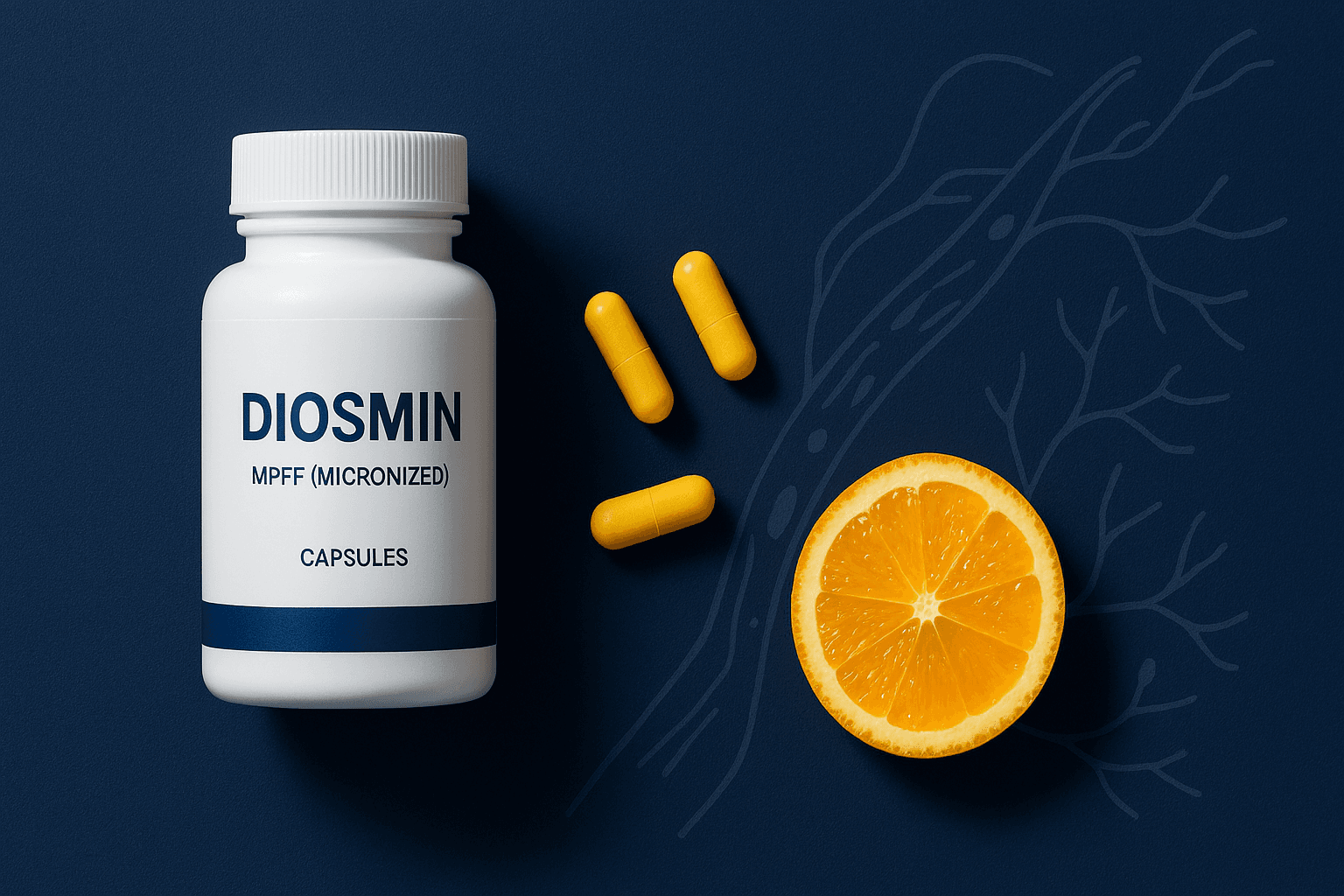
Strengthening vein walls & boosting lymphatic flow: Understanding Diosmin
Diosmin is a naturally occurring flavonoid glycoside primarily extracted from citrus fruits (such as oranges, lemons, and grapefruit) and belongs to a class of compounds called phlebotonics. It is often combined with other flavonoids like Hesperidin in a micronized purified flavonoid fraction (MPFF) to enhance absorption and efficacy. Diosmin’s primary role is as a vasculoprotective agent. Mechanistically, it improves the health of the circulatory system by acting on the capillaries and veins . It works by decreasing venous distensibility (making veins less stretchy and leaky), improving venous tone (making veins contract more efficiently), and enhancing lymphatic drainage. This makes it an essential supplement for managing conditions related to venous insufficiency.
Wellness takeaway: If your main aims are to support leg circulation, manage symptoms of Chronic Venous Insufficiency (CVI) (like heavy, tired legs and edema), or alleviate discomfort from hemorrhoids, Diosmin is a highly effective, clinically validated option. Use consistently for 2–4 months for CVI, and track your subjective relief of symptoms like swelling and pain.
Key Benefits
Chronic Venous Insufficiency (CVI) Relief: Reduces symptoms like leg pain, heaviness, cramping, and nocturnal discomfort associated with poor vein function.
Reduces Edema/Swelling: Improves lymphatic and venous circulation, leading to a measurable reduction in lower limb swelling (edema) caused by blood pooling.
Hemorrhoid Management: Significantly reduces the duration and severity of acute hemorrhoidal attacks (pain, bleeding, and inflammation) by strengthening capillary resistance.
Microcirculation Support: Decreases capillary permeability and fragility, protecting the smallest blood vessels from leakage.
Reality check: Diosmin is a therapeutic agent and should be used under the guidance of a healthcare professional, especially when managing severe CVI or recurrent hemorrhoids. It is not a substitute for compression stockings or lifestyle changes (movement, avoiding prolonged standing/sitting).
Research Findings
Time to benefit:
Acute Hemorrhoids: Relief from pain, bleeding, and discharge often begins within 24–72 hours with high, initial loading doses.
Chronic Venous Insufficiency (CVI): Subjective improvement in leg heaviness and pain usually begins after 4–8 weeks; significant reduction in edema is often observed by 2–4 months of continuous use.
Ulcer Healing: Used as an adjunct, it can support venous leg ulcer healing, with full effects seen over 6 months.
Human study highlights (succinct):
CVI Symptoms: Numerous randomized controlled trials and systematic reviews confirm that Diosmin, particularly in the Micronized Purified Flavonoid Fraction (MPFF) form (typically 90% Diosmin, 10% Hesperidin, standardized to 500 mg dose), significantly reduces leg pain, heaviness, and functional discomfort in CVI patients compared to placebo. It has been shown to reduce leg volume (swelling) by an average of 1.5 to 2.5 cm.
Hemorrhoidal Disease: High-dose Diosmin MPFF is highly effective for both acute and chronic hemorrhoids. Trials show it reduces bleeding, pain severity, and recurrence by increasing anal cushion tone and microcirculation resistance. Protocol often involves a high loading dose (e.g., 3000 mg/day for 4 days) followed by a maintenance dose for acute relief.
Safety & Tolerability: Long-term studies (up to one year) have shown excellent safety profiles and tolerability. It is often compared favorably to other treatments due to minimal side effects.
Tolerability: Generally excellent. The most common side effects are mild and rare, including minor gastrointestinal complaints (stomach discomfort, diarrhea), headache, or occasional malaise. These are usually non-limiting and decrease with continued use.
Best Sources & Dosage
What to buy:
- Forms: - Micronized Purified Flavonoid Fraction (MPFF): This is the most studied and effective form. Micronization dramatically improves the absorption of the otherwise poorly absorbed Diosmin molecule. Standard ratio is 90% Diosmin / 10% Hesperidin.
- Capsules/Tablets: Look for products that specifically state they are Micronized and clearly label the amount of Diosmin and Hesperidin.
Quality: Choose brands that specify the source (citrus bioflavonoid) and the micronization status. Third-party testing for purity and potency is always advisable.
Avoid: Generic Diosmin powder or extracts that do not specify micronization, as the bioavailability of the non-micronized form is very low.
Evidence-aligned ranges (by use case):
- Chronic Venous Insufficiency (CVI) / Lymphedema: - Dose: 1,000 mg (1 gram) per day, often split into two doses (500 mg morning, 500 mg evening) or one single dose, utilizing the MPFF form (900 mg Diosmin, 100 mg Hesperidin).
- Use daily for 4–6 months for full benefit.
- Acute Hemorrhoidal Attacks: - Loading Dose: 3,000 mg (3 grams) per day for the first 4 days (e.g., 1,000 mg three times daily).
- Tapering Dose: 2,000 mg (2 grams) per day for the next 3 days. - Maintenance: Revert to CVI dose or stop until next acute episode, based on severity.
Timing & tips:
Take with meals to improve tolerability and absorption.
For CVI, combine Diosmin with compression stockings, regular walking, and elevating the legs to maximize results.
For Hemorrhoids, ensure adequate fiber and fluid intake (avoiding constipation) alongside the Diosmin protocol.
Safety, interactions & exclusions:
Drug Interactions: Diosmin has a low potential for significant drug interactions. However, it may theoretically interfere with some drugs metabolized by the CYP450 enzyme system (specifically CYP1A2, 2A6, and 2C9). Consult your pharmacist or physician if you are on narrow therapeutic index medications (e.g., warfarin, certain anti-epileptics).
Bleeding Disorders: Due to its potential effect on capillaries, use with caution if taking blood thinners (anticoagulants) or if you have a known bleeding disorder, though major interactions are rare.
Surgery/Procedures: As a precaution, often recommended to pause Diosmin 1–2 weeks prior to surgery due to its microcirculatory effects.
Pregnancy/Lactation: Human data, particularly in high-quality MPFF forms, suggest low risk, but standard medical advice is to avoid or use only under strict clinical supervision.
Allergies: Avoid if sensitive to citrus bioflavonoids.
Bold safety flag: Do not use to treat sudden, severe pain, or heavy, bright red rectal bleeding without immediate medical consultation; these require ruling out life-threatening conditions. Use only the micronized form for best results.
Dosage Quick-Reference
CVI/Leg Symptoms: 1,000 mg MPFF daily (900 mg Diosmin, 100 mg Hesperidin), 4–6 months → ↓Leg Heaviness, ↓Edema (↑).
Acute Hemorrhoids: 3,000 mg MPFF for 4 days, then 2,000 mg MPFF for 3 days → ↓Pain, ↓Bleeding (↑↑).
LDL Cholesterol Lowering (Secondary Benefit): No primary role; effects are structural on veins, not typically metabolic like sterols.
Safety note: Must use the micronized form; monitor if on blood thinners; seek immediate medical attention for severe bleeding; not typically recommended during pregnancy/lactation.