
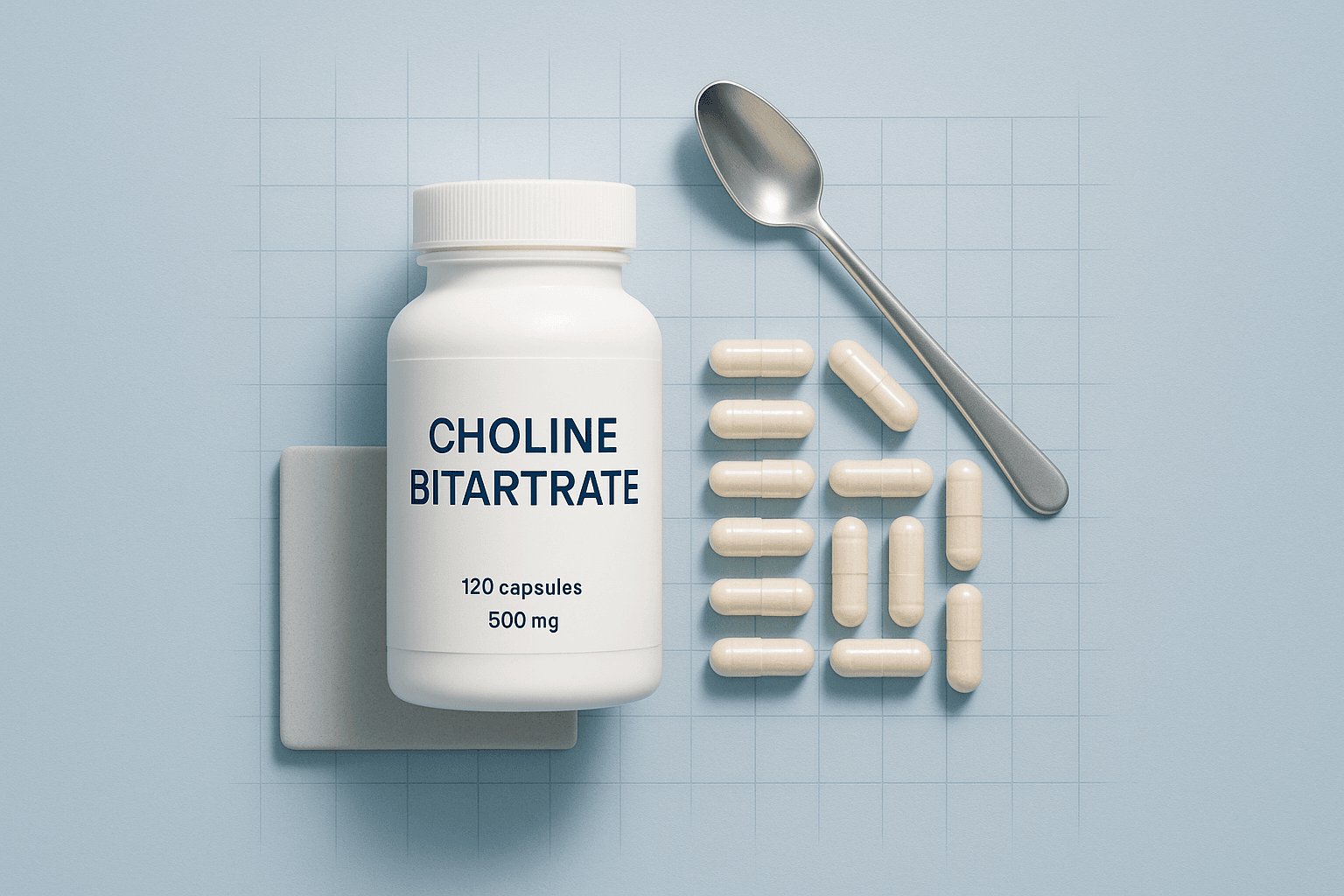
Understanding Choline Bitartrate
Choline bitartrate is a salt of choline—an essential, vitamin-like nutrient your body uses to build cell membranes (via phosphatidylcholine), make the neurotransmitter acetylcholine, and export fat from the liver as very-low-density lipoprotein (VLDL). After ingestion, the salt dissociates into free choline (the active nutrient) and bitartrate (a tartaric acid counter-ion that stabilizes the compound). Free choline is taken up primarily by the liver to support phospholipid synthesis and methyl-group metabolism (by converting to betaine, which helps recycle homocysteine to methionine). Some choline also crosses the blood–brain barrier to support acetylcholine production, though brain-targeted forms such as citicoline (CDP-choline) and alpha-GPC typically raise brain choline more efficiently per milligram.
Diet provides choline—especially egg yolks, beef liver, meats, fish, and soy. Despite this, many adults fall short of the Adequate Intake (about 425 mg/day for women and 550 mg/day for men). Requirements rise in pregnancy and lactation to support fetal and infant brain development. Endogenous synthesis via the PEMT pathway is modest and affected by estrogen status and common genetic variants (e.g., PEMT, MTHFD1), meaning diet alone does not reliably cover needs for everyone. That’s where a predictable supplemental source becomes practical.
Why choose choline bitartrate? It’s widely available, cost-effective, and provides a relatively high percentage of elemental choline. It excels at closing intake gaps and supporting liver and methylation needs. For acute cognitive enhancement, evidence with this form is mixed; citicoline or alpha-GPC have stronger brain-focused data. But for meeting baseline requirements, choline bitartrate is straightforward and well tolerated for most people.
Key Benefits
Helps prevent deficiency-related liver and muscle changes. Controlled feeding studies show that inadequate choline leads to fatty liver and elevated muscle enzymes in many adults; restoring choline intake reverses these findings.
Supports fetal and infant brain development when needs are higher. Pregnancy increases choline demand for membrane synthesis and acetylcholine signaling; supplementation helps ensure the maternal–fetal unit meets those needs.
Contributes methyl groups for homocysteine balance. As a precursor to betaine, choline supports remethylation of homocysteine, complementing folate and B12 pathways.
Reality check: For acute memory or attention in healthy young adults, choline bitartrate shows inconsistent effects. If cognition is the primary goal, consider citicoline or alpha-GPC instead.
Research Findings
Deficiency and repletion (controlled diets): In tightly controlled, multi-week feeding studies with adults, reducing dietary choline to very low levels induced fatty liver (by imaging) and/or elevated creatine kinase within weeks in a majority of men and postmenopausal women. Repleting choline resolved these abnormalities, with variability influenced by sex, menopausal status, and genetics.
Pregnancy and infant outcomes: Randomized, double-blind trials that increased maternal choline intake (typically achieving 480–930 mg/day from diet plus supplements, often phosphatidylcholine or choline salts) reported faster infant information-processing speed on standardized visual attention tasks at 4–13 months versus controls. Maternal supplementation was well tolerated and targeted intakes at or above the AI.
Homocysteine and methylation: In 6–12-week randomized studies, supplemental choline or betaine at amounts equivalent to roughly 400–800 mg/day of choline modestly reduced fasting homocysteine compared with placebo, especially in those with marginal folate/B12 status.
Cognition in healthy adults (acute dosing): Small crossover trials administering single doses of choline bitartrate (often 500–2,000 mg, providing ~200–800 mg choline) before testing generally found null or mixed effects on reaction time, working memory, and sustained attention. This supports using choline bitartrate primarily for meeting needs rather than as a quick nootropic.
Best Sources & Dosage
Food sources (approximate choline per typical serving):
- Egg, 1 large: ~125–150 mg
- Beef liver, 85 g cooked: ~350–420 mg
- Chicken breast, 85 g cooked: ~60–75 mg
- Atlantic cod, 85 g cooked: ~70 mg
- Soybeans/edamame, ½ cup: ~45–75 mg
- Milk, 1 cup: ~40 mg
Supplement forms:
Choline bitartrate (this article’s focus): economical, high elemental choline; best for closing intake gaps and supporting liver/methylation.
Citicoline (CDP-choline) and alpha-GPC: more brain-directed; used in cognition research.
Phosphatidylcholine (lecithin): gentler on the stomach; lower elemental choline percentage; common in prenatal regimens.
Evidence-based dosage ranges (adults):
General coverage / closing intake gaps: 250–500 mg/day of choline from choline bitartrate (≈600–1,200 mg of the salt), taken with food. Combined with diet, this typically reaches the AI (425–550 mg/day).
Pregnancy: Aim for 450–650 mg/day total choline from diet plus supplements. Many protocols add 350–550 mg/day supplemental choline (any form). Coordinate with prenatal care.
Lactation: 550–650 mg/day total choline, often requiring a 300–500 mg/day supplement if dietary intake is low.
Homocysteine support or low-folate diets: 400–800 mg/day choline (from bitartrate or betaine-equivalent) alongside adequate folate and B12.
Upper Limit (UL) for total choline intake: 3.5 g/day; avoid exceeding without medical supervision.
Timing and practical tips:
Take with meals to improve tolerability and reduce the chance of fishy body odor (trimethylamine), which is dose-related.
Split larger daily amounts into two or three doses to minimize gastrointestinal discomfort and odor.
If cognitive performance is the main goal, consider citicoline or alpha-GPC; choline bitartrate remains a solid choice for meeting requirements.
Safety and interactions:
Common, dose-related effects: mild nausea, stomach cramping, sweating, increased salivation, and a fishy odor. Lower the dose or split it if this occurs.
Very high intakes can lower blood pressure and heart rate; respect the UL.
Medication considerations: choline supports acetylcholine synthesis and could theoretically counter strong anticholinergic drugs or add to cholinergic effects, though this is uncommon at typical doses. Discuss use if you take anticholinergics, cholinesterase inhibitors, or anticoagulants.
Trimethylaminuria (TMAU) increases odor risk with higher choline intakes.
Pregnancy and lactation: generally beneficial for meeting AI; choose products tested for quality and follow clinician guidance.
Dosage Quick-Reference
Close a diet gap (adult): 600–1,200 mg/day choline bitartrate (≈250–500 mg choline) • 8–12 weeks, reassess • Outcome: intake meets AI; liver/methylation support ↑.
Pregnancy (meeting AI): add 350–550 mg/day choline (any form) to diet • 3rd trimester → postpartum • Outcome: supports fetal brain development; maternal status ↑.
Homocysteine balance: 800–1,600 mg/day choline bitartrate (≈330–660 mg choline) • 6–12 weeks • Outcome: fasting homocysteine ↓ (modest).
Cognition (healthy adults, acute): 500–2,000 mg choline bitartrate pre-testing • single dose • Outcome: effects →/mixed; consider citicoline or alpha-GPC.
Do not exceed UL: 3.5 g/day total choline • ongoing • Outcome: lowers risk of hypotension, GI upset, strong odor.