1. Understanding Beta-Alanine – What It Is and How It Works
What is Beta-Alanine?
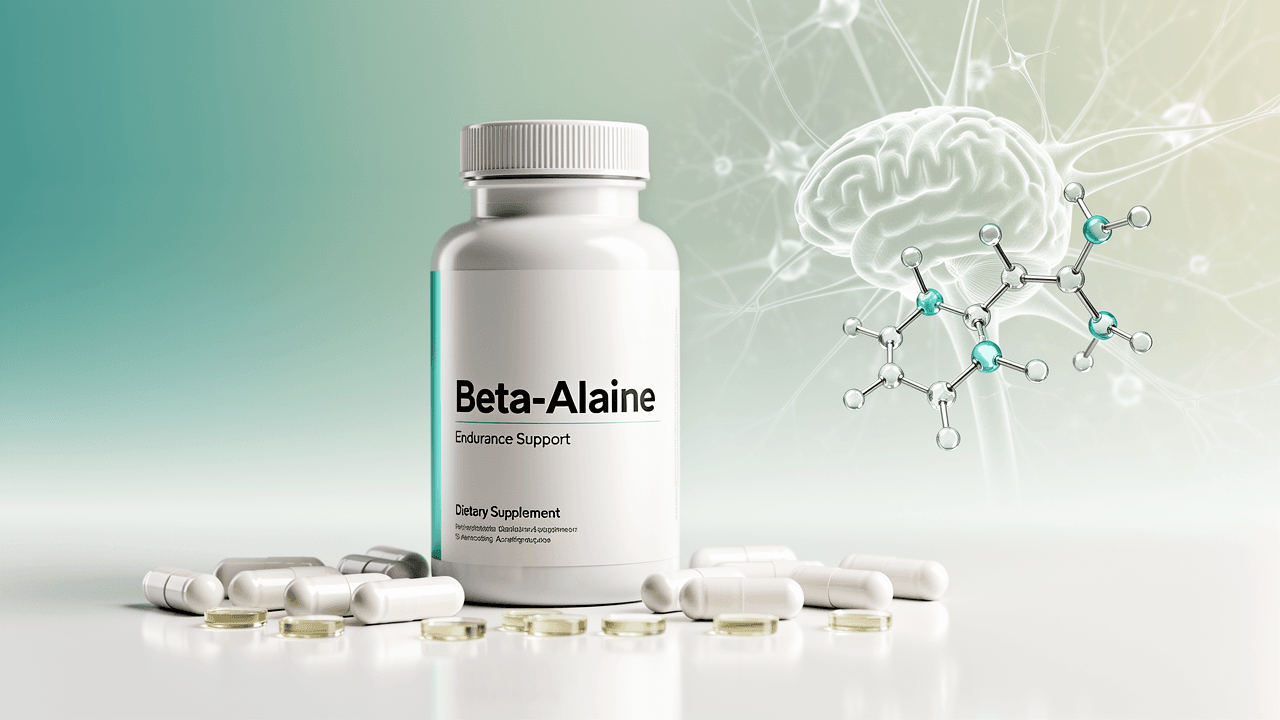
Beta-alanine is a non-essential amino acid (your body can make it) that is distinct from the more common amino acid L-alanine. It is not used directly to build proteins. Instead, its main role is as a precursor to carnosine, a dipeptide made from beta-alanine and histidine.
Carnosine is highly concentrated in skeletal muscle and, to a lesser degree, in the brain and heart. Because beta-alanine availability is the rate-limiting step in carnosine synthesis, supplementing beta-alanine reliably increases muscle carnosine content.
How Beta-Alanine Works in the Body
1. Carnosine and Intramuscular pH Buffering
During high-intensity exercise (e.g., sprinting, heavy lifting, repeated intervals), your muscles rely heavily on anaerobic glycolysis, which produces hydrogen ions (H⁺) and lowers pH (increases acidity). This drop in pH is associated with:
- Burning sensation in muscles
- Reduced enzyme activity
- Impaired muscle contraction and force output
Carnosine acts as an intracellular buffer, accepting H⁺ ions and helping stabilize muscle pH. Higher carnosine levels mean better buffering capacity and delayed fatigue during intense efforts lasting roughly 30 seconds to 10 minutes.
Supplementing beta-alanine typically increases muscle carnosine by 40–80% over 4–12 weeks, depending on dose and duration.
2. Potential Neurological and Nootropic Roles
Carnosine is also found in the brain, where it may:
- Act as an antioxidant and anti-glycation agent
- Modulate neurotransmission (via effects on glutamate and GABA systems in animal and in vitro models)
- Help protect neurons under metabolic or oxidative stress
Human data on beta-alanine as a nootropic are limited, but some studies suggest potential benefits for mental performance under fatigue, sustained attention, and perceived exertion.
3. Beta-Alanine vs. Carnosine Supplements
You can take carnosine directly, but it is rapidly broken down in the gut and by serum carnosinase. Beta-alanine, in contrast, is efficiently absorbed and transported into muscle, where it combines with histidine to form carnosine. For raising muscle carnosine, beta-alanine is more effective and more cost-efficient than carnosine itself.
2. Key Benefits of Beta-Alanine
1. Improved High-Intensity Exercise Performance
The most consistent benefit is improved performance in short-to-moderate duration high-intensity efforts (about 30 seconds to 10 minutes), such as:
- 400–1500 m running events
- Rowing races (e.g., 2000 m)
- Repeated sprints (team sports: soccer, rugby, hockey)
- High-rep strength training and CrossFit-style workouts
By increasing muscle carnosine and buffering capacity, beta-alanine can help you maintain power output longer and delay fatigue.
2. Increased Training Volume and Work Capacity
Because fatigue is delayed, many users can perform more total work:
- More reps per set
- More sets at a given load
- Higher total volume in interval sessions
Over weeks to months, this can indirectly support greater strength, power, and hypertrophy gains, assuming nutrition and recovery are adequate.
3. Enhanced Performance in Intermittent or Team Sports
Sports that require repeated bursts of high-intensity effort with short recovery intervals may benefit from beta-alanine supplementation. Studies show improvements in:
- Repeated sprint ability
- Time to exhaustion during high-intensity intermittent tests
- Some sport-specific performance metrics (e.g., Yo-Yo test performance)
4. Potential Cognitive and Anti-Fatigue Effects
Evidence is still emerging, but some data suggest beta-alanine might:
- Reduce mental fatigue during sustained or stressful tasks
- Support cognitive performance under physical stress (e.g., military tasks, extended exercise)
- Improve subjective feelings of vigor or reduce perceived exertion
These effects are modest and not as well-established as the exercise benefits, but they are of interest for nootropic use, especially in physically demanding contexts.
3. Research Findings on Beta-Alanine
3.1 Effects on Muscle Carnosine
- Study design: Meta-analysis of 15 studies (various sports; typical doses 4–6.4 g/day for 4–12 weeks)
- Findings: Muscle carnosine increased by ~40–80%, with larger increases at higher doses and longer durations. This increase correlated with improvements in high-intensity exercise capacity.
(Representative references: Harris et al., 2006; Derave et al., 2007; Stellingwerff et al., 2012)
3.2 High-Intensity Exercise Performance
1. Time-to-Exhaustion Cycling
- Study: Hill et al., 2007
- Participants: 25 healthy men
- Protocol: 6.4 g/day beta-alanine for 4 weeks, then 3.2 g/day for 6 weeks vs. placebo
- Outcome: Time to exhaustion during cycling at 110% of maximal power output increased by 13–16% in the beta-alanine group; no significant change in placebo.
2. Rowing Performance
- Study: Baguet et al., 2010
- Participants: 8 elite rowers
- Protocol: 5 g/day beta-alanine for 7 weeks
- Outcome: Muscle carnosine increased by ~45%; 2000 m rowing performance improved by ~2.0–2.5 seconds compared with baseline. While this seems small, in elite sport it can be meaningful.
3. High-Intensity Cycling Capacity (Meta-analysis)
- Study: Hobson et al., 2012 (systematic review and meta-analysis)
- Data: 15 studies, 360 participants
- Outcome: Beta-alanine significantly improved exercise capacity (time to exhaustion) in tasks lasting 60–240 seconds. Effects on time-trial performance (fixed distance/time) were smaller and more variable.
3.3 Strength Training and Hypertrophy
1. Resistance Training in Recreationally Active Men
- Study: Hoffman et al., 2008
- Participants: 33 men
- Protocol: 6.4 g/day beta-alanine vs. placebo for 10 weeks during resistance training
- Outcome: Beta-alanine group had greater increases in training volume and lean body mass compared with placebo. Strength gains (1RM) improved in both groups, with a trend favoring beta-alanine but not always statistically significant.
2. Hypertrophy-Focused Training
- Several studies report that beta-alanine can increase the number of repetitions performed at a given load (e.g., 70–80% 1RM), which over time may contribute to greater hypertrophy. However, beta-alanine is not a direct muscle-building agent; its benefits are mediated through increased training volume.
3.4 Cognitive and Anti-Fatigue Effects
1. Military and Tactical Populations
- Study: Hoffman et al., 2014
- Participants: 20 soldiers
- Protocol: 6 g/day beta-alanine vs. placebo for 4 weeks during military training
- Outcome: The beta-alanine group showed improved performance on a simulated marksmanship task and cognitive function tests under physical stress. They also reported reduced perceived exertion. Sample size was small, so findings are preliminary.
2. Mental Fatigue and Endurance Tasks
- Some small trials in athletes and tactical populations suggest beta-alanine may help maintain vigilance, reaction time, or decision-making during prolonged or intense physical activity. However, no large-scale, high-quality trials have established beta-alanine as a general cognitive enhancer in everyday settings.
3.5 Who Benefits Most?
Evidence is strongest for:
- Athletes in events lasting 30 s–10 min (sprint/middle-distance running, rowing, track cycling)
- Team-sport athletes with repeated high-intensity efforts
- Individuals doing high-intensity interval training (HIIT) or metabolically demanding resistance training
Benefits are modest or inconsistent for:
- Very short efforts (<30 seconds) where phosphocreatine dominates (creatine is more relevant)
- Low-intensity, long-duration endurance (e.g., marathons) where other factors limit performance
- General cognitive enhancement in non-fatigued, healthy adults (data are limited)
4. Best Sources & Dosage – Forms, Dosing, Timing, Safety
4.1 Forms of Beta-Alanine
- Pure beta-alanine powder or capsules
- Most common and cost-effective
- Often sold alone or as part of pre-workout formulas
- Sustained-release formulations
- Designed to reduce paresthesia (tingling) by slowing absorption
- Beta-alanine in blends (pre-workouts)
- Often underdosed (e.g., 1.6–2 g/serving) relative to optimal daily totals
Look for products that are:
- Third-party tested (e.g., NSF Certified for Sport, Informed-Sport) if you are an athlete
- Clearly labeled with per-serving beta-alanine content
4.2 Evidence-Based Dosage Guidelines
The key to beta-alanine is daily total intake and duration, not acute timing around workouts.
Standard Performance Protocol
- Typical dose: 4–6 g/day
- Duration: At least 4 weeks, ideally 8–12 weeks for maximal carnosine loading
- Dosing strategy: Split into 2–4 smaller doses (e.g., 1.6–2 g, 2–3 times per day) to reduce tingling
This approach usually raises muscle carnosine by ~40–80%, with higher and longer dosing producing greater increases.
Lower-Dose, Longer-Term Strategy
- Dose: 3–3.2 g/day
- Duration: 10–12 weeks
- Use case: Individuals sensitive to paresthesia or wanting a milder approach
Still effective for increasing carnosine, but loading takes slightly longer.
Nootropic or Cognitive-Focused Use
There is no standardized “nootropic dose,” but based on the same carnosine-loading principle:
- Dose: 3–6 g/day, in divided doses, similar to sports protocols
- Duration: At least 4–8 weeks
Cognitive benefits, if any, are likely to be modest and more pronounced in physically or cognitively stressful conditions rather than at rest.
4.3 Timing Considerations
- Not acutely performance-dependent: Unlike caffeine, beta-alanine does not need to be taken immediately before exercise. Its effects depend on chronic muscle carnosine levels.
- Flexible timing: You can take it with meals or spread through the day.
- With food: Some evidence suggests taking beta-alanine with meals may enhance muscle uptake, possibly due to insulin-mediated amino acid transport.
4.4 Safety, Side Effects, and Interactions
Common Side Effect: Paresthesia (Tingling)
- What it is: A transient tingling, prickling, or flushing sensation, usually in the face, neck, and hands.
- When it occurs: Typically with single doses ≥1.6–2 g, especially on an empty stomach.
- Duration: 30–60 minutes; it is benign and not associated with harm.
- How to minimize:
- Use smaller, divided doses (e.g., 0.8–1.6 g per dose)
- Take with food
- Consider sustained-release formulations
Long-Term Safety
- Human studies up to 12–24 weeks at 4–6 g/day show no serious adverse effects in healthy adults.
- Limited data beyond ~1 year, but available evidence suggests beta-alanine is generally safe at commonly used doses in healthy individuals.
- No strong evidence of adverse effects on liver or kidney function in healthy people at recommended doses, but individuals with pre-existing organ disease should exercise caution.
Potential Nutrient Interactions
Taurine: Beta-alanine and taurine share some transport pathways in tissues. High-dose beta-alanine can lower taurine levels in certain animal models. Human evidence of clinically meaningful taurine depletion at standard doses is limited, but it may be prudent for long-term high-dose users to:
- Ensure adequate dietary taurine (fish, meat) or
- Consider moderate taurine supplementation (e.g., 500–1000 mg/day) if diet is low
Histidine: Because carnosine is made from beta-alanine + histidine, adequate protein intake (containing histidine) supports optimal carnosine synthesis. Most people with normal protein intake meet this need.
Drug Interactions
There are no well-documented, serious drug–beta-alanine interactions in the literature, but data are limited. Theoretical or practical considerations:
- Drugs affecting nerve function (e.g., some chemotherapy agents, neuropathy-inducing drugs): In theory, individuals with neuropathy might be more sensitive to tingling; use with caution and consult a clinician.
- Antihypertensives or vasodilators: Beta-alanine may cause mild flushing; usually not clinically significant but could be confused with side effects from other drugs.
Because formal interaction studies are sparse, people on multiple medications, especially for neurological or cardiovascular conditions, should consult their healthcare provider before long-term use.
Special Populations
- Pregnancy and breastfeeding: Insufficient safety data. Avoid use unless specifically recommended by a healthcare professional.
- Children and adolescents: Limited research. Use only under medical supervision, especially in competitive youth athletes.
- Kidney or liver disease: Amino acid handling may be altered. Avoid or use only with medical oversight.
4.5 Who Should and Shouldn’t Use Beta-Alanine
Likely Good Candidates
- Competitive athletes in sports with high-intensity bouts lasting 30 s–10 min (sprint/middle-distance running, rowing, track cycling, swimming events, combat sports)
- Team-sport athletes (soccer, rugby, basketball, hockey) performing repeated sprints
- Recreational lifters and CrossFit/HIIT trainees wanting to push more reps and volume in high-intensity sets
- Tactical populations (military, firefighters, law enforcement) engaged in physically and mentally demanding tasks, where modest performance and fatigue-resistance gains may be valuable
Those Who May Not Need It
- Individuals doing mainly low-intensity, long-duration endurance (e.g., easy long-distance jogging, walking) where acid-base buffering is not the main limitation
- People whose workouts are mostly very short, maximal efforts (<10–15 seconds), where creatine and neuromuscular factors are more critical
- Those expecting dramatic cognitive enhancement in normal daily life—current evidence does not support large nootropic effects in healthy, rested individuals
Those Who Should Be Cautious or Avoid Use
- Pregnant or breastfeeding women (lack of safety data)
- Individuals with kidney or liver disease without medical supervision
- People with a history of severe neuropathy or unusual sensitivity to tingling/paresthesia
- Children and adolescents unless guided by a qualified healthcare provider
- Anyone on multiple medications or with complex medical conditions should consult a clinician before sustained use.
Practical Takeaways
- Beta-alanine is a well-researched supplement for improving high-intensity exercise capacity by increasing muscle carnosine and buffering acidity.
- Typical effective intake is 4–6 g/day, divided into smaller doses, for at least 4–8 weeks.
- Benefits are most pronounced in activities lasting 30 seconds to 10 minutes and in repeated-sprint or high-intensity training contexts.
- Side effects are generally mild and limited to transient tingling; long-term safety in healthy adults at recommended doses appears good, though data beyond 1–2 years are limited.
- Cognitive and nootropic benefits are emerging but not yet robustly established, and likely modest outside of physically stressful situations.
- As with any supplement, beta-alanine should complement—not replace—sound training, nutrition, sleep, and medical care.