1. Understanding Beetroot Extract – What It Is and How It Works
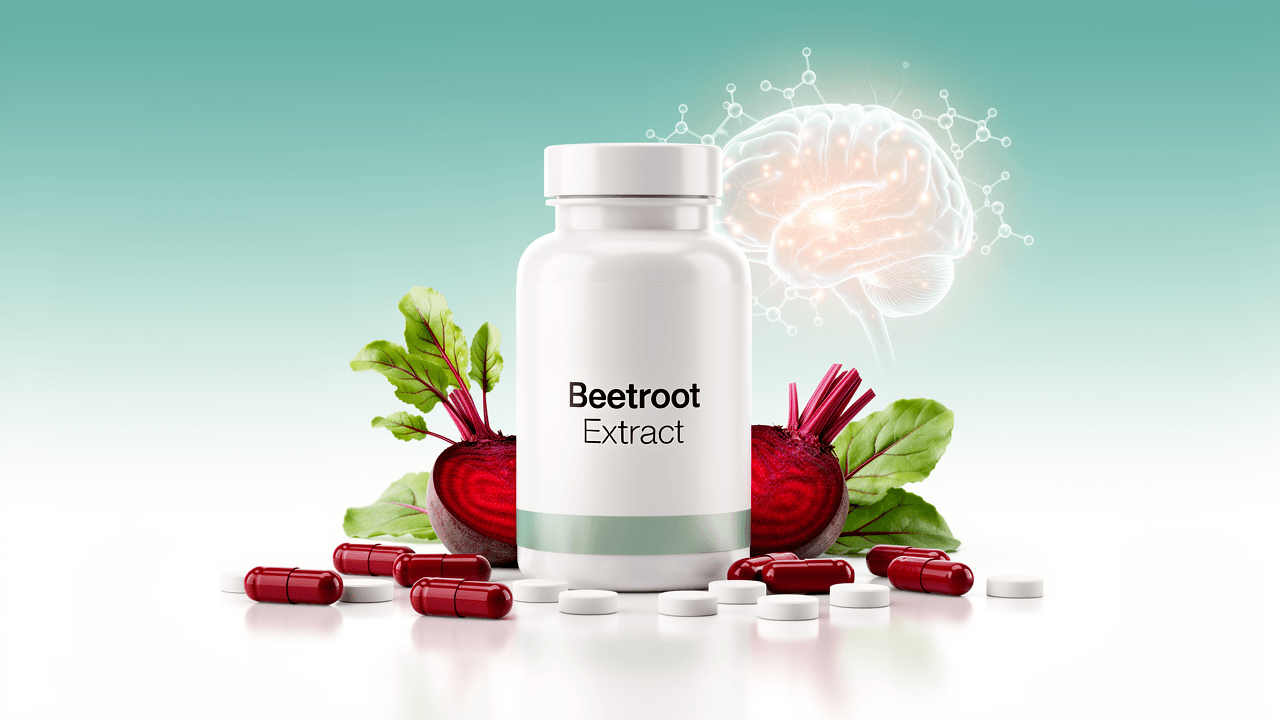
Beetroot extract is a concentrated form of Beta vulgaris (red beet) typically standardized for nitrate and/or betalain content. It is used as a dietary supplement for cardiovascular health, exercise performance, and increasingly, for cognitive support.
Key Active Components
- Inorganic nitrate (NO₃⁻): Converted in the body to nitric oxide (NO), a signaling molecule that regulates blood vessel dilation, blood flow, and mitochondrial efficiency.
- Betalains (betanin, vulgaxanthin): Pigments with antioxidant and anti-inflammatory properties.
- Polyphenols and flavonoids: Contribute additional antioxidant and vasoprotective effects.
- Minerals and vitamins: Small amounts of potassium, magnesium, folate, and vitamin C.
How Beetroot Extract Works in the Body
Nitrate–Nitrite–Nitric Oxide Pathway
- Dietary nitrate from beetroot is absorbed in the small intestine and circulates in the blood.
- About 25% is taken up by the salivary glands and secreted into saliva.
- Oral bacteria on the tongue reduce nitrate (NO₃⁻) to nitrite (NO₂⁻).
- In the acidic environment of the stomach and in tissues with low oxygen, nitrite is further reduced to nitric oxide (NO).
- NO causes vasodilation (relaxation of blood vessels), improving blood flow and reducing blood pressure.
Effects on Mitochondria and Energy Efficiency
Nitric oxide can modulate mitochondrial respiration, making ATP production more efficient. This is one reason beetroot is linked to reduced oxygen cost of exercise and improved endurance.Antioxidant and Anti-Inflammatory Actions
Betalains and polyphenols in beetroot can:- Neutralize reactive oxygen species (ROS)
- Reduce markers of inflammation (e.g., CRP, certain cytokines)
- Protect blood vessels and possibly brain tissue from oxidative damage
Cerebral Blood Flow and Nootropic Potential
By enhancing nitric oxide and vasodilation, beetroot may increase cerebral blood flow, particularly in regions involved in executive function. This underpins its emerging role as a supportive nootropic, especially in older adults or those with vascular risk factors.
2. Key Benefits of Beetroot Extract
1. Supports Healthy Blood Pressure and Vascular Function
- Nitrate-driven NO production relaxes blood vessels and can lower blood pressure, especially in individuals with elevated levels.
- Improved endothelial function (health of the vessel lining) supports long-term cardiovascular health.
2. Enhances Exercise Performance and Endurance
- Beetroot extract can reduce the oxygen cost of submaximal exercise, allowing athletes and recreational exercisers to perform the same work at a lower perceived effort.
- It may improve time-to-exhaustion and time-trial performance, particularly in endurance sports.
3. May Improve Cognitive Function and Cerebral Blood Flow
- By increasing nitric oxide and blood flow to the brain, beetroot may support executive function, processing speed, and reaction time, especially in older adults or those with reduced vascular health.
- Potential synergy with exercise: better blood flow plus exercise-induced neuroplasticity.
4. Antioxidant and Anti-Inflammatory Support
- Betalains and polyphenols contribute to reduced oxidative stress and lower inflammatory markers.
- This may indirectly support cardiovascular and brain health and recovery from intense exercise.
3. Research Findings on Beetroot Extract
Below are representative studies; many use beetroot juice, but findings are relevant to standardized beetroot extract providing comparable nitrate doses.
3.1 Blood Pressure and Vascular Health
Acute blood pressure reduction
- Study: Randomized, placebo-controlled, crossover trial (Kapil et al., 2010).
- Participants: 14 healthy volunteers.
- Intervention: 500 mL beetroot juice (~6.4 mmol nitrate) vs nitrate-depleted juice.
- Duration: Single dose; BP monitored over 24 hours.
- Results: Systolic blood pressure decreased by about 10 mmHg at peak effect (6 hours post-ingestion). The effect correlated with increased plasma nitrite.
Hypertensive population
- Study: Randomized, double-blind, placebo-controlled trial (Hobbs et al., 2013).
- Participants: 68 hypertensive adults.
- Intervention: 250 mL/day beetroot juice (~6.4 mmol nitrate) vs placebo for 4 weeks.
- Results: Significant reductions in systolic BP (~7–8 mmHg) and diastolic BP (~3–5 mmHg) compared with placebo.
3.2 Exercise Performance and Endurance
Reduced oxygen cost of exercise
- Study: Double-blind crossover trial (Lansley et al., 2011).
- Participants: 9 well-trained male cyclists.
- Intervention: 500 mL beetroot juice (~6.2 mmol nitrate) or nitrate-depleted control for 6 days.
- Results:
- Reduced oxygen cost of moderate-intensity exercise by ~3%.
- Improved 4-km time trial by 2.8% and 16-km time trial by 2.7% vs placebo.
Time-to-exhaustion
- Study: Randomized crossover (Bailey et al., 2009).
- Participants: 8 healthy men.
- Intervention: 500 mL/day beetroot juice (~5.2 mmol nitrate) vs blackcurrant cordial for 6 days.
- Results: Time-to-exhaustion during severe-intensity exercise increased by 15–16%; reduced oxygen cost of submaximal exercise.
Older adults and functional capacity
- Study: Double-blind crossover (Kelly et al., 2013).
- Participants: 12 older adults with peripheral arterial disease.
- Intervention: Beetroot juice (500 mL, ~9.6 mmol nitrate) vs placebo.
- Results: Improved walking time to claudication onset and total walking time, suggesting enhanced functional capacity.
3.3 Cognitive Function and Cerebral Blood Flow
Older adults, cerebral blood flow
- Study: Acute crossover trial (Presley et al., 2011).
- Participants: 14 older adults (mean age ~75 years).
- Intervention: High-nitrate diet including 500 mL beetroot juice vs low-nitrate diet.
- Duration: 2 days per condition.
- Results:
- Increased regional cerebral blood flow in the frontal lobe (via MRI), a region involved in executive function.
- Demonstrates that dietary nitrate can directly influence brain perfusion.
Cognition in older adults
- Study: Randomized controlled trial (Wightman et al., 2015).
- Participants: 40 healthy older adults (60–70 years).
- Intervention: 450 mL beetroot juice (~7.5 mmol nitrate) vs placebo.
- Results:
- Improved simple reaction time and choice reaction time.
- Some improvements in executive function tasks; effects were modest but significant.
Younger adults, cognitive tasks
- Study: Double-blind crossover (Thompson et al., 2014).
- Participants: 32 healthy young adults.
- Intervention: Beetroot juice (250 mL, ~5.0 mmol nitrate) vs nitrate-depleted control.
- Results:
- Improved reaction time and performance on a serial subtraction task.
- Some evidence of enhanced cerebral oxygenation during demanding tasks.
3.4 Antioxidant and Anti-Inflammatory Effects
Oxidative stress markers
- Study: Randomized crossover (Clifford et al., 2016).
- Participants: 12 recreationally active men.
- Intervention: Beetroot juice vs placebo before and after high-intensity intermittent exercise.
- Results:
- Reduced markers of lipid peroxidation and oxidative stress post-exercise.
- Suggests beetroot may support recovery and protect against exercise-induced oxidative damage.
Inflammation and vascular markers
- Several small trials show reductions in C-reactive protein (CRP) and improvements in endothelial function, though results are not entirely consistent and often limited by small sample sizes and short durations.
4. Best Sources & Dosage – Forms, Dosing, Timing, Safety
4.1 Common Supplement Forms
Beetroot Extract Capsules or Tablets
- Often standardized for nitrate content (e.g., 2–5% nitrate) or betalains.
- Convenient, more consistent dosing than whole food.
Beetroot Powder
- Dehydrated and ground beetroot, sometimes standardized.
- Mixed into water, smoothies, or pre-workout drinks.
- Nitrate content can vary by brand and lot.
Beetroot Juice / Concentrate Shots
- Frequently used in research.
- Standard shots often provide ~6–8 mmol nitrate (≈ 370–500 mg nitrate).
- May contain natural sugars; consider if managing blood sugar.
Functional Blends (pre-workouts, nootropic stacks)
- Combine beetroot extract with caffeine, amino acids, or other vasodilators.
- Total nitrate content may be lower than dedicated beet products; check labels.
4.2 Evidence-Based Dosage Guidelines
Doses are typically expressed as nitrate content, not just beetroot mass. Unfortunately, supplement labels don’t always list nitrate explicitly; where possible, choose products that specify nitrate standardization.
For Blood Pressure and Vascular Health
- Typical research range: 300–600 mg nitrate/day (≈ 4.8–9.6 mmol).
- Often delivered as 250–500 mL beetroot juice or equivalent extract.
- Practical supplemental dose:
- Standardized beetroot extract: Enough to yield 300–400 mg nitrate daily, often 500–1,500 mg extract depending on standardization.
- Timing: Once daily, preferably at the same time each day.
- Onset:
- Acute BP lowering within 2–6 hours after ingestion.
- More stable reductions with daily use over several weeks.
For Exercise Performance and Endurance
- Acute performance enhancement:
- 300–600 mg nitrate (~4.8–9.6 mmol) 2–3 hours before exercise.
- This corresponds roughly to 500 mL beetroot juice or a concentrated shot.
- Loading protocols (for multi-day events):
- Same daily nitrate dose for 3–6 days before competition plus a final dose 2–3 hours pre-event.
- Practical supplemental dose:
- 500–1,500 mg beetroot extract standardized to provide 300–600 mg nitrate, taken 2–3 hours pre-workout.
For Cognitive Support and Nootropic Use
Research is more limited, but effective doses generally mirror cardiovascular protocols:
- Acute cognitive support:
250–450 mL beetroot juice providing **300–500 mg nitrate** 2–3 hours before demanding cognitive tasks.
- Ongoing support (especially in older adults):
- 300–400 mg nitrate daily from beetroot extract or juice.
- Practical approach:
- 500–1,000 mg standardized beetroot extract daily (or equivalent juice), ideally taken in the morning or 2–3 hours before cognitively demanding periods.
For General Antioxidant / Wellness Support
- Lower, consistent intake may be adequate:
- 250–500 mg beetroot extract daily, or 3–5 g beetroot powder, even if nitrate content is modest.
- Benefits here are more speculative and based on antioxidant content rather than nitrate alone.
4.3 Timing and Practical Tips
- Allow 2–3 hours from ingestion to peak nitric oxide levels.
- Do not use strong antibacterial mouthwash around dosing time (e.g., within 1–2 hours), as it can kill oral bacteria needed to convert nitrate to nitrite and blunt the effect.
- Take with or without food; heavy meals may slightly delay absorption but are not usually problematic.
5. Safety, Side Effects, and Drug Interactions
Beetroot extract is generally well-tolerated at doses used in research. However, there are important considerations.
5.1 Common, Usually Harmless Effects
- Beeturia (red or pink urine) and reddish stools
- Benign but can be alarming if unexpected.
- Mild gastrointestinal discomfort
- Bloating, gas, or loose stools, especially with juices or high doses.
- Starting with a lower dose and increasing gradually can help.
5.2 Blood Pressure and Hypotension Risk
Because beetroot can lower blood pressure:
- People with low baseline blood pressure may experience:
- Dizziness
- Lightheadedness
- Faintness upon standing (orthostatic hypotension)
- Monitor blood pressure if you are:
- On antihypertensive medication
- Prone to dizziness or fainting
5.3 Kidney Stones and Oxalates
Beetroot is relatively high in oxalates, which may contribute to kidney stone formation in susceptible individuals.
- Those with a history of calcium oxalate kidney stones should:
- Use beetroot supplements cautiously.
- Discuss with a nephrologist or healthcare provider.
- Ensure adequate hydration.
5.4 Nitrate Safety and Cancer Concerns
Concerns about nitrates historically focused on processed meats, where nitrates/nitrites plus high heat and certain conditions can form potentially carcinogenic nitrosamines.
- In vegetables like beetroot, the context is different:
- High in vitamin C, polyphenols, and antioxidants that inhibit nitrosamine formation.
- Epidemiological data generally link higher vegetable nitrate intake to lower cardiovascular risk and do not show increased cancer risk at typical dietary levels.
- Current evidence suggests vegetable-derived nitrate is safe for most people at doses used in studies.
5.5 Methemoglobinemia (Very Rare at Supplement Doses)
Excessive nitrite can theoretically cause methemoglobinemia (reduced oxygen-carrying capacity of blood), but this is extremely rare from dietary beetroot in adults.
- Infants are more sensitive to nitrate/nitrite; this is why high-nitrate water and some vegetables are restricted in infant diets.
- Beetroot supplements are not recommended for infants.
5.6 Drug Interactions
Antihypertensive Medications (Blood Pressure Drugs)
- ACE inhibitors, ARBs, beta-blockers, calcium channel blockers, diuretics.
- Potential effect: Additive blood pressure lowering → dizziness, fainting.
- Recommendation: Monitor BP closely; consult a healthcare provider before using beetroot extract regularly.
Nitrates for Angina (e.g., nitroglycerin, isosorbide dinitrate)
- Already increase nitric oxide and vasodilation.
- Potential effect: Excessive hypotension when combined with additional nitrate sources.
- Recommendation: Use only under medical supervision.
PDE5 Inhibitors (e.g., sildenafil, tadalafil)
- These drugs also enhance nitric oxide signaling and vasodilation.
- Potential effect: Additive drop in blood pressure.
- Recommendation: Caution and medical advice recommended if combining with high-dose beetroot.
Anticoagulants and Antiplatelet Drugs
- Warfarin, DOACs, aspirin, clopidogrel.
- Beetroot does not strongly affect coagulation at typical doses, but any supplement that alters vascular function warrants caution in those with bleeding risks.
- Recommendation: Generally low risk, but discuss with your prescriber if you have complex cardiovascular disease or are on multiple agents.
Antibacterial Mouthwash
- Strong antiseptic mouthwashes (e.g., chlorhexidine) can reduce oral bacteria needed for nitrate → nitrite conversion.
- Effect: Markedly blunts blood pressure and performance benefits from nitrate.
- Recommendation: Avoid using strong mouthwash around the time of beetroot dosing.
5.7 Special Populations
Pregnancy and Breastfeeding:
- Limited controlled data on concentrated beetroot extract.
- Normal dietary intake from whole beets is considered safe; high-dose supplements should be used only under medical guidance.
Children and Adolescents:
- Occasional dietary beetroot is fine; high-dose nitrate supplements are not well-studied.
- Avoid concentrated products in young children without pediatric guidance.
6. Who Should and Shouldn’t Use Beetroot Extract
6.1 Who May Benefit Most
Adults with Elevated Blood Pressure (Prehypertension or Hypertension)
- Under medical supervision, beetroot extract can be a useful adjunct to lifestyle changes and medications.
- Not a replacement for prescribed therapy.
Endurance Athletes and Physically Active Individuals
- Runners, cyclists, rowers, team-sport athletes may experience improved time-trial performance, time-to-exhaustion, and reduced perceived exertion.
Older Adults Concerned About Vascular and Cognitive Health
- Those with reduced vascular function or early cognitive changes may benefit from improved cerebral blood flow and modest cognitive enhancements.
People Seeking Non-Stimulant Pre-Workout Support
- Beetroot offers performance and blood flow benefits without caffeine or central stimulants, useful for evening workouts or stimulant-sensitive individuals.
6.2 Who Should Use Beetroot Extract With Caution
Individuals on Blood Pressure–Lowering Medications
- Risk of excessive BP reduction; monitor BP and involve your clinician.
People with Low Baseline Blood Pressure
- May experience dizziness or faintness; start with small doses and assess tolerance.
History of Kidney Stones (Especially Calcium Oxalate)
- Beets are high in oxalate; concentrated supplements may increase risk in susceptible individuals.
Those on Nitrate Medications or PDE5 Inhibitors
- Additive vasodilation can be problematic; use only with professional guidance.
Pregnant or Breastfeeding Women
- Stick mainly to food-level intake unless a healthcare provider approves supplemental use.
6.3 Who Should Generally Avoid High-Dose Beetroot Extract
- Infants and very young children (due to nitrate sensitivity).
- Individuals with rare genetic or acquired disorders of nitric oxide or nitrite metabolism (e.g., certain hemoglobinopathies, methemoglobin reductase deficiency) unless supervised by a specialist.
Practical Takeaways
- Beetroot extract works primarily by increasing nitric oxide, improving blood flow, and enhancing mitochondrial efficiency, with additional antioxidant support from betalains and polyphenols.
- Evidence supports benefits for blood pressure reduction, endurance performance, and cerebral blood flow, with modest but promising cognitive effects, especially in older adults.
- Effective doses typically provide 300–600 mg nitrate daily (≈ 4.8–9.6 mmol), taken 2–3 hours before exercise or cognitively demanding tasks for acute effects, or daily for chronic benefits.
- Side effects are usually mild (beeturia, GI discomfort), but those with low blood pressure, on cardiovascular medications, with kidney stone history, or who are pregnant should use beetroot extract cautiously and consult a healthcare professional.
As with any supplement, beetroot extract should complement—not replace—core lifestyle strategies: balanced nutrition, regular exercise, adequate sleep, and management of cardiovascular risk factors.