1. Understanding Beetroot Extract – What It Is and How It Works
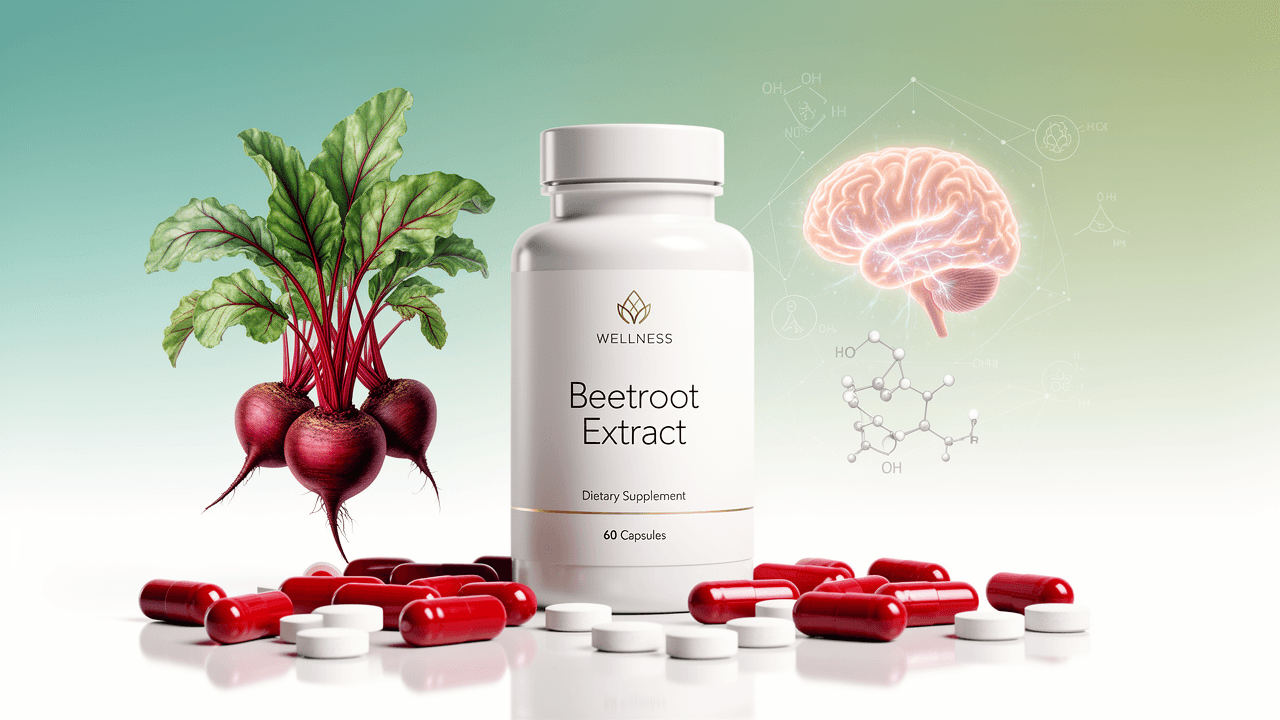
What is Beetroot Extract?
Beetroot extract is a concentrated form of Beta vulgaris (red beet) typically standardized for:
- Inorganic nitrate (NO₃⁻) – the main active constituent
- Betalain pigments (betanin, vulgaxanthin) – antioxidant compounds
- Polyphenols and flavonoids – additional antioxidant and vascular-supportive compounds
It is usually sold as:
- Capsules or tablets (standardized to a certain % nitrate or mg nitrate per dose)
- Liquid extracts or shots
- Powdered extracts (sometimes labeled as “beetroot juice powder” or “nitrate-rich beet extract”)
How Beetroot Extract Works in the Body
The main mechanism is the nitrate–nitrite–nitric oxide (NO) pathway:
- Ingestion – You consume nitrate (NO₃⁻) from beetroot extract.
- Conversion in the mouth – Oral bacteria convert nitrate to nitrite (NO₂⁻).
- Conversion in the body – In low-oxygen or acidic conditions (e.g., exercising muscle, brain), nitrite is further reduced to nitric oxide (NO).
Nitric oxide is a signaling molecule that:
- Relaxes and widens blood vessels (vasodilation)
- Improves blood flow and oxygen delivery
- Modulates mitochondrial function and energy production
- Influences neuronal communication and cerebral blood flow
Beetroot also provides antioxidants (betalains, polyphenols) that may:
- Reduce oxidative stress
- Support endothelial (blood vessel lining) health
- Modulate inflammation
This combined effect underlies most of its proposed benefits: better blood pressure control, enhanced exercise performance, and potential cognitive support.
2. Key Benefits of Beetroot Extract
1. Blood Pressure and Vascular Health
Dietary nitrate from beetroot can support lower blood pressure and improve vascular function by increasing nitric oxide availability and promoting vasodilation.
Potential effects:
- Mild reductions in systolic and diastolic blood pressure
- Improved endothelial function (better vessel responsiveness)
- Possible support for arterial stiffness in some populations
2. Exercise Performance and Endurance
Beetroot extract is popular among athletes and active individuals because it may:
- Reduce the oxygen cost of exercise (you use oxygen more efficiently)
- Improve time-to-exhaustion and performance in endurance exercise
- Support high-intensity intermittent exercise in some cases
These effects appear more consistent in recreationally active or moderately trained individuals than in elite athletes.
3. Cognitive Function and Brain Blood Flow
Because nitric oxide also affects cerebral blood vessels, beetroot-derived nitrate may:
- Increase cerebral blood flow in specific brain regions
- Support cognitive performance in tasks involving executive function and reaction time
The evidence is still emerging, but some studies, especially in older adults, show promising acute and short-term effects.
4. Potential Metabolic and Cardiovascular Support
Preliminary research suggests beetroot may:
- Improve endothelial function and reduce markers of oxidative stress
- Modestly improve exercise tolerance in people with cardiovascular or pulmonary limitations
- Potentially support insulin sensitivity and glucose regulation (evidence is early and mixed)
These benefits require more long-term, large-scale trials but are biologically plausible given the nitrate–NO mechanism and antioxidant content.
3. Research Findings on Beetroot Extract
Below are representative human studies. Note that many use beetroot juice rather than isolated extract, but the key active (nitrate) and mechanisms are similar. Standardized extracts aim to deliver comparable nitrate doses in more convenient forms.
3.1 Blood Pressure and Vascular Health
Acute blood pressure reduction
- Study: Randomized, double-blind, placebo-controlled crossover
- Participants: 30 healthy adults (18–38 years)
- Intervention: 500 mL beetroot juice (~6.4 mmol nitrate ≈ ~400 mg) vs nitrate-depleted placebo
- Duration: Single dose, measured up to 24 hours
- Findings: Systolic blood pressure decreased by ~10 mmHg and diastolic by ~8 mmHg at 2.5–3 hours post-ingestion; effects persisted, though diminished, up to 24 hours.
- Reference: Webb et al., Hypertension, 2008.
Hypertensive individuals
- Study: Randomized, double-blind, placebo-controlled parallel trial
- Participants: 68 adults with hypertension (office BP 140–159/90–99 mmHg), not on BP meds
- Intervention: 250 mL/day beetroot juice (~6.4 mmol nitrate) vs nitrate-depleted placebo
- Duration: 4 weeks
- Findings: Beetroot group had ~7.7 mmHg reduction in clinic systolic BP and ~5.2 mmHg reduction in diastolic BP compared with placebo; improvements in endothelial function were also observed.
- Reference: Kapil et al., Hypertension, 2015.
Older adults and endothelial function
- Study: Randomized, double-blind, crossover
- Participants: 38 older adults (mean age ~67 years)
- Intervention: High-nitrate beetroot juice (~9.5 mmol nitrate) vs nitrate-depleted placebo
- Duration: Single dose
- Findings: Significant increase in flow-mediated dilation (a measure of endothelial function) 2–3 hours after ingestion.
- Reference: Velmurugan et al., Hypertension, 2016.
3.2 Exercise Performance and Endurance
Cycling time-to-exhaustion (recreational athletes)
- Study: Randomized, double-blind, crossover
- Participants: 8 healthy, recreationally active men
- Intervention: 500 mL/day beetroot juice (~5.2 mmol nitrate) vs nitrate-depleted placebo
- Duration: 6 days
- Findings: Beetroot reduced oxygen cost of submaximal exercise by ~19% and increased time-to-exhaustion during high-intensity cycling by ~16%.
- Reference: Bailey et al., Journal of Applied Physiology, 2009.
Time-trial performance
- Study: Randomized, double-blind, crossover
- Participants: 9 competitive male cyclists
- Intervention: 500 mL/day beetroot juice (~6.2 mmol nitrate) vs placebo
- Duration: 6 days
- Findings: 4-km and 16.1-km cycling time-trial performance improved by 2.8% and 2.7%, respectively, in the beetroot condition.
- Reference: Lansley et al., Medicine & Science in Sports & Exercise, 2011.
Elite athletes – mixed results
- Study: Randomized, double-blind, crossover
- Participants: 10 elite cyclists
- Intervention: 140 mL concentrated beetroot shot (~8 mmol nitrate) vs nitrate-depleted placebo
- Duration: 6 days
- Findings: No significant improvement in 50-mile time-trial performance, suggesting benefits may be smaller or absent in highly trained endurance athletes.
- Reference: Peacock et al., International Journal of Sports Physiology and Performance, 2012.
3.3 Cognitive Function and Brain Blood Flow
Older adults – executive function
- Study: Randomized, double-blind, crossover
- Participants: 14 older adults (mean age ~74 years)
- Intervention: High-nitrate breakfast including beetroot juice (~500 mL, ~9.5 mmol nitrate) vs low-nitrate control
- Duration: Single dose
- Findings: Increased regional cerebral blood flow in the frontal lobe (areas linked to executive function) measured by MRI; some improvements in cognitive task performance were noted.
- Reference: Presley et al., Nitric Oxide, 2011.
Cognitive tasks in healthy adults
- Study: Randomized, double-blind, crossover
- Participants: 40 healthy adults (18–35 years)
- Intervention: Beetroot juice (~450 mL, ~7.5 mmol nitrate) vs nitrate-depleted placebo
- Duration: Single dose
- Findings: Improved performance on tasks involving reaction time and executive function 90 minutes after ingestion.
- Reference: Wightman et al., British Journal of Nutrition, 2015.
3.4 Clinical Populations (Emerging Evidence)
Heart failure and exercise tolerance
- Study: Randomized, double-blind, crossover
- Participants: 9 patients with heart failure with reduced ejection fraction
- Intervention: 140 mL concentrated beetroot juice (~8 mmol nitrate) vs placebo
- Duration: Single dose
- Findings: Increased peak power output and improved submaximal exercise endurance; blood pressure changes were modest.
- Reference: Zamani et al., JACC: Heart Failure, 2015.
Peripheral arterial disease (PAD)
- Study: Randomized, double-blind, crossover
- Participants: 20 patients with PAD
- Intervention: 500 mL beetroot juice (~12.9 mmol nitrate) vs nitrate-depleted placebo
- Duration: Single dose
- Findings: Improved walking time before onset of claudication pain and total walking time.
- Reference: Kenjale et al., Journal of Applied Physiology, 2011.
Overall, most trials are short-term (single dose to several weeks). Long-term safety and sustained efficacy over months to years are less well-characterized.
4. Best Sources & Dosage – Forms, Dosing, Timing, Safety
4.1 Forms of Beetroot Supplementation
Beetroot Extract Capsules/Tablets
- Standardized to a specific nitrate content (e.g., 300–500 mg nitrate per serving) or expressed in mmol.
- Convenient for daily use and controlled dosing.
Beetroot Juice / Concentrated Shots
- Often used in research.
- Typical research doses: 250–500 mL juice or 70–140 mL concentrated shot providing 4–12 mmol nitrate (~250–750 mg).
Beetroot Powder (Juice or Root Powder)
- Nitrate content can vary widely.
- Some products list nitrate content; others only list grams of beetroot.
- More food-like; can be mixed into water or smoothies.
For nootropic or cardiovascular purposes, standardized nitrate content is more important than the exact form.
4.2 Evidence-Based Dosage Ranges
Doses below are approximations based on human studies using beetroot juice, converted to nitrate content. Always follow product-specific instructions and consult a clinician, especially if you have cardiovascular or kidney conditions.
For Blood Pressure and Vascular Health
- Typical effective nitrate dose:
- 4–8 mmol nitrate per day ≈ 250–500 mg nitrate
- Common practical doses:
- Beetroot extract providing 300–500 mg nitrate once daily
- Or beet juice equivalent of 250–500 mL (if using juice) with similar nitrate content
- Timing:
- Once daily, with or without food
- Effects on blood pressure usually peak 2–3 hours after ingestion and may last up to 24 hours.
- Duration in studies: 1 day (acute) to 4 weeks; long-term use beyond this is common in practice but less studied.
For Exercise Performance
- Acute pre-exercise dose:
- 6–12 mmol nitrate ≈ 370–750 mg nitrate
- Practical regimen:
- Single dose of beetroot extract or juice 2–3 hours before exercise (time needed for nitrate–nitrite–NO conversion)
- Some studies use loading: daily doses for 3–6 days before an event plus an acute pre-event dose.
- Population differences:
- More consistent benefits in recreational or moderately trained individuals.
- Elite athletes may need higher doses and/or may see smaller effects.
For Cognitive Support / Nootropic Use
Evidence is more limited, but most cognitive studies use doses similar to cardiovascular trials.
- Suggested range (based on studies):
- 4–8 mmol nitrate ≈ 250–500 mg nitrate, once daily or acutely before cognitively demanding tasks
- Timing:
- 1.5–3 hours before tasks requiring focus or executive function, to align with peak NO and cerebral blood flow changes.
- Chronic use:
- Some older-adult studies used daily high-nitrate diets for several weeks; optimal long-term regimen is not firmly established.
4.3 Practical Supplement Guidelines
Choose standardized products
- Look for labels specifying mg nitrate or mmol nitrate per serving.
- Avoid products that only list “beetroot 1000 mg” without nitrate standardization if you want predictable effects.
Start low and titrate
- Begin near the lower end of effective ranges (e.g., 250–300 mg nitrate/day).
- Monitor blood pressure, GI comfort, and overall response for 1–2 weeks.
Avoid antibacterial mouthwashes around dosing
- Strong antiseptic mouthwashes (e.g., chlorhexidine) can reduce oral bacteria that convert nitrate to nitrite, blunting the effect.
- If possible, avoid antiseptic mouthwash within 2–3 hours before and after ingestion.
Combine with lifestyle
- Beetroot is adjunctive, not a replacement, for:
- Antihypertensive medication (unless supervised reduction by a physician)
- Exercise, diet, weight management, sleep optimization.
- Beetroot is adjunctive, not a replacement, for:
4.4 Safety, Side Effects, and Interactions
Common, Generally Benign Effects
- Beeturia: Red or pink urine
- Red stools: Due to betalain pigments
- Mild GI upset: Bloating, nausea, or loose stools in some individuals, especially at higher doses or concentrated shots
These effects are usually harmless but can be alarming if unexpected.
Blood Pressure Effects
Because beetroot can lower blood pressure, it may cause:
- Dizziness or lightheadedness, especially when standing up quickly (orthostatic hypotension)
- Excessive BP lowering in people already on antihypertensive medications or with naturally low blood pressure
Monitor BP regularly if you:
- Take blood pressure medications
- Have a history of syncope (fainting) or very low BP
Kidney and Electrolyte Considerations
- Beets are relatively high in oxalates, which may be a concern in people with a history of calcium oxalate kidney stones.
- Concentrated extracts may still contribute to oxalate load, though often less than large volumes of juice; data are limited.
- People with chronic kidney disease (CKD) should be cautious with high-nitrate diets due to potential issues with nitrogenous waste and electrolyte balance; consult a nephrologist.
Methemoglobinemia Risk
In adults with normal enzyme function, dietary nitrate at typical supplemental doses is very unlikely to cause methemoglobinemia (a condition where hemoglobin cannot carry oxygen effectively). This risk is more relevant to:
- Infants consuming high-nitrate well water
- Very high nitrate exposures far beyond supplemental ranges
Drug and Supplement Interactions
Antihypertensive Medications (e.g., ACE inhibitors, ARBs, beta-blockers, calcium channel blockers, diuretics)
- Additive blood pressure–lowering effect
- May increase risk of hypotension or dizziness
- Action: Monitor BP; involve your physician if you plan regular use.
Nitrates for Angina (e.g., nitroglycerin, isosorbide dinitrate/mononitrate)
- Theoretical additive vasodilatory effect; clinical significance is unclear but caution is warranted.
- Action: Use only under medical supervision.
PDE5 Inhibitors (e.g., sildenafil, tadalafil)
- Both increase NO signaling and vasodilation.
- Combined with beetroot, there is a theoretical risk of excessive BP drop, especially in sensitive individuals.
- Action: Avoid high doses of beetroot extract near the time of PDE5 inhibitor use without medical guidance.
Anticoagulants / Antiplatelets (e.g., warfarin, clopidogrel, aspirin)
- Beetroot is not a strong anticoagulant, but any supplement that affects vascular function and platelets warrants caution.
- Action: Low-to-moderate doses are likely safe for most, but inform your prescriber; monitor for unusual bruising or bleeding.
Antibacterial Mouthwashes and Broad-Spectrum Oral Antibiotics
- Can reduce oral bacteria needed for nitrate-to-nitrite conversion, reducing efficacy of beetroot.
- Action: If possible, time mouthwash and antibiotics away from beetroot dosing.
Populations Requiring Extra Caution
Pregnant and breastfeeding individuals:
- Beetroot as food is generally considered safe.
- High-dose nitrate supplements have limited safety data.
- Action: Avoid high-dose supplements unless advised by a clinician.
People with gastrointestinal disorders:
- IBS, IBD, or sensitive GI tracts may react to concentrated extracts or juices.
- Action: Start with small doses; discontinue if symptoms worsen.
People with certain rare enzyme deficiencies or hemoglobin disorders
- May be more susceptible to nitrite-related issues.
- Action: Seek specialist advice before using high-nitrate supplements.
4.5 Who Should and Shouldn’t Use Beetroot Extract
Potentially Good Candidates
Adults with mildly elevated blood pressure
- Especially those not yet on medication or on stable regimens, under medical supervision.
- May use beetroot as part of a broader lifestyle approach.
Recreational and endurance athletes
- Runners, cyclists, rowers, team-sport athletes seeking small performance gains.
- Particularly in events lasting >5–10 minutes where oxygen efficiency matters.
Middle-aged and older adults concerned about vascular and brain health
- Those without significant kidney disease or contraindications.
- May benefit from improved endothelial function and cerebral blood flow.
Individuals with reduced exercise tolerance (with physician approval)
- Heart failure, PAD, or COPD patients have shown improved exercise tolerance in some studies, but must be supervised medically.
Those Who Should Avoid or Use Only Under Supervision
People with very low blood pressure or unstable cardiovascular status
- History of syncope, severe orthostatic hypotension, or labile BP.
Individuals on complex antihypertensive regimens or nitrates
- Need careful BP monitoring and physician oversight.
People with chronic kidney disease or recurrent kidney stones
- Particularly calcium oxalate stone formers.
Pregnant or breastfeeding individuals
- High-dose nitrate supplements not well studied.
Infants and very young children
- High-nitrate supplements are not recommended.
Those with known sensitivity to beets
- Allergic reactions to beetroot are rare but possible.
Summary
Beetroot extract is a nitrate-rich supplement that supports nitric oxide production via the nitrate–nitrite–NO pathway. Evidence from randomized controlled trials suggests it can:
- Modestly lower blood pressure and improve endothelial function
- Enhance exercise performance and endurance, especially in recreationally active individuals
- Increase cerebral blood flow and potentially support cognitive performance in some contexts
Typical effective doses deliver ~250–750 mg nitrate (4–12 mmol), taken once daily or 2–3 hours before exercise or cognitively demanding tasks. While generally safe for healthy adults, beetroot extract can lower blood pressure and may interact with antihypertensive drugs, nitrates, and PDE5 inhibitors. People with kidney disease, recurrent kidney stones, very low BP, or those who are pregnant should use it cautiously and under medical supervision.
Used thoughtfully, beetroot extract can be a useful adjunct for vascular health, physical performance, and possibly cognitive function, but it should complement—never replace—evidence-based medical care and healthy lifestyle practices.