1. Understanding 5-HTP – What It Is and How It Works
What is 5-HTP?
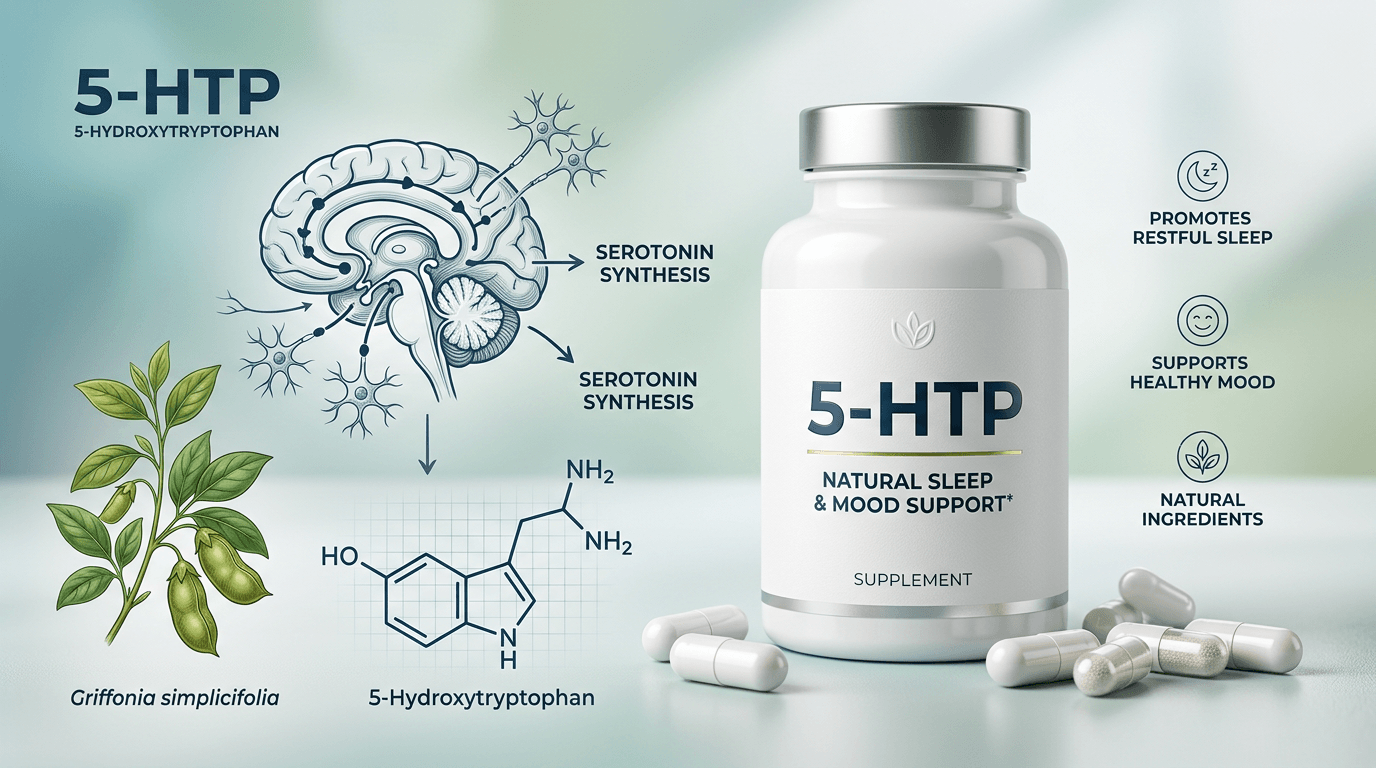
5-Hydroxytryptophan (5-HTP) is an amino acid derivative and the direct biochemical precursor to serotonin, a neurotransmitter involved in mood, appetite, pain perception, and sleep regulation.
Commercially, 5-HTP is typically extracted from the seeds of the African plant Griffonia simplicifolia.
How 5-HTP Works in the Body
5-HTP sits in the middle of the serotonin synthesis pathway:
- Tryptophan → 5-HTP via the enzyme tryptophan hydroxylase (rate‑limiting step)
- 5-HTP → Serotonin (5-HT) via aromatic L‑amino acid decarboxylase (AAAD)
Supplementing 5-HTP effectively bypasses the rate‑limiting first step, potentially increasing serotonin synthesis both in the periphery and the brain.
Key pharmacological points:
- Crosses the blood–brain barrier: Unlike serotonin itself, 5-HTP can cross into the central nervous system.
- Decarboxylation to serotonin: Once in the brain, AAAD converts 5-HTP to serotonin, which can then influence mood, sleep, appetite, and pain pathways.
- Not tightly feedback‑regulated: 5-HTP conversion to serotonin is less constrained by feedback mechanisms than tryptophan, so high doses can lead to excessive serotonin.
Because of these properties, 5-HTP is used as a dietary supplement for:
- Mood support (depressive symptoms, anxiety)
- Sleep onset and sleep quality
- Appetite control and weight management
- Migraine and tension headache management
However, its pharmacology also means there is real risk of adverse effects and drug interactions, particularly with other serotonergic agents.
2. Key Benefits of 5-HTP
2.1 Mood Support and Depressive Symptoms
By increasing central serotonin, 5-HTP may help alleviate depressive symptoms in some individuals. Several small trials have compared 5-HTP with antidepressants or placebo, with mixed but generally positive findings.
Proposed mechanisms:
- Increased serotonin availability in brain regions involved in mood regulation (prefrontal cortex, limbic system)
- Modulation of downstream systems (e.g., melatonin, dopamine indirectly)
2.2 Sleep and Circadian Rhythm Support
Serotonin is a precursor to melatonin, the hormone that regulates sleep–wake cycles. 5-HTP may:
- Shorten sleep onset latency (time to fall asleep)
- Improve subjective sleep quality
- Increase REM sleep proportion in some studies
Effects are often modest and may be more pronounced when combined with other sleep‑supportive compounds (e.g., GABA, valerian, melatonin).
2.3 Appetite Control and Weight Management
Serotonin modulates satiety and carbohydrate cravings. 5-HTP may:
- Increase feelings of fullness
- Reduce spontaneous caloric intake
- Decrease carbohydrate‑rich snack consumption
Most evidence comes from small, short‑term trials, often in overweight or obese individuals.
2.4 Migraine and Headache Prophylaxis
Serotonergic pathways are implicated in migraine pathophysiology. 5-HTP may help reduce:
- Migraine frequency
- Attack severity
- Use of rescue medications
The evidence is older and methodologically limited, but suggests potential benefit in some patients.
3. Research Findings on 5-HTP
3.1 Depression and Mood
5-HTP vs. Fluvoxamine (SSRI)
- Design: Double‑blind randomized trial
- Participants: 63 adults with major depressive disorder
- Intervention: 5-HTP 100 mg three times daily vs. fluvoxamine 50 mg three times daily for 6 weeks
- Findings: Both groups showed significant improvement on the Hamilton Depression Rating Scale (HAM‑D). Response rates were similar, but the study was small and not powered to prove equivalence. Gastrointestinal side effects were more common with 5-HTP.
- Limitations: No placebo arm; older diagnostic criteria; small sample; short duration.
5-HTP vs. Imipramine
- Design: Double‑blind trial
- Participants: ~60 patients with depression (varies by report)
- Intervention: 5-HTP 100–300 mg/day vs. imipramine 100–200 mg/day for 4 weeks
- Findings: Both groups improved; 5-HTP was reported as roughly comparable to imipramine in symptom reduction.
- Limitations: Older trial, limited reporting, not up to modern standards.
Systematic assessments generally conclude that 5-HTP may have antidepressant effects, but the evidence base is:
- Mostly from the 1970s–1990s
- Small sample sizes
- Variable dosing and formulations
- Limited modern, high‑quality randomized controlled trials (RCTs)
Overall, 5-HTP should not be considered a replacement for prescribed antidepressants without medical supervision, but may have adjunctive or mild monotherapy utility in some cases.
3.2 Sleep and Insomnia
5-HTP and Sleep Quality (Combination Formula)
- Design: Double‑blind, placebo‑controlled trial
- Participants: 18 adults with mild sleep disturbances
- Intervention: A combination supplement containing 5-HTP (100 mg), GABA, and several herbal extracts vs. placebo for 1 month
- Findings: Significant improvements in subjective sleep quality, sleep latency, and sleep duration in the active group.
- Limitations: Multi‑ingredient formula; effects cannot be attributed solely to 5-HTP; small sample.
Polysomnographic Studies (Older, Small Trials)
Several small studies (n≈10–20 per study) using 100–200 mg 5-HTP at bedtime reported:
- Reduced sleep onset latency
- Increased REM sleep percentage
- Mixed effects on overall sleep architecture
Evidence suggests modest sleep benefits, particularly for sleep onset and subjective quality, but more modern RCTs are needed.
3.3 Appetite, Weight Loss, and Cravings
Overweight Women and Spontaneous Food Intake
- Design: Double‑blind, placebo‑controlled crossover trial
- Participants: 19 overweight women
- Intervention: 5-HTP 8 mg/kg/day (~400–600 mg/day) vs. placebo for 5 weeks
- Findings: The 5-HTP group showed:
- Reduced spontaneous caloric intake
- Greater weight loss (~1.5–2.0 kg vs. ~0.3–0.5 kg in placebo)
- Decreased carbohydrate intake
- Limitations: Small sample; short duration; diet not strictly controlled.
Follow‑up Study in Obese Individuals
- Design: Double‑blind, placebo‑controlled
- Participants: 20 obese subjects
- Intervention: 5-HTP 900 mg/day vs. placebo for 12 weeks
- Findings: Significant weight loss in the 5-HTP group, mainly via reduced caloric intake; no prescribed diet.
- Limitations: Modest sample size; higher dose than commonly used today; older study.
Overall, data indicate that 5-HTP can reduce appetite and support weight loss in the short term, primarily by increasing satiety. Long‑term safety and efficacy remain insufficiently studied.
3.4 Migraine and Headache
5-HTP vs. Methysergide (Migraine Prophylaxis)
- Design: Double‑blind, randomized trial
- Participants: 60 migraine patients
- Intervention: 5-HTP 600 mg/day vs. methysergide 3 mg/day for 6 months
- Findings: Both groups showed reductions in migraine frequency and intensity. Methysergide was slightly more effective overall, but 5-HTP still conferred clinically meaningful benefit.
- Limitations: Older trial; high 5-HTP dose; side effects not thoroughly characterized.
Additional Trials with 200–600 mg/day 5-HTP have reported:
- Decreased migraine attack frequency
- Reduced analgesic use
- Variable effect sizes across studies
Evidence suggests potential benefit for some migraine sufferers, but modern comparative studies versus current standard prophylactics are lacking.
4. Best Sources & Dosage
4.1 Forms and Quality Considerations
Common forms:
- Capsules/Tablets: Typically 50 mg or 100 mg per capsule, derived from Griffonia simplicifolia.
- Slow‑release formulations: Designed to reduce peak‑related side effects (nausea, flushing) and provide steadier serotonin support.
Quality tips:
- Choose products from brands that provide third‑party testing (for purity and potency).
- Verify that 5-HTP is from standardized Griffonia extract and free from contaminants.
- Avoid products with undisclosed multi‑ingredient “proprietary blends” where the 5-HTP dose is unclear.
4.2 General Dosing Principles
- Start low and slow due to variable sensitivity.
- Take with a small amount of food if nausea occurs, though absorption is somewhat better on an empty stomach.
- Divide daily doses >100 mg into 2–3 smaller doses to reduce side effects.
Below are typical evidence‑informed dosing ranges for adults. These are not prescriptions and should not replace medical advice.
4.2.1 Mood Support / Depressive Symptoms
- Typical range: 100–300 mg/day
- Common protocols:
- 50–100 mg, 2–3 times per day
- Start at 50 mg once daily for 3–7 days, then gradually increase
- Onset: Some notice effects within days; full mood effects may take several weeks.
Because 5-HTP affects serotonin, medical supervision is strongly recommended when used for mood, especially if you have a psychiatric diagnosis or take other medications.
4.2.2 Sleep Support
- Typical range: 50–200 mg, 30–60 minutes before bedtime
- Start at 50 mg and increase by 50 mg increments every few nights if needed and tolerated.
- Some individuals use an additional 50–100 mg dose in the late afternoon for evening mood and sleep onset.
4.2.3 Appetite Control / Weight Management
- Typical range in studies: 300–900 mg/day, divided doses
- Practical approach:
- 50–100 mg, 2–3 times per day, 30–60 minutes before meals
- Higher doses (>300 mg/day) should only be used under professional guidance due to increased risk of side effects.
4.2.4 Migraine Prophylaxis
- Research range: 200–600 mg/day, divided into 2–3 doses
- A cautious modern approach:
- Start at 50 mg twice daily and titrate upward every 1–2 weeks if needed and tolerated.
Again, migraine treatment should be supervised by a clinician, particularly if you already use other migraine medications.
4.3 Duration of Use
- Many studies are 4–12 weeks long.
- For chronic use, it is prudent to:
- Reassess need and benefit every 2–3 months.
- Consider periodic breaks (e.g., 1–2 weeks off after 8–12 weeks), especially at higher doses.
Long‑term safety data beyond 6–12 months are limited.
5. Safety, Side Effects, and Drug Interactions
5.1 Common Side Effects
Most side effects are dose‑dependent and related to increased serotonin or peripheral conversion of 5-HTP:
- Nausea
- Stomach cramps or discomfort
- Diarrhea or loose stools
- Heartburn or reflux
- Headache
- Flushing or warmth
- Drowsiness or fatigue (especially at higher or bedtime doses)
These often improve when:
- Starting with a lower dose
- Taking with a light snack
- Using divided doses instead of a single large dose
5.2 Serious Risks
5.2.1 Serotonin Syndrome
Serotonin syndrome is a potentially life‑threatening condition caused by excessive serotonergic activity in the CNS. 5-HTP can contribute to this, especially when combined with other serotonergic drugs.
Symptoms can include:
- Agitation, restlessness, confusion
- Rapid heart rate, high blood pressure
- Dilated pupils, sweating, shivering
- Muscle rigidity, tremor, clonus
- Fever, in severe cases
Although rare with 5-HTP alone at moderate doses, the risk increases significantly when combined with:
- SSRIs, SNRIs
- MAO inhibitors
- Tricyclic antidepressants
- Triptans
- Certain opioids (e.g., tramadol, meperidine)
Any signs of serotonin syndrome warrant immediate medical attention and discontinuation of serotonergic agents.
5.2.2 Eosinophilia‑Myalgia Syndrome (EMS) Concerns
In the late 1980s, a contaminated batch of L‑tryptophan was associated with an outbreak of eosinophilia‑myalgia syndrome (EMS). A few case reports have raised similar concerns with 5-HTP, but causality remains unclear and may relate to specific contaminants rather than 5-HTP itself.
To minimize risk:
- Use products from reputable manufacturers with clear quality testing.
- Avoid unusually cheap or unbranded 5-HTP sources.
5.3 Drug Interactions
Do NOT combine 5-HTP with the following without explicit physician approval:
Antidepressants
- SSRIs (e.g., fluoxetine, sertraline, citalopram)
- SNRIs (e.g., venlafaxine, duloxetine)
- MAO inhibitors (e.g., phenelzine, tranylcypromine)
- Tricyclics (e.g., amitriptyline, clomipramine)
Other serotonergic agents
- Triptans for migraine (e.g., sumatriptan)
- Certain opioids (tramadol, meperidine, fentanyl)
- Linezolid and some other antibiotics with MAOI‑like activity
- St. John’s wort
- MDMA and other serotonergic recreational drugs
Carbidopa/Levodopa (Parkinson’s disease)
- Combined use may increase risk of GI and neurological side effects due to altered peripheral decarboxylation.
Other supplements that impact serotonin
- High‑dose tryptophan
- SAMe (S‑adenosyl‑L‑methionine) at high doses
If you are on any prescription medication for mood, pain, or migraine, consult your prescriber before using 5-HTP.
5.4 Special Populations and Precautions
- Pregnancy and breastfeeding: Safety data are insufficient. Avoid use unless specifically recommended by a healthcare professional.
- Children and adolescents: Limited data; should only be used under pediatric specialist supervision.
- Bipolar disorder: Increasing serotonin may trigger mania or hypomania in susceptible individuals. 5-HTP is generally not recommended without close psychiatric oversight.
- Schizophrenia or psychotic disorders: Serotonergic modulation can potentially worsen psychosis; use is generally discouraged.
- Liver or kidney disease: Metabolism and clearance may be altered; use only with medical supervision.
- Surgery and anesthesia: Because of interactions with serotonergic medications used perioperatively, discontinuation 1–2 weeks before elective surgery is often advised (confirm with your surgeon/anesthesiologist).
6. Who Should and Shouldn’t Use 5-HTP
6.1 Who May Consider 5-HTP (With Appropriate Guidance)
5-HTP may be reasonable to consider for adults who:
- Have mild depressive symptoms or low mood and are not on serotonergic medications, and who are also addressing lifestyle factors (sleep, stress, diet, exercise).
- Experience mild sleep onset difficulties and prefer a serotonin‑based approach rather than melatonin alone.
- Want additional support for appetite control and cravings as part of a structured weight management program.
- Have recurrent migraines and are exploring adjunctive options under clinician guidance.
In all these cases, it is advisable to:
- Discuss use with a healthcare provider, especially if symptoms are moderate to severe.
- Start with the lowest effective dose and monitor for side effects.
- Reassess regularly whether benefits outweigh risks.
6.2 Who Should Avoid 5-HTP
5-HTP is generally not recommended for individuals who:
- Are taking any antidepressant (SSRIs, SNRIs, MAOIs, tricyclics) unless under explicit psychiatric supervision.
- Use triptans, tramadol, or other serotonergic pain or migraine medications.
- Have a history of bipolar disorder, mania/hypomania, or psychotic disorders, unless under close psychiatric care.
- Are pregnant or breastfeeding, due to insufficient safety data.
- Have a history of serotonin syndrome.
- Have significant liver or kidney disease without specialist oversight.
6.3 When to Seek Professional Help Instead of Self‑Supplementing
Seek medical evaluation rather than self‑treating with 5-HTP if you:
- Have persistent low mood lasting more than 2 weeks, especially with loss of interest, hopelessness, or functional impairment.
- Experience suicidal thoughts, self‑harm urges, or severe anxiety.
- Have frequent or disabling migraines.
- Have insomnia that significantly impairs daily functioning.
In these cases, 5-HTP might still have a role, but only as part of a comprehensive, professionally guided treatment plan.
7. Practical Takeaways
- 5-HTP is a serotonin precursor that crosses the blood–brain barrier and can influence mood, sleep, appetite, and pain.
- Evidence suggests potential benefits for mild depressive symptoms, sleep onset, appetite control, and migraine prophylaxis, but most studies are small and older, and high‑quality modern trials are limited.
- Typical adult doses range from 50–300 mg/day for mood and sleep, with higher doses (up to 600–900 mg/day) used in some weight loss and migraine studies under medical supervision.
- Side effects are usually gastrointestinal and dose‑related, but serious risks such as serotonin syndrome exist, especially when combined with other serotonergic drugs.
- 5-HTP is not appropriate for everyone. Those on antidepressants, with bipolar or psychotic disorders, pregnant or breastfeeding individuals, and people with complex medical regimens should avoid unsupervised use.
Used thoughtfully and cautiously, 5-HTP can be a useful tool in a broader strategy for mood, sleep, and appetite support—but it should never replace comprehensive medical care when that is needed.