1. Understanding 5-HTP – What It Is and How It Works
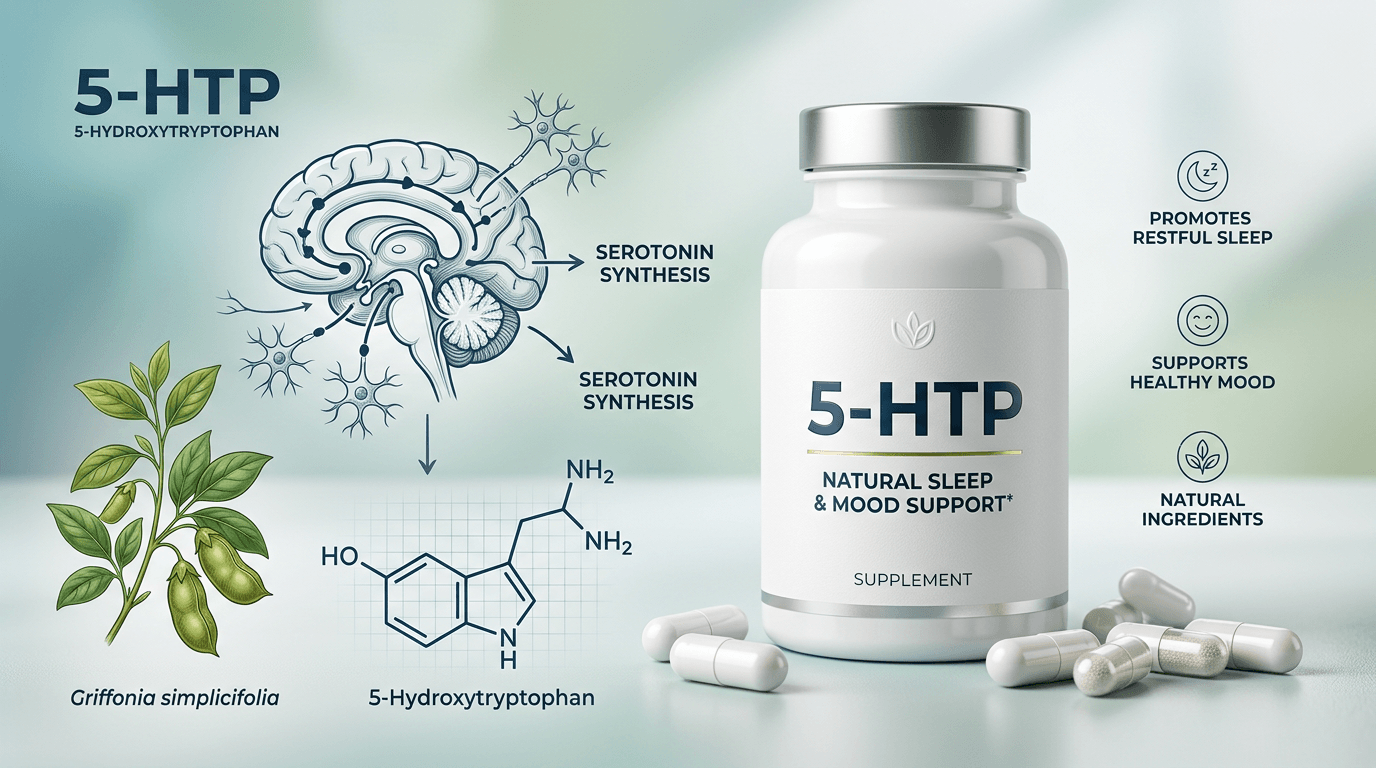
5-HTP (5-hydroxytryptophan) is a naturally occurring amino acid and the direct biochemical precursor to serotonin, a neurotransmitter involved in mood, sleep, appetite, and pain perception.
What is 5-HTP?
- 5-HTP is produced in the body from the essential amino acid L-tryptophan.
- As a supplement, it is typically extracted from the seeds of the African plant Griffonia simplicifolia.
- Unlike serotonin itself, which does not cross the blood–brain barrier, 5-HTP does cross and can be converted into serotonin in the central nervous system.
How 5-HTP Works in the Body
Biochemical pathway
- Dietary protein → L-tryptophan → (enzyme: tryptophan hydroxylase) → 5-HTP → (enzyme: aromatic L-amino acid decarboxylase) → serotonin (5-HT).
- Serotonin can then be further converted into melatonin in the pineal gland.
Serotonin synthesis support
- 5-HTP bypasses the rate-limiting step (conversion of tryptophan to 5-HTP) and directly increases substrate availability for serotonin production.
- It competes with other large neutral amino acids for transport across the blood–brain barrier but is generally more efficient than tryptophan in raising brain serotonin.
Potential effects on neurotransmission
- Increased serotonin availability may influence:
- Mood and anxiety
- Sleep onset and quality
- Appetite and satiety
- Pain modulation
- Because serotonin interacts with many receptor subtypes (5-HT1, 5-HT2, etc.), effects can be broad and individual responses vary.
- Increased serotonin availability may influence:
Pharmacokinetics
- Oral 5-HTP is rapidly absorbed, with peak blood levels usually within 1–2 hours.
- Half-life is relatively short (around 2–4 hours), which is why divided doses are often used.
- Co-administration with a peripheral decarboxylase inhibitor (e.g., carbidopa in some clinical research) can increase central serotonin while potentially increasing side effects.
2. Key Benefits of 5-HTP as a Supplement
1. Mood Support and Depressive Symptoms
By supporting serotonin synthesis, 5-HTP may help improve mood and reduce depressive symptoms in some individuals. Several clinical trials have compared 5-HTP to standard antidepressants, with mixed but generally promising results, especially in mild–moderate depression.
2. Sleep Quality and Insomnia
Because serotonin is a precursor to melatonin, 5-HTP may support sleep onset and quality. Some studies show shorter time to fall asleep and improved REM sleep, particularly when combined with other sleep-supportive compounds.
3. Appetite Control and Weight Management
Serotonin plays a role in satiety and carbohydrate cravings. 5-HTP may reduce appetite, especially for carbohydrate-rich foods, and has been studied as an adjunct in weight-loss programs.
4. Headache and Migraine Support
Altered serotonin function is implicated in migraine and tension-type headaches. Early research suggests 5-HTP may reduce headache frequency in some people, though data are less robust than for mood or appetite.
3. Research Findings on 5-HTP
3.1 5-HTP and Depression
Double-blind trial vs. fluvoxamine (serotonin reuptake inhibitor)
- Design: Randomized, double-blind, parallel-group
- Participants: 63 adults with major depressive disorder
- Intervention: 5-HTP 100 mg three times daily vs. fluvoxamine 50 mg three times daily
- Duration: 6 weeks
- Findings:
- Both groups showed significant reductions in depression scores (Hamilton Depression Rating Scale).
- Response rates were similar between 5-HTP and fluvoxamine groups.
- 5-HTP group reported more gastrointestinal side effects (nausea, heartburn) but generally better tolerability in terms of sedation and sexual side effects.
- Limitations: relatively small sample size, short duration, no placebo arm.
Open-label and smaller controlled studies
- Several trials from the 1970s–1990s used doses of 150–300 mg/day of 5-HTP.
- Many reported clinically meaningful improvements in depressive symptoms, especially in mild to moderate cases.
- Methodological quality varied; many lacked modern diagnostic criteria or robust placebo control.
Takeaway: Evidence suggests 5-HTP can improve depressive symptoms, but data are older and less rigorous than for standard antidepressants. It should not replace prescribed antidepressants without medical supervision.
3.2 5-HTP and Anxiety
Anxiety-related studies are fewer and often combine 5-HTP with other substances.
- Some small trials suggest 5-HTP may reduce generalized anxiety and panic symptoms by enhancing serotonergic tone.
- A crossover study in healthy volunteers found that 5-HTP (200 mg) reduced experimentally induced panic-like responses in susceptible individuals.
Takeaway: Preliminary evidence supports an anxiolytic effect, but research is limited and not sufficient to recommend 5-HTP as a primary treatment for anxiety disorders.
3.3 5-HTP and Sleep
5-HTP and sleep architecture
- Early polysomnography studies in small groups (n ≈ 10–20) showed that 5-HTP (100–200 mg at night):
- Reduced time to fall asleep (sleep latency)
- Increased REM sleep proportion
- In some cases, improved subjective sleep quality
Combination formula trial in children with sleep terrors
- Participants: 45 children with frequent sleep terrors
- Intervention: 5-HTP 2 mg/kg at bedtime
- Duration: 6 months
- Findings:
- Significant reduction in frequency and intensity of sleep terrors in the 5-HTP group compared with baseline.
- Improvement persisted at long-term follow-up in many children.
- Limitations: No placebo control, pediatric data cannot be directly generalized to adults.
Takeaway: 5-HTP appears to positively influence sleep onset and REM sleep, particularly when serotonin–melatonin pathways are involved. Evidence is promising but limited.
3.4 5-HTP for Appetite and Weight Loss
Carbohydrate cravings and satiety
- Study: Randomized, double-blind, placebo-controlled
- Participants: 19 overweight women (BMI 25–30)
- Intervention: 5-HTP 8 mg/kg/day (≈ 300–500 mg/day depending on body weight), divided doses vs. placebo
- Duration: 5 weeks
- Findings:
- 5-HTP group had a spontaneous reduction in caloric intake, particularly from carbohydrates.
- Average weight loss was significantly greater in the 5-HTP group compared with placebo.
- Reported side effects were mainly mild nausea.
Additional weight loss trials
- Several small studies using 300–900 mg/day of 5-HTP over 6–12 weeks found:
- Reduced hunger and earlier satiety.
- Greater weight loss relative to placebo when combined with dietary counseling.
Takeaway: Evidence supports a modest appetite-suppressing effect of 5-HTP, especially for carbohydrate cravings. Long-term safety and efficacy beyond a few months are not well studied.
3.5 5-HTP and Headache/Migraine
Migraine prophylaxis trial
- Design: Randomized, double-blind, active-comparator
- Participants: 124 adults with recurrent migraines
- Intervention: 5-HTP 600 mg/day vs. methysergide (a migraine prophylactic drug)
- Duration: 6 months
- Findings:
- Both groups showed reduction in migraine frequency and intensity.
- Methysergide was slightly more effective overall, but 5-HTP still produced clinically meaningful improvement in many participants.
- 5-HTP had fewer serious side effects.
Other smaller studies also suggest benefit for tension-type headaches.
Takeaway: 5-HTP may help reduce migraine frequency and severity, but evidence is older and not as robust as for standard migraine prophylactics.
4. Best Sources & Dosage – Forms, Dosing, Timing, Safety
4.1 Common Forms of 5-HTP
- Capsules/Tablets: Most common; typically 50 mg or 100 mg per capsule.
- Griffonia simplicifolia extract: Standardized to a specific percentage of 5-HTP (e.g., 98%).
- Combination formulas: Often paired with vitamins (B6), magnesium, or other herbs (valerian, melatonin). These can change effects and side-effect profiles.
Quality varies widely; third-party tested brands (e.g., NSF, USP, Informed-Choice) are preferable to reduce contamination risk.
4.2 General Dosing Principles
- Start low and go slow due to GI and serotonergic side effects.
- Common individual dose: 50–100 mg.
- Total daily dose range used in studies: 100–600 mg/day, sometimes up to 900 mg/day under medical supervision.
- Often divided into 2–3 doses per day to smooth blood levels and reduce side effects.
4.3 Dosage by Use Case (for Adults)
These are general informational ranges, not medical prescriptions. Always consult a clinician, especially if you take medications.
1. Mood Support / Depressive Symptoms
- Typical range: 150–300 mg/day
- Dosing pattern:
- Start: 50 mg once daily with food for 3–7 days.
- Then: 50 mg twice daily (morning and late afternoon).
- If tolerated and needed: increase to 100 mg twice daily (200 mg/day total), and in some cases up to 100 mg three times daily (300 mg/day).
- Timing: Morning and mid/late afternoon; avoid high doses too close to bedtime in some individuals as it can cause vivid dreams or sleep disruption.
2. Sleep Support / Insomnia
- Typical range: 50–200 mg taken 30–60 minutes before bedtime.
- Approach:
- Start at 50 mg and increase by 50 mg increments as needed and tolerated.
- Often combined with magnesium or low-dose melatonin (under guidance) for synergistic effects.
3. Appetite Control / Weight Management
- Typical range in studies: 300–900 mg/day, divided.
- Practical approach:
- 50–100 mg, 30–45 minutes before meals, 2–3 times per day.
- Total: 150–300 mg/day initially; higher doses only under professional supervision due to increased side-effect risk.
4. Migraine/Headache Prophylaxis
- Research range: up to 600 mg/day in divided doses.
- Practical starting point: 50–100 mg, 2–3 times daily (100–300 mg/day total) and titrate only under medical oversight.
4.4 Safety, Side Effects, and Interactions
Common Side Effects
Most are dose-dependent and often improve over time:
- Nausea
- Heartburn or stomach discomfort
- Diarrhea or loose stools
- Drowsiness or fatigue
- Headache
- Vivid dreams or sleep disturbances (especially at higher doses)
Taking 5-HTP with food and using divided doses can reduce GI side effects.
Serious Risks
Serotonin Syndrome
- A potentially life-threatening condition caused by excessive serotonin.
- Symptoms: agitation, confusion, rapid heart rate, high blood pressure, dilated pupils, muscle rigidity or twitching, sweating, shivering, diarrhea, high fever.
- Risk is significantly increased when 5-HTP is combined with other serotonergic drugs (see below).
Eosinophilia–Myalgia Syndrome (EMS) Concern
- EMS was linked to contaminated L-tryptophan supplements in the late 1980s.
- A few case reports have raised concern about 5-HTP, but clear causal evidence is limited.
- Contamination or impurities, not 5-HTP itself, are suspected causes.
- Emphasizes the importance of high-quality, third-party tested products.
Mania/Hypomania in Bipolar Disorder
- Increasing serotonin can potentially trigger manic or hypomanic episodes in individuals with bipolar spectrum disorders.
Bleeding Risk (Theoretical)
- Serotonin influences platelet function; combining 5-HTP with anticoagulants or antiplatelet drugs may theoretically increase bleeding risk, though robust clinical data are limited.
Drug and Supplement Interactions
Avoid combining 5-HTP with other serotonergic agents unless closely supervised by a physician. These include:
Antidepressants
- SSRIs: fluoxetine, sertraline, citalopram, escitalopram, paroxetine, fluvoxamine
- SNRIs: venlafaxine, duloxetine, desvenlafaxine
- Tricyclics (TCAs): amitriptyline, clomipramine, imipramine
- MAOIs: phenelzine, tranylcypromine, selegiline
- Atypicals with serotonergic activity: trazodone, vilazodone, vortioxetine, etc.
Other serotonergic drugs
- Triptans for migraine (sumatriptan, rizatriptan)
- Certain opioids (tramadol, meperidine, tapentadol)
- Linezolid and other MAOI-like antibiotics
- Dextromethorphan (found in many cough syrups)
- Lithium (complex serotonergic effects)
Other supplements with serotonergic or overlapping effects
- St. John’s wort
- SAMe (S-adenosylmethionine)
- High-dose tryptophan
- Possibly combinations with melatonin or other sleep aids (mainly additive sedation, not serotonin syndrome per se).
Alcohol and sedatives
- Combining 5-HTP with alcohol, benzodiazepines, or other sedatives may increase drowsiness and impair coordination.
Special Populations and Conditions
Pregnancy and breastfeeding:
- Insufficient safety data. Generally not recommended unless clearly indicated and supervised by a physician.
Children and adolescents:
- Limited data; some pediatric studies (e.g., sleep terrors) exist but are not sufficient for broad recommendations.
- Use only under specialist supervision.
Liver or kidney disease:
- Altered metabolism and excretion may occur; caution and medical oversight are advised.
Bipolar disorder or history of mania:
- 5-HTP may destabilize mood; should generally be avoided unless under psychiatric supervision.
Autoimmune conditions or eosinophilia history:
- Due to theoretical EMS risk, extra caution is warranted; discuss with a physician.
4.5 Who Should and Shouldn’t Use 5-HTP
Potentially Suitable Candidates (with Medical Guidance)
- Adults with:
- Mild depressive symptoms or low mood who are not on serotonergic medications and are being monitored.
- Occasional insomnia or sleep onset difficulties.
- Carb cravings or appetite issues contributing to overweight, as part of a broader lifestyle program.
- Recurrent migraines, where standard treatments are not tolerated or are insufficient, and a clinician is overseeing care.
In all these cases, 5-HTP should be viewed as adjunctive support, not a stand-alone cure.
Those Who Should Avoid or Use Only Under Strict Supervision
- People currently taking any antidepressant or other serotonergic drugs.
- Individuals with bipolar disorder, psychotic disorders, or a history of mania/hypomania.
- Pregnant or breastfeeding women (due to lack of safety data).
- Children and adolescents, unless under pediatric specialist care.
- Individuals with significant liver or kidney impairment.
- Those with a history of eosinophilia–myalgia syndrome or unexplained severe muscle pain and eosinophilia.
Practical Summary
- 5-HTP is a serotonin precursor that can cross the blood–brain barrier and support serotonin and melatonin synthesis.
- Evidence supports potential benefits for mood, sleep, appetite control, and migraine frequency, though many studies are older and small.
- Common effective doses range from 100–300 mg/day for mood and sleep, up to 600 mg/day in some migraine and weight-loss research, usually in divided doses.
- Side effects are mostly gastrointestinal and dose-related; serious risks include serotonin syndrome (especially with serotonergic drugs) and possible mood destabilization in bipolar disorder.
- 5-HTP is not appropriate for everyone and should not be combined with antidepressants or other serotonergic medications without medical supervision.
If considering 5-HTP, discuss it with a healthcare professional who can review your medications, mental health history, and overall risk profile, and help determine a safe starting dose and monitoring plan.